Pushkar Lake and Ghats: Which Ghat for Sunrise, Sunset and Aarti
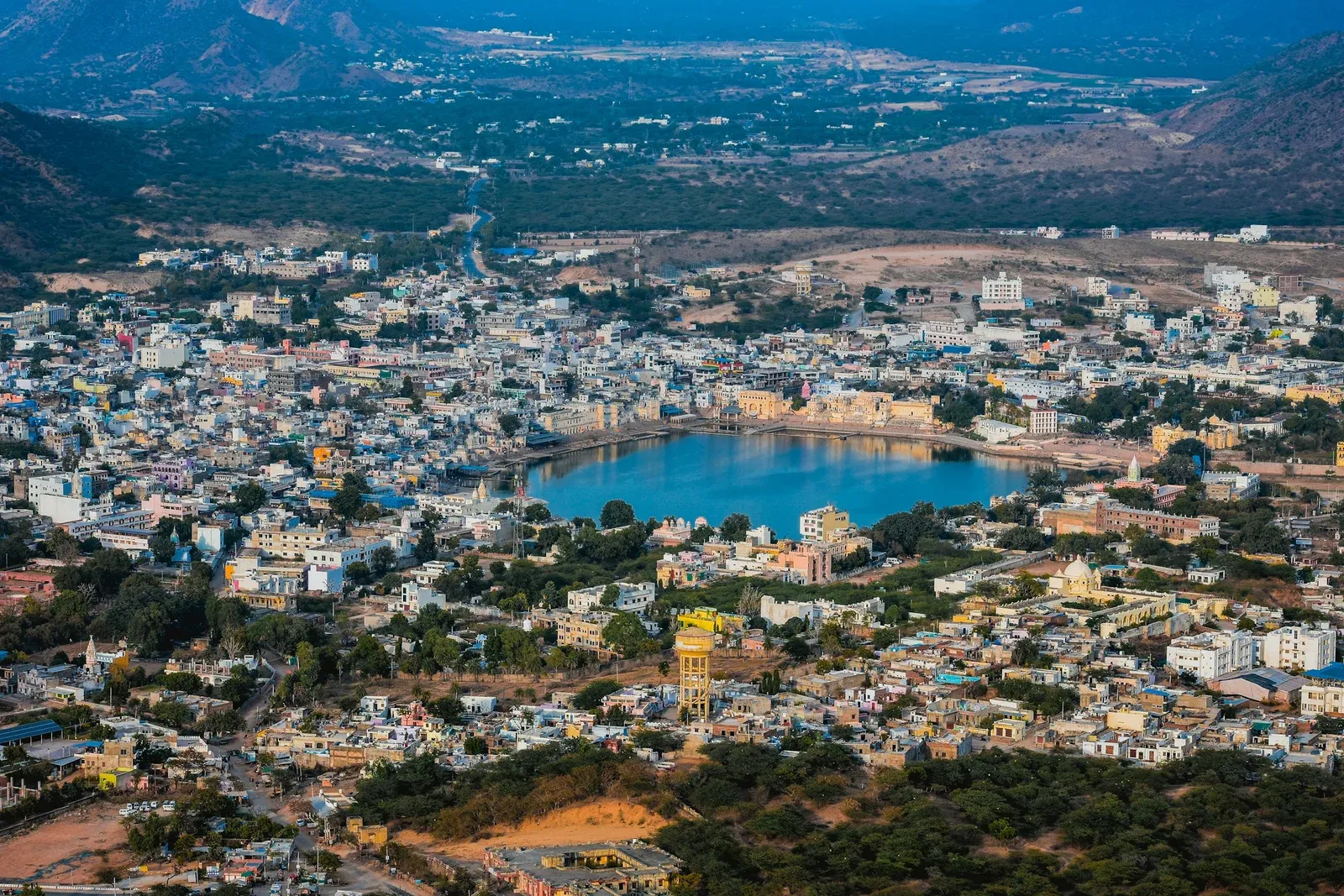
Pushkar Lake has 52 ghats. You can walk past 36 of them, right round the lake, in about 24 minutes. For sunrise, go to Brahma Ghat, which faces the sunrise over the water all year. For sunset, sit at Jaipur Ghat. The evening aarti is at Varah Ghat, and entry is free.
In this guide
Pushkar Lake ghats at a glance
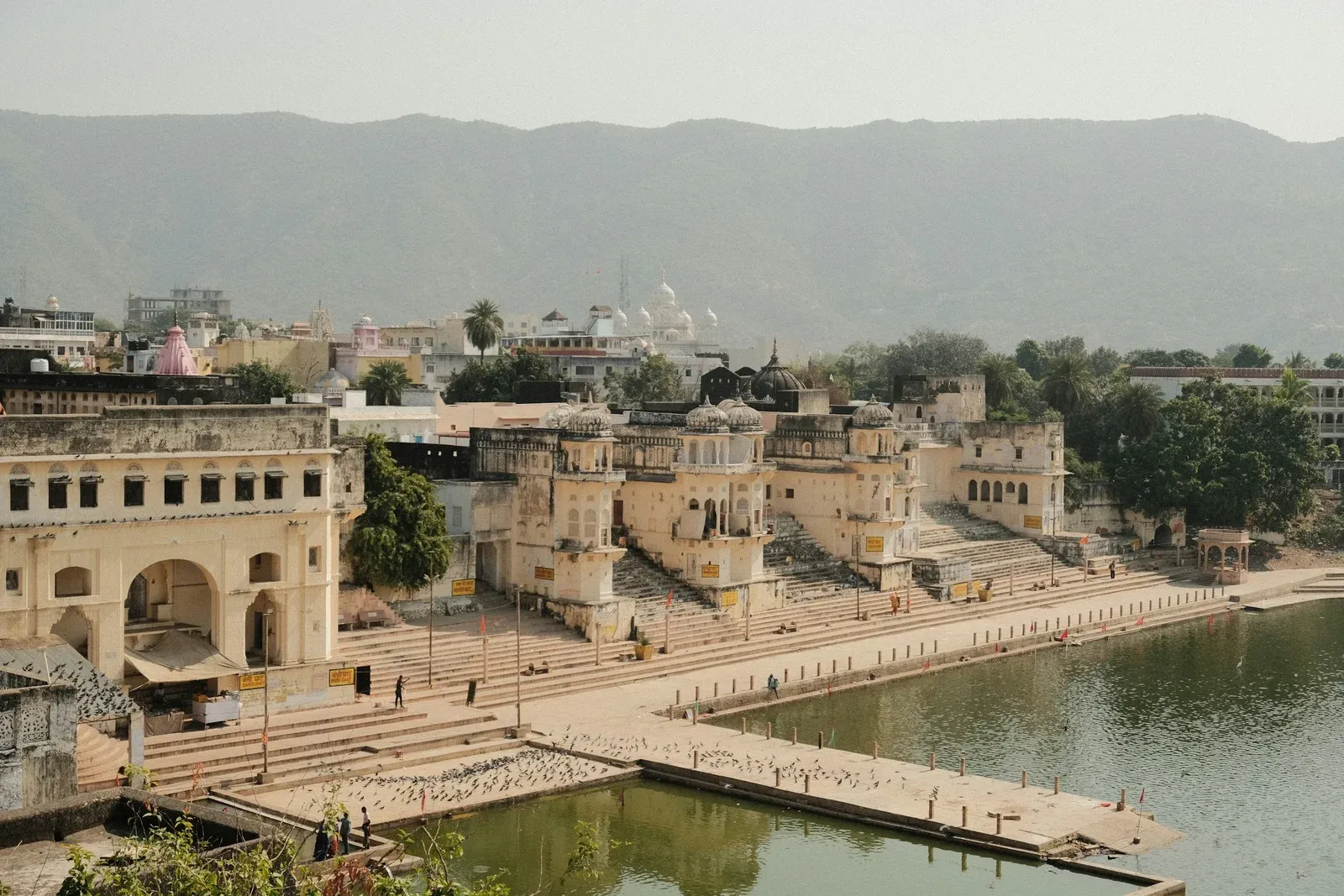
These 7 ghats cover the 3 things you'll want: the sunrise, the sunset and the aarti (a prayer with lamps). A ghat is a flight of steps down to the water. You can walk to all 7 from Brahma Temple.
| Ghat | Bank | Walk from Brahma Temple | Best for | Map |
|---|---|---|---|---|
| Brahma Ghat | North-west | 7 min (0.5 km) | Sunrise over the lake all year; pilgrims bathe here at first light | Map |
| Gau Ghat | North-west | 7 min (0.5 km) | Where Mahatma Gandhi's ashes were immersed; sunrise over the lake, September to March | Map |
| Gangaur Ghat | North | 8 min (0.6 km) | Looking straight across the lake from the middle of the north bank | - |
| Varah Ghat | North-east | 10 min (0.7 km) | The evening aarti, with bells and lamps | Map |
| Gwalior Ghat | North-east | 13 min (1.0 km) | Sunset over the lake, August to April | - |
| Jaipur Ghat | East | 12 min (0.9 km) | Sunset over the lake all year; next to Sunset Point | Map |
| Saptarishi Ghat | South | 10 min (0.8 km) | Sunset over the lake, April to September; across the water from Varah Ghat | Map |
Walking times are from the gate of Brahma Temple. "Sunset over the lake" means you look across open water towards the setting sun.
My pick for a first visit is simple. See Brahma Ghat at sunrise and Jaipur Ghat at sunset, then stay for the aarti at Varah Ghat. Plan your Pushkar day around these three.
Pushkar Lake sunrise and sunset, by month
At Brahma Ghat, the sun rises over the lake in all 12 months. The same is true at Dadhich Ghat and Karni Ghat, close by on the west bank. At Jaipur Ghat and its neighbour Bangla Ghat, the sun sets over the lake all year.
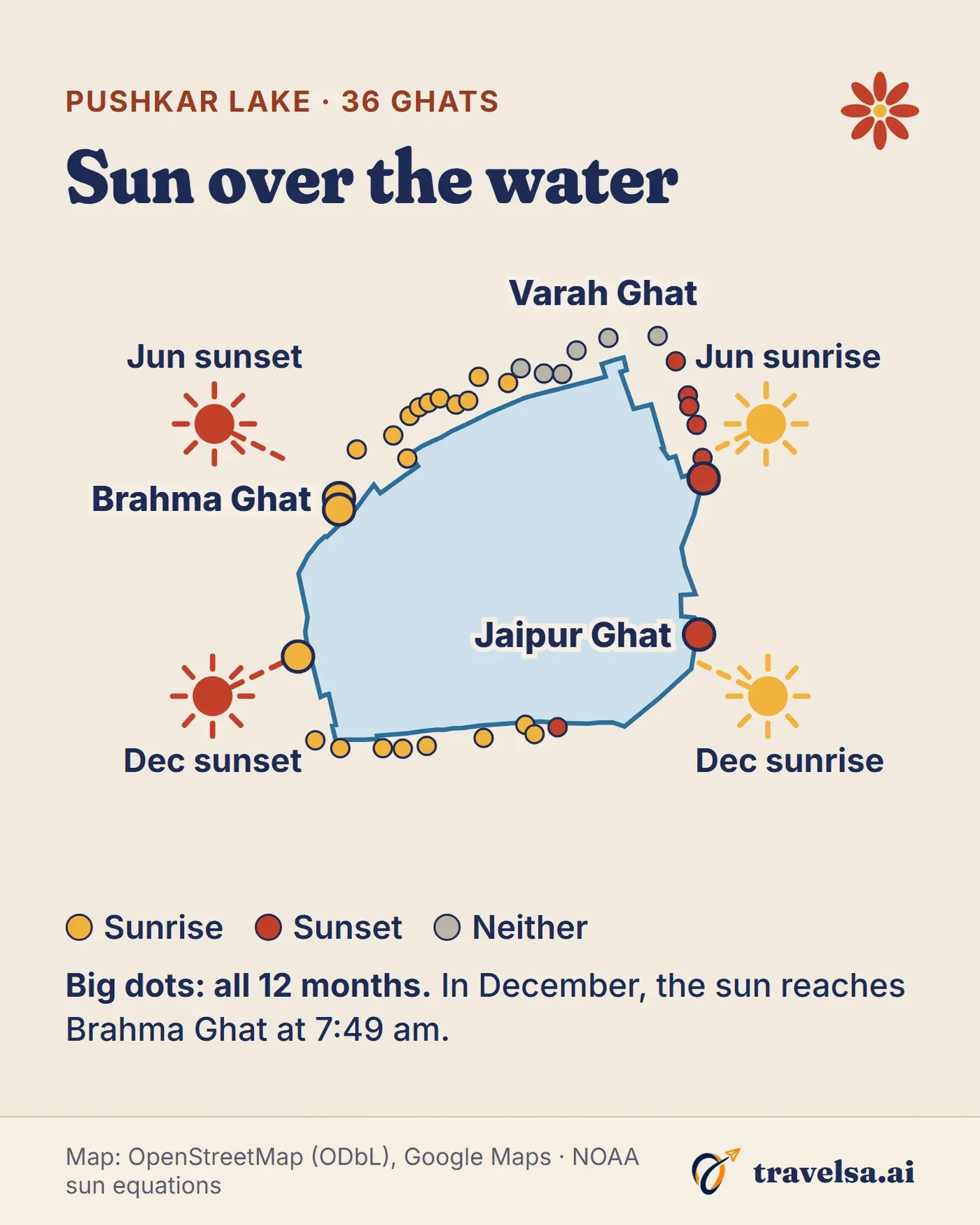
Which ghats look over the water towards the sunrise or the sunset. Tap to enlarge.
| Month | Sunrise | Sun reaches Brahma Ghat | Sunset | Sun drops out of sight at Jaipur Ghat | Air at 7 am |
|---|---|---|---|---|---|
| Jan | 7:21 am | 7:58 am | 6:01 pm | 5:51 pm | 10°C |
| Feb | 7:09 am | 7:42 am | 6:25 pm | 6:15 pm | 14°C |
| Mar | 6:43 am | 7:12 am | 6:42 pm | 6:30 pm | 20°C |
| Apr | 6:09 am | 6:28 am | 6:56 pm | 6:44 pm | 26°C |
| May | 5:45 am | 6:11 am | 7:12 pm | 6:55 pm | 29°C |
| Jun | 5:38 am | 5:55 am | 7:27 pm | 7:09 pm | 29°C |
| Jul | 5:47 am | 6:07 am | 7:29 pm | 7:11 pm | 26°C |
| Aug | 6:03 am | 6:29 am | 7:11 pm | 6:59 pm | 25°C |
| Sep | 6:16 am | 6:42 am | 6:39 pm | 6:27 pm | 25°C |
| Oct | 6:30 am | 7:02 am | 6:06 pm | 5:57 pm | 22°C |
| Nov | 6:50 am | 7:26 am | 5:44 pm | 5:34 pm | 17°C |
| Dec | 7:12 am | 7:49 am | 5:43 pm | 5:32 pm | 12°C |
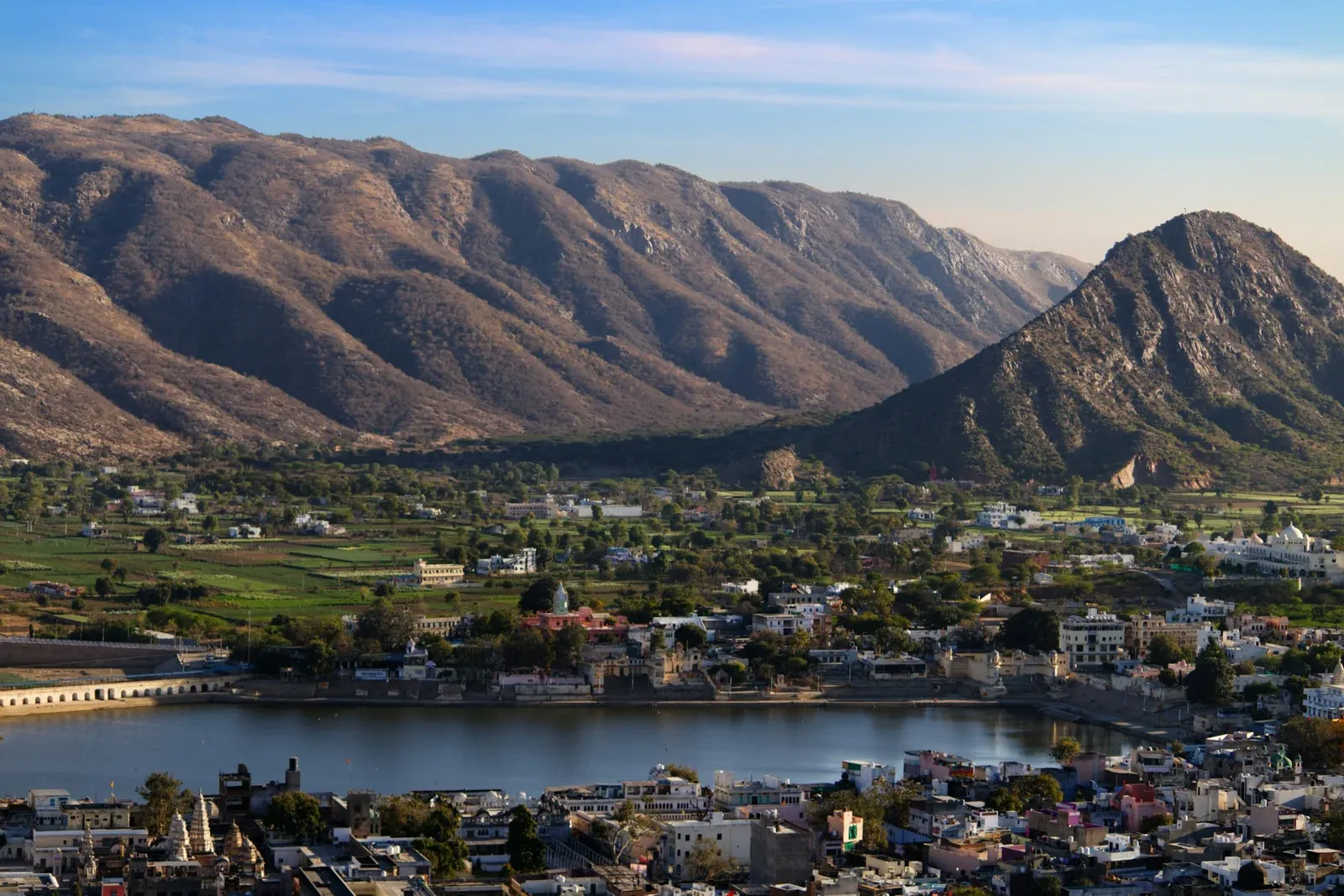
The hills on the Ajmer side hide the sun for a while after it rises. So in December, the sun reaches Brahma Ghat at about 7:49 am, 37 minutes after sunrise. You can take your time over breakfast in winter. At sunset, the sun drops behind the higher ground across the lake 9 to 18 minutes before the official time. Sit down at Jaipur Ghat 20 minutes before sunset, or you'll miss it.
Sunrise and sunset are for the 15th of each month. Buildings and trees can hide the sun for a few minutes more.
Your best ghat changes with the season:
- October to March: for sunrise, Brahma Ghat and the north-west bank, from Gandhi Ghat to Chir Ghat. For sunset, the north-east and east bank, from Chandra Ghat to Jaipur Ghat.
- April to September: for sunrise, Brahma Ghat, or the south-west bank from Vashya Ghat to Sikar Ghat in May to August. For sunset, Jaipur Ghat or the south bank at Saptarishi and Shiva ghats.
Got your month? Turn your sunrise and sunset into a full Pushkar plan.
Pushkar Lake aarti time and place
The main evening aarti is at Varah Ghat, with bells and lamps, and it starts around sunset. Brahma Ghat has an evening aarti too. The time moves with the season. In November, it starts at about 6 pm, some 20 minutes after sunset. So ask at the ghat in the afternoon for that day's time.
Here's the evening I'd plan. Watch the sun go down at Jaipur Ghat. Then walk 4 minutes along the bank to Varah Ghat for the aarti.
Brahma Temple holds its own evening aarti about 40 minutes after sunset. Varah Ghat is 10 minutes on foot from the temple, so you can see the ghat aarti first.
Pushkar Lake parikrama walk
You can walk past 36 ghats in about 24 minutes, a loop of 1.8 km. Pilgrims call a walk around a sacred place a parikrama. You can do this one at your own pace and stop wherever the steps are quiet. Start at Brahma Ghat and keep the water on your right.
The north side is one long row of 23 ghats, from Brahma Ghat to Gwalior Ghat, so you can walk it without leaving the water. It's easy. After Jaipur Ghat, the path crosses to the south bank. On the way back, Karni Ghat and Dadhich Ghat bring you round to Brahma Ghat.
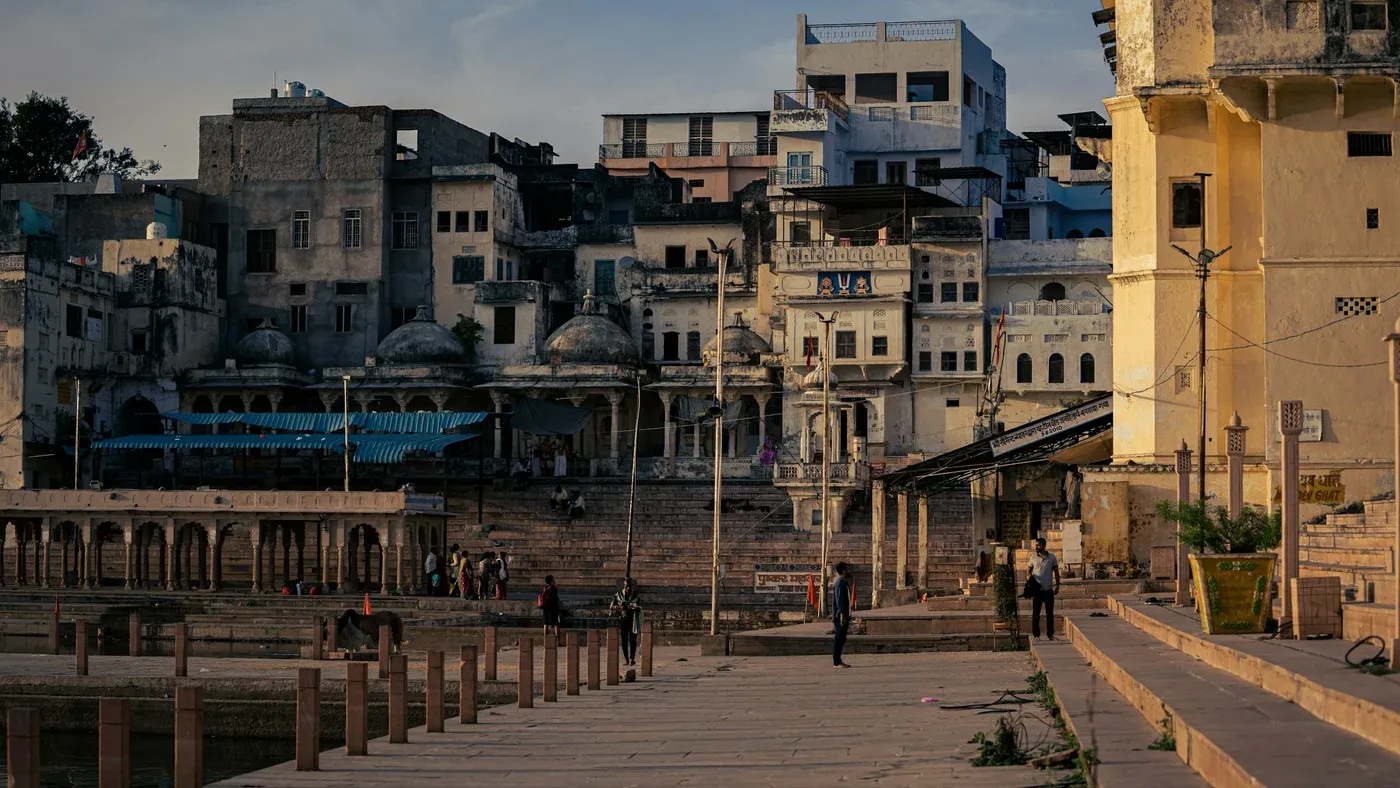
The walkway along the ghats.
Photo: Arsh.D.sonda / Unsplash
You take your shoes off at the top of the steps at each ghat. So wear slip-on sandals, and carry a cloth bag for them. If you leave them at a shoe stand and get a token, take a photo of it. The lower steps are wet, so walk slowly near the water.
36 Pushkar ghats in walking order
| # | Ghat | Bank | Walk from Brahma Temple | Sun over the water |
|---|---|---|---|---|
| 1 | Brahma Ghat | North-west | 7 min | Sunrise over the lake, all year |
| 2 | Gandhi Ghat | North-west | 6 min | Sunrise over the lake, September to April |
| 3 | Yag Ghat | North-west | 7 min | Sunrise over the lake, September to April |
| 4 | Gau Ghat | North-west | 7 min | Sunrise over the lake, September to March |
| 5 | Janana Ghat | North-west | 7 min | Sunrise over the lake, October to March |
| 6 | Chir Ghat | North-west | 7 min | Sunrise over the lake, October to March |
| 7 | Nagar Ghat | North | 8 min | Sunrise over the lake, October to February |
| 8 | Jagannath Ghat | North | 8 min | Sunrise over the lake, October to February |
| 9 | Rams Ghat | North | 8 min | Sunrise over the lake, October to February |
| 10 | Mukti Ghat | North | 8 min | Sunrise over the lake, November to February |
| 11 | Gangaur Ghat | North | 8 min | Sunrise over the lake, December to January |
| 12 | Asthal Ghat | North | 8 min | Sunrise over the lake, December |
| 13 | Badri Ghat | North | 9 min | Neither, the sun rises and sets over land |
| 14 | Bhadawar Ghat | North | 9 min | Neither, the sun rises and sets over land |
| 15 | Palika Ghat | North | 9 min | Neither, the sun rises and sets over land |
| 16 | Nagar Palika Ghat | North | 9 min | Neither, the sun rises and sets over land |
| 17 | Narsingh Ghat | North-east | 10 min | Neither, the sun rises and sets over land |
| 18 | Varah Ghat | North-east | 10 min | Neither, the sun rises and sets over land |
| 19 | Banshi Ghat | North-east | 13 min | Sunset over the lake, November to January |
| 20 | Mahadev Ghat | North-east | 13 min | Sunset over the lake, October to February |
| 21 | Chandra Ghat | North-east | 12 min | Sunset over the lake, October to March |
| 22 | Indra Ghat | North-east | 13 min | Sunset over the lake, September to March |
| 23 | Gwalior Ghat | North-east | 13 min | Sunset over the lake, August to April |
| 24 | Bangla Ghat | East | 15 min | Sunset over the lake, all year |
| 25 | Jaipur Ghat | East | 12 min | Sunset over the lake, all year |
| 26 | Saptarishi Ghat | South | 10 min | Sunset over the lake, April to September |
| 27 | Kota Ghat | South | 9 min | Sunrise over the lake, June; Sunset over the lake, April to August |
| 28 | Shiva Ghat | South | 9 min | Sunrise over the lake, May to July; Sunset over the lake, April to September |
| 29 | Jodhpur Ghat | South | 9 min | Sunrise over the lake, May to July; Sunset over the lake, June to July |
| 30 | Balunda Ghat | South | 8 min | Sunrise over the lake, May to August |
| 31 | Bunhan Ji Ghat | South-west | 8 min | Sunrise over the lake, May to August |
| 32 | Sikar Ghat | South-west | 8 min | Sunrise over the lake, May to August |
| 33 | Kotak Ghat | South-west | 7 min | Sunrise over the lake, April to August |
| 34 | Vashya Ghat | South-west | 7 min | Sunrise over the lake, April to August |
| 35 | Karni Ghat | South-west | 6 min | Sunrise over the lake, all year |
| 36 | Dadhich Ghat | West | 7 min | Sunrise over the lake, all year |
Guides often list 10 ghats as the most important. They are Varaha Ghat, Dadhich Ghat, Saptarishi Ghat, Gwalior Ghat, Kota Ghat, Gau Ghat, Yag Ghat, Jaipur Ghat, Karni Ghat and Gangaur Ghat. All 10 are in the table above. Spellings differ from guide to guide, and some ghats go by two names.
Pushkar ghats, one by one
Brahma Ghat
7 minutes from Brahma Temple · sunrise over the lake all year
Brahma Ghat is named after Brahma. Hindu tradition says Brahma, the creator god, bathed and performed a fire ritual here. Pilgrims come early to bathe and pray, so it is busiest in the first hour of light.
Travellers report the "free puja" pitch here most often. Come for the sunrise and the bathing, and say no to anyone who offers you a puja you did not ask for.
Gau Ghat (Gandhi Ghat)
7 minutes from Brahma Temple · sunrise over the lake, September to March
Mahatma Gandhi's ashes were immersed in the lake at Gau Ghat, and it was renamed Gandhi Ghat after that. The steps right next to it also carry the Gandhi Ghat name. Guides often list Gau Ghat among the 10 most important ghats.
Gangaur Ghat
8 minutes from Brahma Temple · in the middle of the north bank
Gangaur Ghat faces south, straight across the lake. With time for only 2 ghats, I'd pick Brahma Ghat and this one.
Varah Ghat
10 minutes from Brahma Temple · the evening aarti
Varah Ghat, also spelt Varaha Ghat, is named after Varaha, the boar form of the god Vishnu. Varaha Temple is a short climb up from the steps, and stalls nearby sell puja items, cloth and souvenirs. The ghat faces south-west, so the sun sets over the town, not over the water.
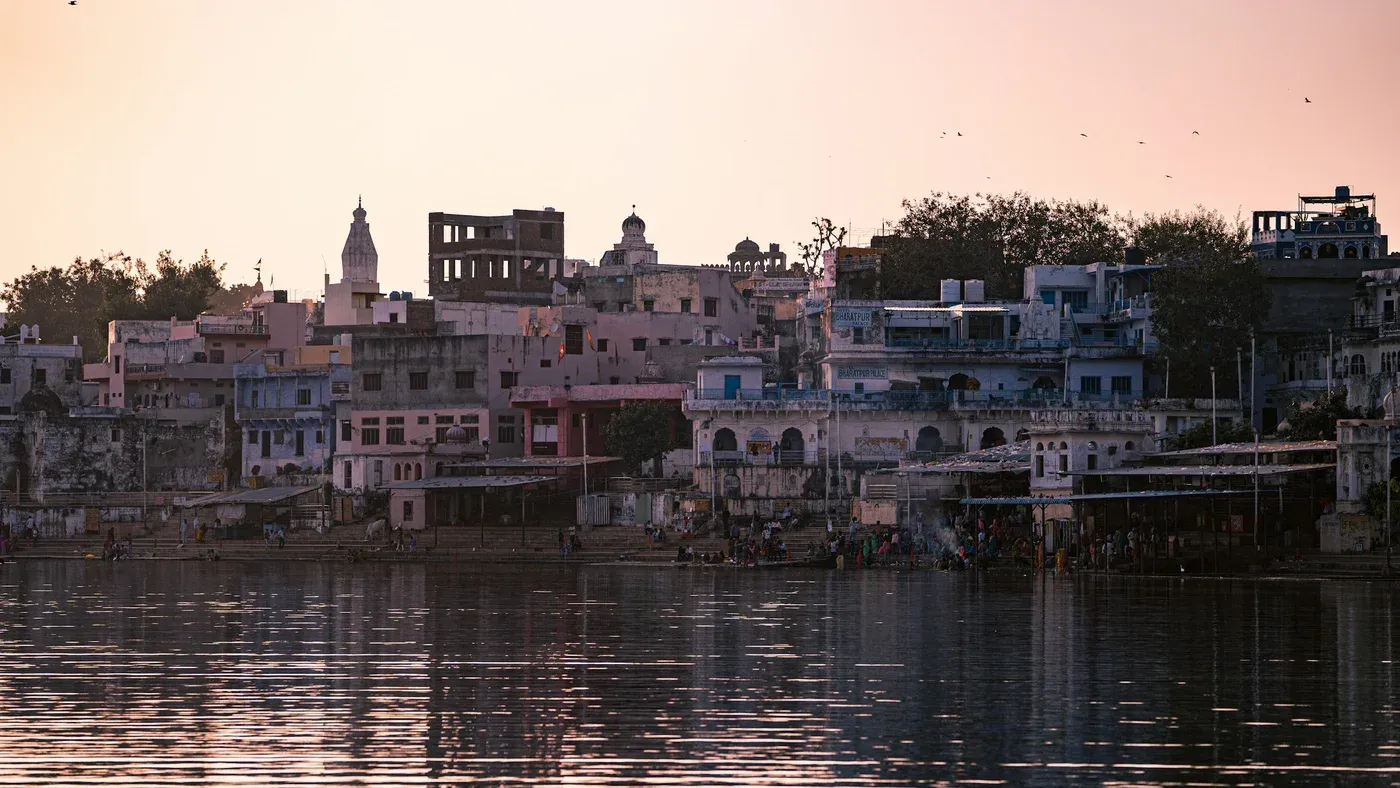
Evening at the ghats of Pushkar Lake.
Photo: Arsh.D.sonda / Unsplash
Gwalior Ghat
13 minutes from Brahma Temple · sunset over the lake, August to April
Gwalior Ghat is on the north-east bank, between Varah Ghat and Jaipur Ghat. From August to April, it is a good second choice when Jaipur Ghat is full.
Jaipur Ghat
12 minutes from Brahma Temple · sunset over the lake all year
Jaipur Ghat is the sunset ghat. You'll find it on the east bank, right next to Sunset Point. Sunset Café is a minute away for chai.
Saptarishi Ghat
10 minutes from Brahma Temple · sunset over the lake, April to September
Saptarishi Ghat is named after the 7 sages of Hindu tradition. It sits on the south bank, across the water from Varah Ghat. From April to September, it is the place to watch the sun set over the lake if Jaipur Ghat is busy.
Pushkar Lake for families, couples, elders and solo travellers
Everyone gets something different from the lake. Here's what works for your kind of trip.
| You're going as | Best for you | Good to know |
|---|---|---|
| A family with young kids | The aarti at Varah Ghat at sunset | Every ghat is a flight of steps, so leave the pram at the top; hold children's hands, as the water gets deep close to the edge |
| A family with teens | Sunset at Jaipur Ghat, then chai at Sunset Café next door | Ask before filming people, and never film anyone bathing |
| Elders | Karni Ghat or Brahma Ghat, both a short walk from Brahma Temple | Go down only as far as you need, as the lower steps are wet; for an ambulance, call 108, and the bigger hospitals are in Ajmer |
| Travellers who cannot manage steps | A lake view from a café or stay at street level; ask before you book | Every ghat is a flight of steps down to the water |
| A couple | Sunset at Jaipur Ghat, then the aarti at Varah Ghat | Keep public affection away from the ghats |
| Solo women | The ghats in daylight and the aarti | Cover shoulders and knees; after dark, stay on lit central lanes |
| Friends | The walk past all 36 ghats | Pushkar is vegetarian and alcohol-free, and loud music is not welcome at the ghats |
| Backpackers and students | Sunrise at Brahma Ghat; it costs nothing | Slip-on sandals save time at every ghat |
| Visitors from abroad | Watching the morning bathing and the evening aarti | Say no to any puja you did not ask for |
| Photographers | Brahma Ghat when the sun clears the hills, 7:49 am in December | Never photograph people bathing, and ask before any portrait |
| Pilgrims on a one-night trip | The evening aarti at Varah Ghat, then the dawn dip at Brahma Ghat | Kartik Purnima is the busiest bathing day of the year |
| Day-trippers from Ajmer or Jaipur | Come for the late afternoon: sunset at Jaipur Ghat, then the aarti | The aarti ends after dark, so plan your ride back |
Travelling as a group? Plan the lake, the temples and the food into one Pushkar trip.
Pushkar ghat puja and the donation scam
A puja at the ghats is a real part of worship, and you can choose one with a priest. The problem is the uninvited "free" puja that ends in a demand for money. Nobody can make you pay for a puja you did not agree to.
Here's how it usually goes. A man hands you a flower near the steps, or offers a blessing for your family. He leads you to the water, asks the names of your relatives and has you repeat a prayer. Then he asks for money, sometimes for each person you prayed for.
The amounts travellers report are high: ₹1,000 for each family member, or a "minimum donation" of ₹5,000. Some touts split a couple up for a separate "men's puja", so it is harder to say no.
"They warned us that we would be cursed by God if we do not pay the minimum amount." (A traveller at Brahma Ghat)
What to do:
- Say no at the first approach, and keep walking.
- Do not take a flower or a thread from a stranger.
- Stay together if you're a couple or a group.
- If you want a puja, agree the amount before it starts.
Pushkar ghats: what to bring
Pack light for the ghats. These 5 things make the visit easier:
- Slip-on sandals, because the shoes come off at every ghat.
- A cloth bag to carry them in.
- Shawl or scarf, for winter mornings and to cover your shoulders.
- Water bottle: tap water in Pushkar is not safe to drink.
- Phone torch, for the walk back after the aarti.
In December and January, the air at 7 am is about 10°C to 12°C, so the shawl matters at sunrise.
Pushkar ghat rules and safety
Take your shoes off before you go down the steps. Cover your shoulders and knees, and never photograph people while they bathe.
Pushkar is a strictly vegetarian town. Meat and alcohol are not allowed in the town, and that includes the ghats.
Pilgrims bathe in the lake as an act of worship. If you'd like to take a holy dip, bathe at a busy ghat where others are bathing. As with any open lake or river, try not to swallow the water if you have a sensitive stomach.
The water gets deep close to the steps. Stay on the steps, and keep children within reach.
Pushkar Lake entry fee and costs
The lake and the ghats are free. You only pay for what you choose.
| What | Cost |
|---|---|
| Entry to the lake and ghats | Free |
| The evening aarti at Varah Ghat | Free |
| A puja with a priest | Your choice; agree the amount first |
| Ropeway to Savitri Temple, to see the lake from above | ₹195 adult return |
The ropeway fare was checked on 15 November 2026. Fares change, so confirm yours on the Damodar Ropeways site.
Pushkar Lake weather and the best time to visit
October to March is the best time to visit Pushkar Lake. Days stay at 32°C or less, and the 7 am air is 10°C to 22°C. Bring a shawl for sunrise in December and January.
From April to June, the air is already about 29°C at 7 am in May. So go at sunrise, and stay off the steps in the afternoon.
July and August bring about 13 to 14 rainy days each, and the lake fills from the monsoon rain. After a strong monsoon, the water rises over the lower steps of the ghats.
Pushkar ghats on festival, hot and rainy days
On auspicious days like Kartik Purnima and Somvati Amavasya, pilgrims fill the ghats from dawn to take a holy dip and seek blessings. Here's how to plan around those days, and around heat and rain.
- Auspicious bathing days: come early and join the pilgrims at the water, or watch from the rooftop at Out of the Blue, by Gandhi Ghat. If you want quieter steps for photos, come the next morning.
- On very hot days, go at sunrise, and spend the afternoon indoors.
- Rain or high water: the lower steps can go under water. On a clear day after the rain, take the ropeway up to Savitri Temple and see the lake from above.
- If you feel pressured at one ghat, walk on. The next ghat is often less than a minute away.
Pushkar Lake cafés near the ghats
Pushkar's food is all vegetarian, and many rooftop cafés face the lake. These 4 are our picks, each right by a ghat.
| Place to eat | Good for | Where |
|---|---|---|
| Out of the Blue | Rooftop meals with a view of the lake | By Gandhi Ghat |
| Little Tibet Garden | Tibetan food | By Nagar Palika Ghat |
| Honey & Spice | Fresh vegetarian food, juices, breakfast | By Narsingh Ghat |
| Sunset Café | Chai and snacks at sunset | By Jaipur Ghat |
Pushkar Lake history and significance
Hindu tradition says Pushkar Lake formed where a lotus petal fell from the hand of Brahma, the creator god, as he fought a demon. Scriptures call it Tirtha Raj, the king of pilgrimage places. Hindu belief counts 5 sacred lakes, and Pushkar is one, along with Mansarovar. Pilgrims believe a dip on Kartik Purnima brings great merit.
The lake is very old. Coins from the 4th century BC point to it, and inscriptions at Sanchi from the 2nd century BC mention it. The lake took its present form after a dam was built in the 12th century.
Rulers and governors built the ghats and temples over the centuries. Man Singh I of Amber built Raj Ghat, and Daulat Rao Scindia built Kot Tirth Ghat. The lake is holy in Sikhism too: Guru Gobind Singh is said to have recited the Guru Granth Sahib on its banks.
Tradition counts 3 Pushkar lakes, one where each petal fell: Jyeshtha Pushkar, the main lake in town, and the smaller Madhya and Kanishtha Pushkar. Walking around all 3 on Kartik Purnima, about 16 km, is held to be very auspicious.
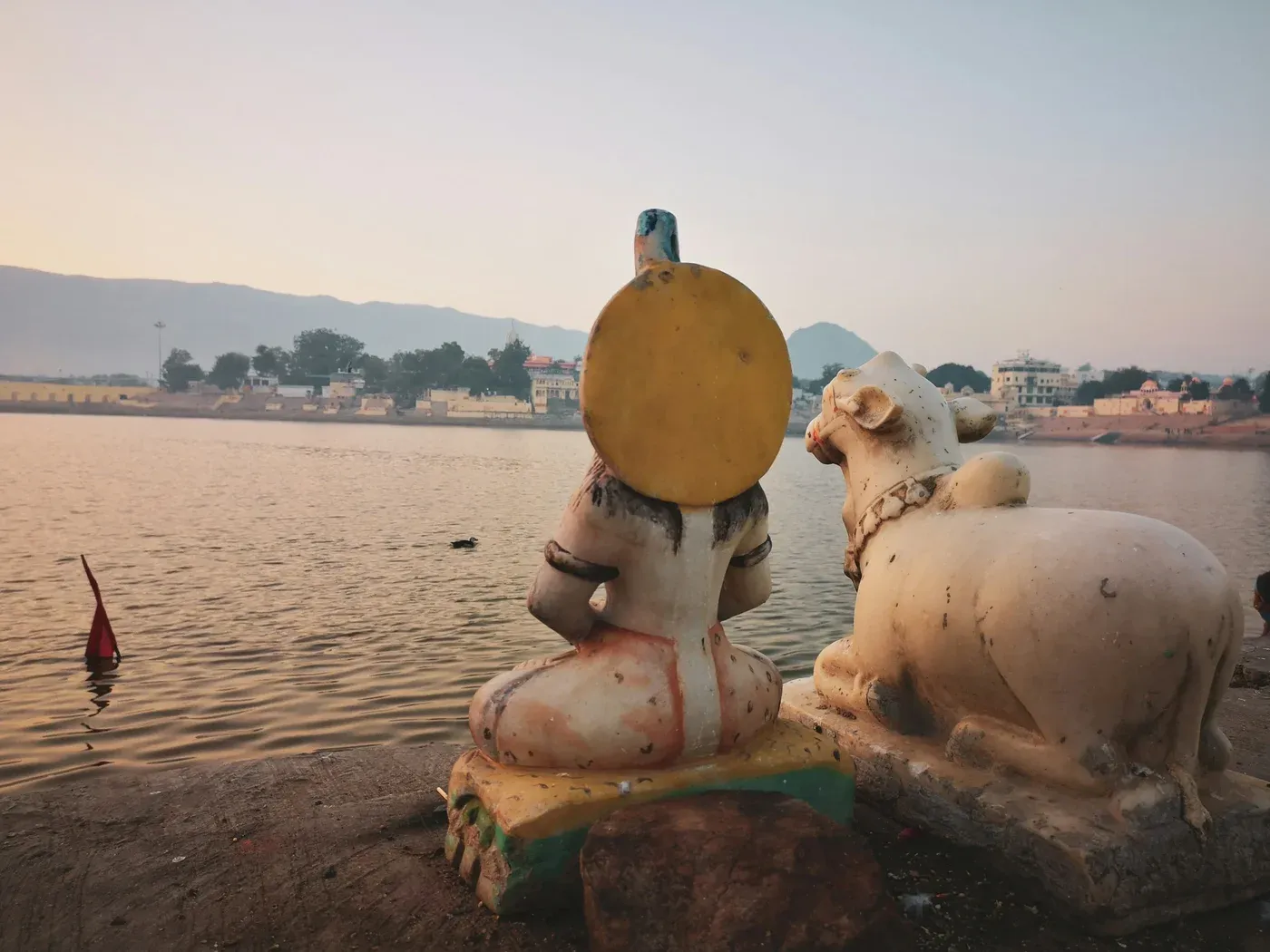
Statues facing the water at Pushkar Lake.
Photo: atarin michaeli / Unsplash
Pushkar Lake holy dip dates for 2026 and 2027
Kartik Purnima, the biggest bathing day, falls on 24 November in 2026. In 2027, it falls on 13 or 14 November. Drik Panchang lists 13 November for the fast and 14 November as the full moon at sunrise, on New Delhi times. The Pushkar Mela, or Pushkar Fair, runs in the days before it, and Rajasthan Tourism publishes the fair dates closer to the time.
For this year's fair and the bathing day, see the Pushkar Mela guide, with the programme day by day.
More Pushkar guides
For the temples, the ropeway and a one-day plan, see places to visit in Pushkar, with walking times. To get here, read how to reach Pushkar from Ajmer, Jaipur and Delhi.
See the ghats for yourself. Plan your Pushkar trip with Travelsa, from the sunrise at Brahma Ghat to the aarti at Varah Ghat.
Ghat names and walking times are from Google Maps and OpenStreetMap, starting at the gate of Brahma Temple. Sun times use the solar equations of NOAA (the US weather agency) and Copernicus terrain heights, and the weather is Open-Meteo data for 2016–2025. News, fares and official facts are from the sources below, checked on 16 November 2026.
Common questions
How many ghats does Pushkar Lake have?
What time is the aarti at Pushkar Lake?
Which ghat is best for sunset in Pushkar?
Which ghat is best for sunrise in Pushkar?
Is there an entry fee for Pushkar Lake?
Can you bathe in Pushkar Lake?
How long does it take to walk around Pushkar Lake?
Is Pushkar Lake safe for children and older people?
Sources
- Patrika: water level reaches 21 feet — after a strong monsoon the water covers the steps of the ghats (2019 report, published 2019-08-01)
- Drik Panchang: Kartik Purnima 2026 — Kartik Purnima on 24 November 2026 (checked 16 Nov 2026)
- Drik Panchang: Kartik Purnima 2027 — fast on 13 November 2027, full moon at sunrise on 14 November, New Delhi times (checked 16 Nov 2026)
- ETV Bharat: Pushkar Fair 2026 programme — the Tourism Department's November programme: Maha Aarti at the ghats at 6 pm (published 2026-10-07)
- Damodar Ropeways: Pushkar — Savitri Temple ropeway, ₹195 adult return (checked 15 Nov 2026)
- Wikipedia: Pushkar Lake — 52 ghats; the 10 ghats usually listed as most important; Brahma, Varah and Gau (Gandhi) ghats; the lotus legend and Tirtha Raj; 4th-century BC coins and Sanchi inscriptions; the 12th-century dam; Raj Ghat and Kot Tirth Ghat builders; holy in Sikhism; the 3 Pushkar lakes and the 16 km circuit on Kartik Purnima; Guru Gobind Singh; shoes off on the ghats (checked 16 Nov 2026)
- Wikivoyage: Pushkar — evening prayers with bells and lamps at Varah Ghat; Brahma Temple's aarti 40 minutes after sunset; shoes off at the steps; offerings at the ghats are not mandatory; no meat or alcohol in town; the lake view from Savitri Temple (checked 16 Nov 2026)
- Eco Heritage, C.P.R. Environmental Education Centre: Pushkar Lake — 52 ghats; Gandhi Ghat, formerly Gau Ghat, where Gandhi's ashes were immersed (checked 16 Nov 2026)
- Outlook Traveller: travelling respectfully in India — always ask before photographing people, especially at religious places (checked 16 Nov 2026)
- OpenStreetMap — the lake outline, the 32 named ghats and walking routes (data © OpenStreetMap contributors, ODbL, November 2026)
- Open-Meteo — weather data by Open-Meteo.com (CC BY 4.0): daily and hourly records for Pushkar Lake, 2016–2025; terrain heights from the Copernicus DEM through the Open-Meteo Elevation API
- NOAA solar calculation — the equations behind the sunrise, sunset and sun-direction figures
- Thrillophilia: Pushkar Lake — free entry to the lake (checked 16 Nov 2026)
- Tripoto: tourist scams in Pushkar — a traveller's account of the evening aarti and the puja scam at Brahma Ghat: the couple split up, the ₹5,000 "minimum donation" (checked 16 Nov 2026)
- Take Your Backpack: backpacking in Pushkar — avoid photos of people bathing; skip the flower-offering touts at the ghats (updated 2026-11-15)
- P. Simon My Way: the Pushkar scam — ₹1,000 asked for each family member prayed for (published 2019-02-26)
Dreaming of Pushkar?
Let Travelsa build your perfect Pushkar itinerary in minutes.