Lakes of Udaipur: History, Map and How All 10 Connect
There are 10 Udaipur lakes worth a visit, and every one is man-made, starting, by tradition, with Lake Pichola in the late 1300s. Pichola, Swaroop Sagar and Rang Sagar are joined, within a 15-minute walk of Jagdish Temple. Fateh Sagar is a 15-minute drive from it, with no traffic. See Pichola for the palaces, Fateh Sagar for an evening and Badi Lake for sunrise.
In this guide
Udaipur lakes at a glance: what each is famous for
See Lake Pichola first, for its palaces and the boat to Jag Mandir. Each of the other nine does one thing well, from a quiet walk to a full-day trip.
| Lake | Famous for | Built | From Jagdish Temple | Boat (Indian adult) | Best time |
|---|---|---|---|---|---|
| Lake Pichola | The City Palace on its shore and two island palaces | Late 1300s (by tradition); dam raised in 1560 | 3 min walk (0.2 km) | ₹600 City Palace boat to Jag Mandir; ₹180 municipal boat | Sunset from the ghats |
| Swaroop Sagar | A quiet lake between Pichola and Fateh Sagar | Reign of Maharana Swaroop Singh (1842–61) | 13 min walk (1.0 km) | - | Morning or evening walk |
| Rang Sagar | Islands and birds | - | 15 min walk (1.1 km) | - | Evening |
| Doodh Talai | Pedal boats, the musical garden and the Karni Mata ropeway | - (part of Pichola) | 10 min drive (2.3 km) | ₹80 to ₹200 pedal boat | Evening |
| Fateh Sagar | Evening walks on the dam road and the boat to Nehru Garden | Dam 1889 (Maharana Fateh Singh) | 15 min drive (5.3 km) | ₹210 to Nehru Garden | Sunset and evening |
| Goverdhan Sagar | A lakeside garden, popular with locals | - | 25 min drive (7.8 km) | - | Early morning |
| Badi Lake | Sunrise and the view from Bahubali Hills | Maharana Raj Singh I (reign 1652–80) | 30 min drive (10 km) | - | Sunrise |
| Udai Sagar | The last lake in the chain, for a quiet picnic | Maharana Udai Singh II (1559–65) | 35 min drive (14 km) | - | Daytime |
| Jaisamand | A huge dam with carved elephants, and islands | Maharana Jai Singh (finished 1691) | 1 h 30 min drive (55 km) | Boats at the jetty (life jacket compulsory) | Full day |
| Rajsamand | The Nauchowki marble ghats and a poem carved in stone | Maharana Raj Singh I (1662–76) | 1 h 30 min drive (66 km) | Speedboats, jet skis, banana rides | Full day |
Walking times are measured from Jagdish Temple. Drive times are Google Maps times with no traffic, rounded up. Your trip may take longer, depending on when you leave, traffic and stops. Boat fares were checked on 23 November 2026, and they change, so confirm yours at the jetty.
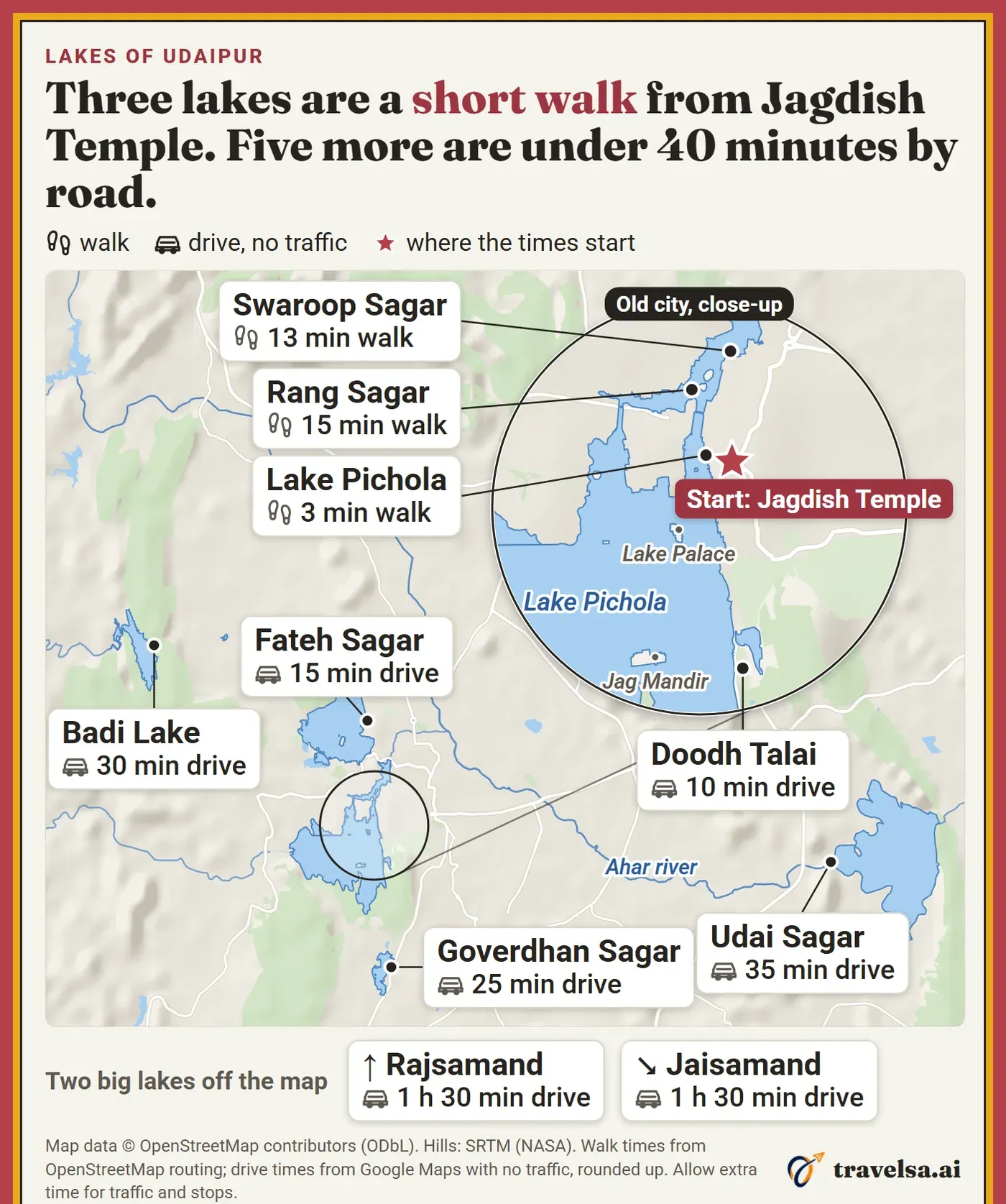
Three lakes are a short walk from Jagdish Temple; five more are under 40 minutes by road. Tap to enlarge.
Once you've picked your lakes, put them into a day-by-day Udaipur plan.
Why Udaipur is called the city of lakes
Udaipur is called the city of lakes because its rulers built one lake after another around it. All of Udaipur's lakes are man-made: each is held back by a dam built to store the monsoon rain.
Lake Pichola came first, before the city. Tradition says a Banjara, a travelling grain trader, built its first dam in the late 14th century, in the time of Maharana Lakha. The lake takes its name from Picholi, a village by the water.
Maharana Udai Singh II founded Udaipur beside that lake in about 1559. His advisers told him a capital in these hills would never run short of supplies, and the hills would help defend it. One story says that while hunting, he met a sadhu (a holy man) on the hill beside Pichola. The sadhu told him a city built there would stay with his family. Udai Singh laid the first stone of a palace on that spot himself.
He raised Pichola's dam in 1560 and built a second, larger lake outside the city, Udai Sagar. The Maharanas after him kept building. Badi Lake, Rajsamand and Jaisamand came in the 1600s, Swaroop Sagar in the 1800s, and Fateh Sagar's great dam in 1889.
Udaipur is often called the Venice of the East, and the comparison is an old one. Rudyard Kipling saw Pichola on his travels in India. He wrote: "If the Venetian owned the Pichola Sagar he might say with justice: 'See it and die.'" Udaipur has a second nickname, too. When the rains turn the hills around Pichola green, an old history of the city says it looks like Kashmir.
Udaipur lakes and how they connect
Udaipur's main lakes are joined, so water moves from one lake to the next. Fateh Sagar is linked to Lake Pichola by a canal that runs through two small lakes, Swaroop Sagar and Rang Sagar. These four lakes work as one set.
The water arrives from the hills above the city. Badi Lake spills into Fateh Sagar, and a feeder canal brings in water from the two Madar lakes further out. Goverdhan Sagar has its own channel to Pichola. Gates on the canals let water from one lake into the next when the levels allow.
When the lakes are full, the extra water drains into the Ayad river, also called the Ahar. The river carries it to Udai Sagar, the last lake in the chain. From there it flows on to the Ganga, through the Berach, Banas, Chambal and Yamuna rivers.
You can stand on one of the joins yourself. At Chand Pole, Pichola flows under the bridge into the smaller lakes behind Jagdish Temple. Cross on Daiji Bridge, a footbridge with no traffic, next to the road bridge. In 1928, a strong wooden gate stood where the canal meets Fateh Sagar. When both lakes were full, it was opened so boats could pass from Pichola into Fateh Sagar.
Lakes in the old city
The old-city lakes are Pichola and the three small lakes joined to it: Swaroop Sagar, Rang Sagar and Doodh Talai. Pichola, Swaroop Sagar and Rang Sagar are all within a 15-minute walk of Jagdish Temple, the old city's temple to Lord Vishnu. Doodh Talai is a short auto ride.
Lake Pichola
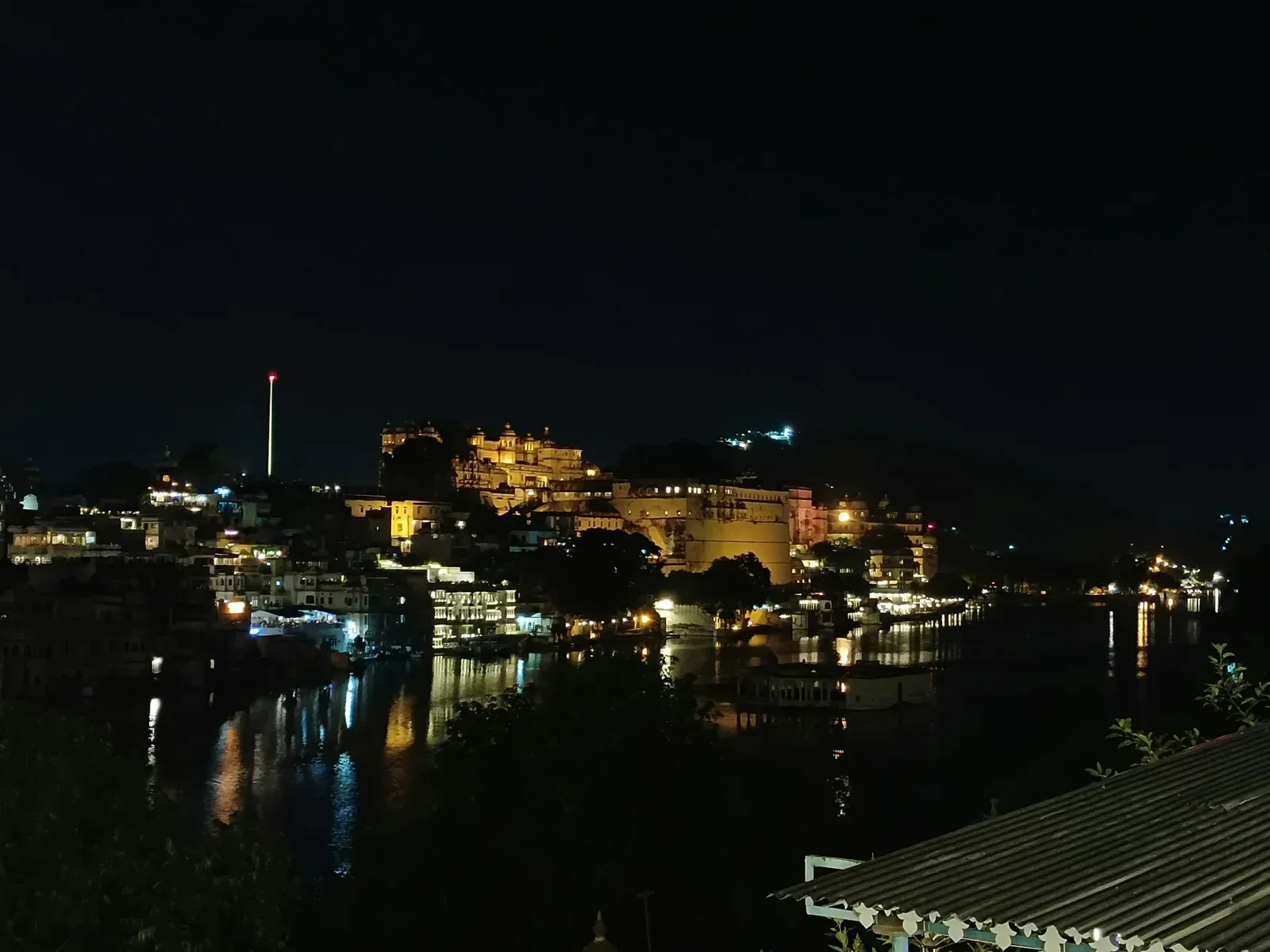
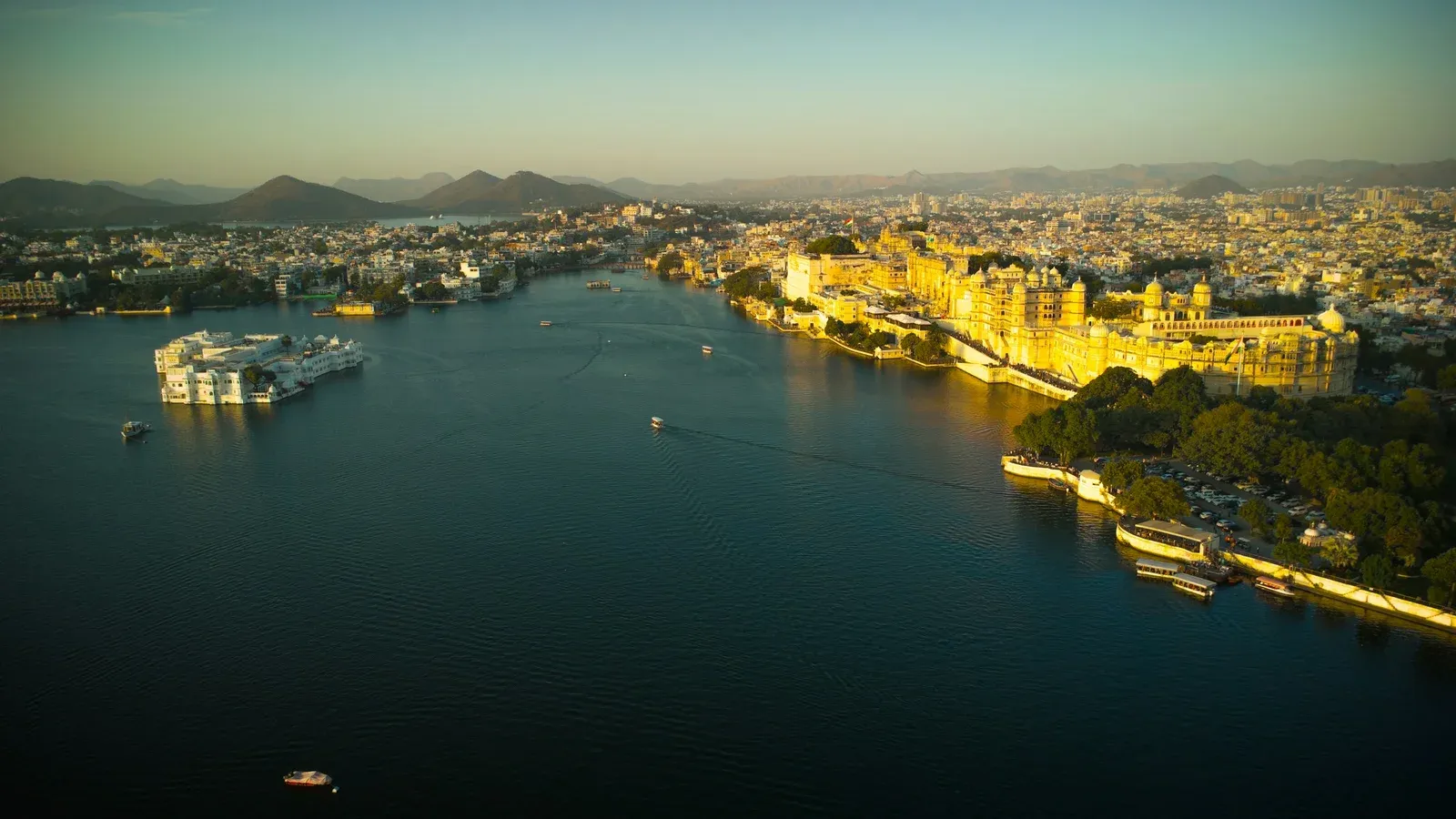
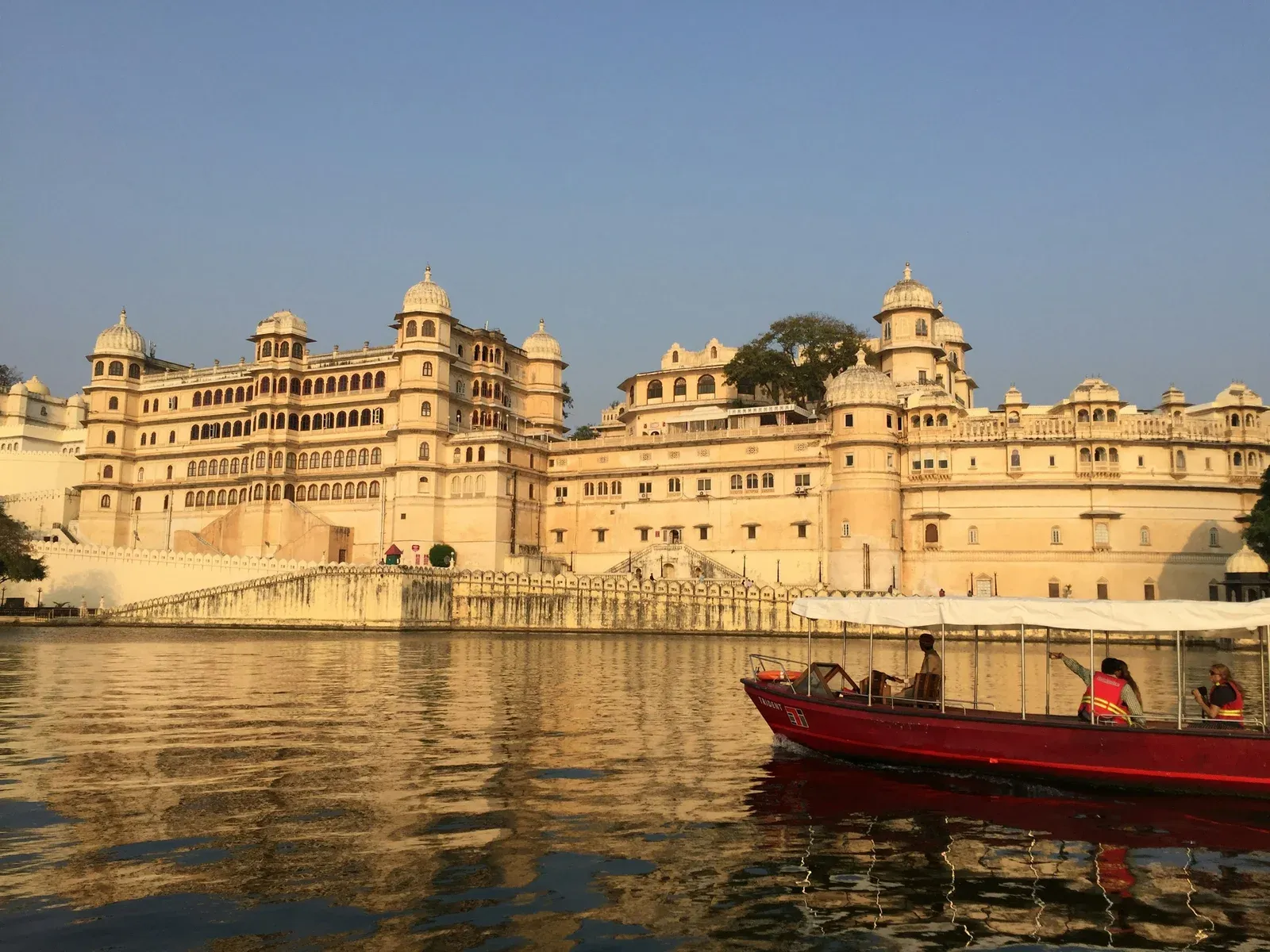
Lake Pichola is famous for the City Palace on its shore and the two palaces on its islands. It is the biggest lake in the city, and the one the old city was built around.
Each island palace was built by a different Maharana. Jagat Singh I completed Jag Mandir (he ruled from 1628 to 1652). Jagat Singh II built Jag Niwas (he ruled from 1734 to 1751). Today it is the Taj Lake Palace hotel, open only to its guests.
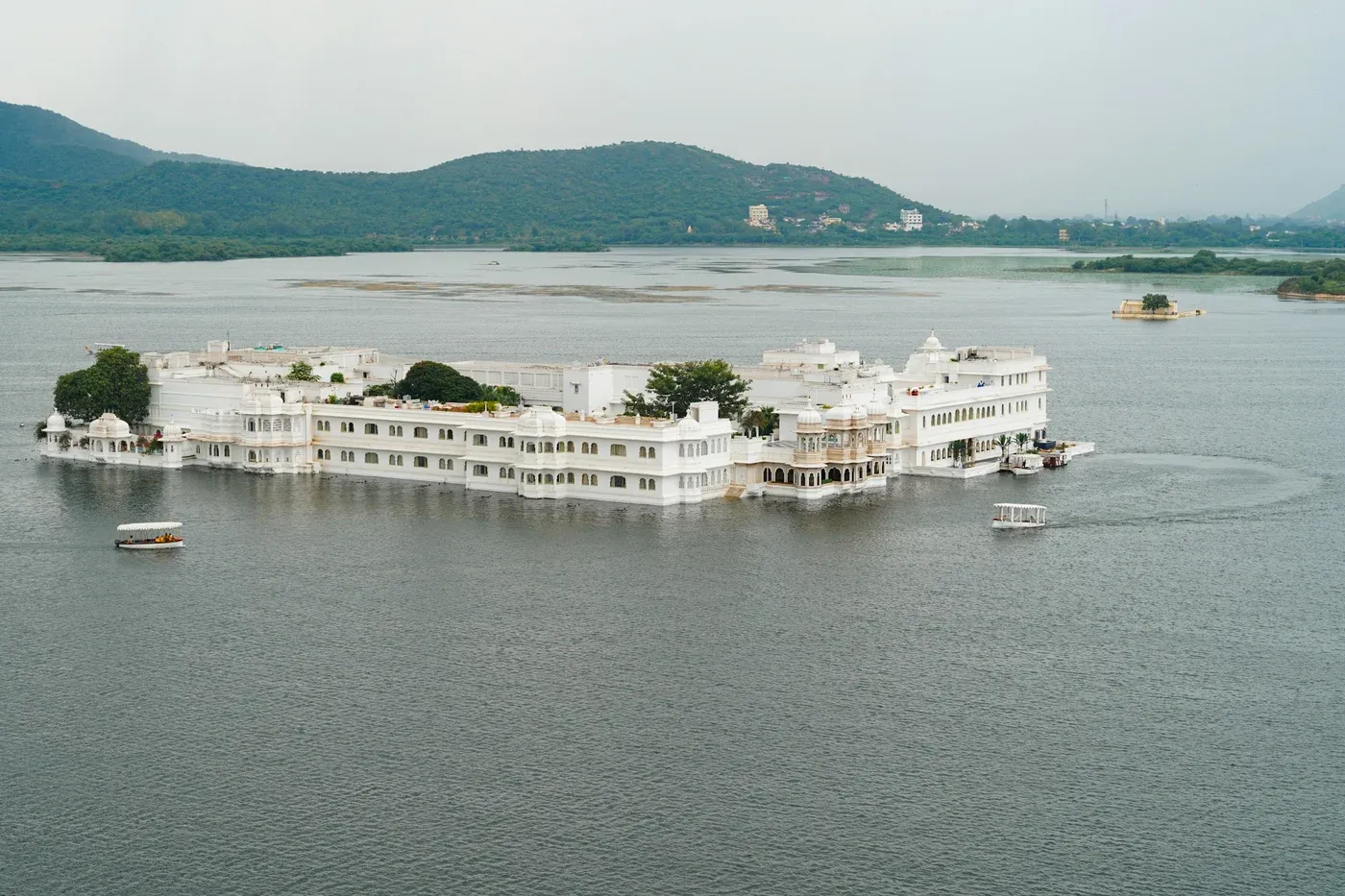
An island palace in the lake, with the Aravalli hills behind.
Photo: Subhashis Das / Unsplash
In the 1620s, Jag Mandir sheltered Prince Khurram, who later became the emperor Shah Jahan. Near the shore, the boats also pass Mohan Mandir, a small island pavilion off Lal Ghat. The Maharana watched the Gangaur festival from it.
You can take one of two kinds of boat. The City Palace boat leaves from Rameshwar Ghat, inside the palace, and stops at Jag Mandir. On its 2025–26 list, it costs every adult ₹600, Indian or foreign. You also need the ₹50 palace entry ticket, sold at Badi Pol, to reach the jetty.
The municipal boat from Doodh Talai costs an Indian adult ₹180 and a foreign adult ₹360. Travellers report that it does not stop at the islands. If you only want time on the water, I'd take this one.
If steps are hard for you, the City Palace lends a wheelchair for free. It also has a lift and an accessible toilet; ask at the information desk in Moti Chowk.
Gangaur Ghat takes its name from Gangaur, the spring festival for the goddess Gauri. During the Mewar Festival, a decorated royal boat carries the idols across the lake to this ghat.
For the sunset, sit at Ambrai Ghat, with the City Palace across the water. Or stay at Gangaur Ghat, near Jagdish Temple: it costs you nothing. Every boat, ghat and fare is in our Lake Pichola boat ride guide.
Swaroop Sagar and Rang Sagar
Swaroop Sagar and Rang Sagar are the two small lakes that join Pichola to Fateh Sagar. Come here for a quiet walk by the water behind Jagdish Temple, away from the boats and the crowds at the ghats. I'd come at golden hour.
Swaroop Sagar is named after Maharana Swaroop Singh, who ruled from 1842 to 1861, and was built in his reign. Rang Sagar is the quieter of the two, with small islands where birds nest.
Doodh Talai
Doodh Talai is a small pond at the edge of Pichola, with two gardens and a ropeway beside it. Bring the children for the pedal boats, from ₹80, and the musical fountain garden in the evening.
The Karni Mata ropeway starts in the garden, a 4-minute walk from the boat stand. It takes you up to the hilltop temple of the goddess Karni Mata. The municipal boats on Pichola also leave from this end of the lake.
Fateh Sagar Lake
Fateh Sagar is the city's evening lake. You walk its long dam road with local families, and boats cross to Nehru Garden island. If walking is hard, you can see the lake from a car on the same road. From Jagdish Temple, the drive takes about 15 minutes.
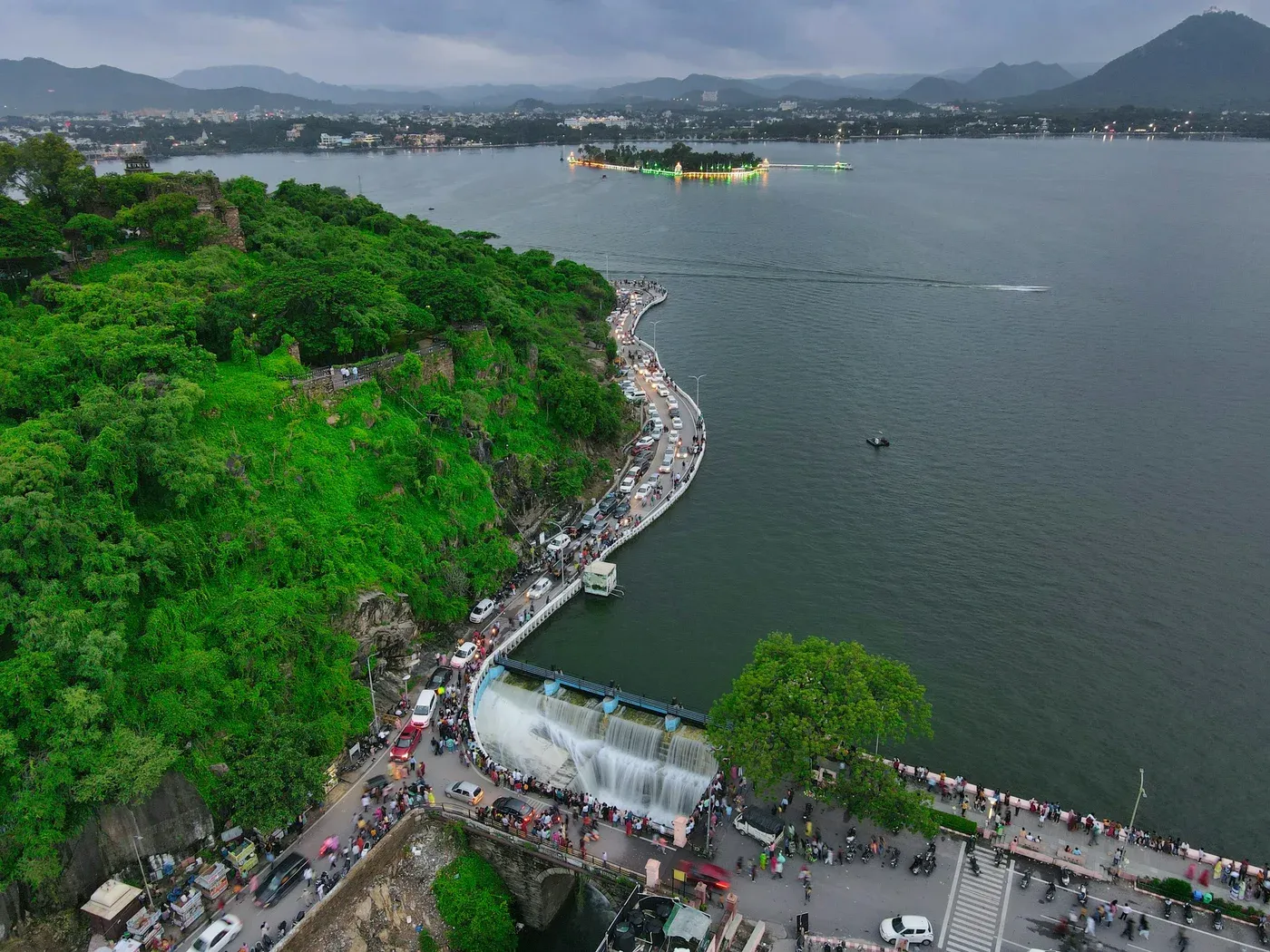
Fateh Sagar from above: the dam road on the left and Nehru Garden island in the lake.
Photo: Mufaddal Photowala / Unsplash
A small lake called Dewali ka talab was here first. Maharana Fateh Singh built a new, higher dam and turned it into a large lake. The Duke of Connaught laid the dam's foundation stone in 1889, so the dam is also called the Connaught Bund.
Fateh Sagar has three islands: Nehru Garden, a park with water fountains, and the Udaipur Solar Observatory. The boat to Nehru Garden leaves from the jetty on Rani Road and costs an Indian adult ₹210, or ₹420 for a foreign adult. In 2025, tickets stopped at 7 pm and the last boat came back at 8 pm. Above the lake is Moti Magri, the hill with the statue of Maharana Pratap on his horse, Chetak.
End the evening with coffee in a kulhad (clay cup). The street stalls are at the Moti Magri end of the dam road.
Lakes outside the old city
Goverdhan Sagar, Badi Lake and Udai Sagar are a drive from the old city. You will not find palaces like Pichola's. But each one is calm when the city lakes are busy.
Goverdhan Sagar
Goverdhan Sagar is a small lake with a garden that is popular with locals. Go in the early morning, because the garden is poorly lit after dark. On a short trip, I'd skip it for Fateh Sagar. Goverdhan Sagar is about 25 minutes by road from Jagdish Temple, with no traffic, and a channel links it to Pichola.
Badi Lake
Badi Lake is famous for sunrise and for the view from Bahubali Hills above it. Maharana Raj Singh I built it during a famine in his reign (1652 to 1680), and named it Jiyan Sagar after his mother, Jana Devi. When it is full, it spills into Fateh Sagar.
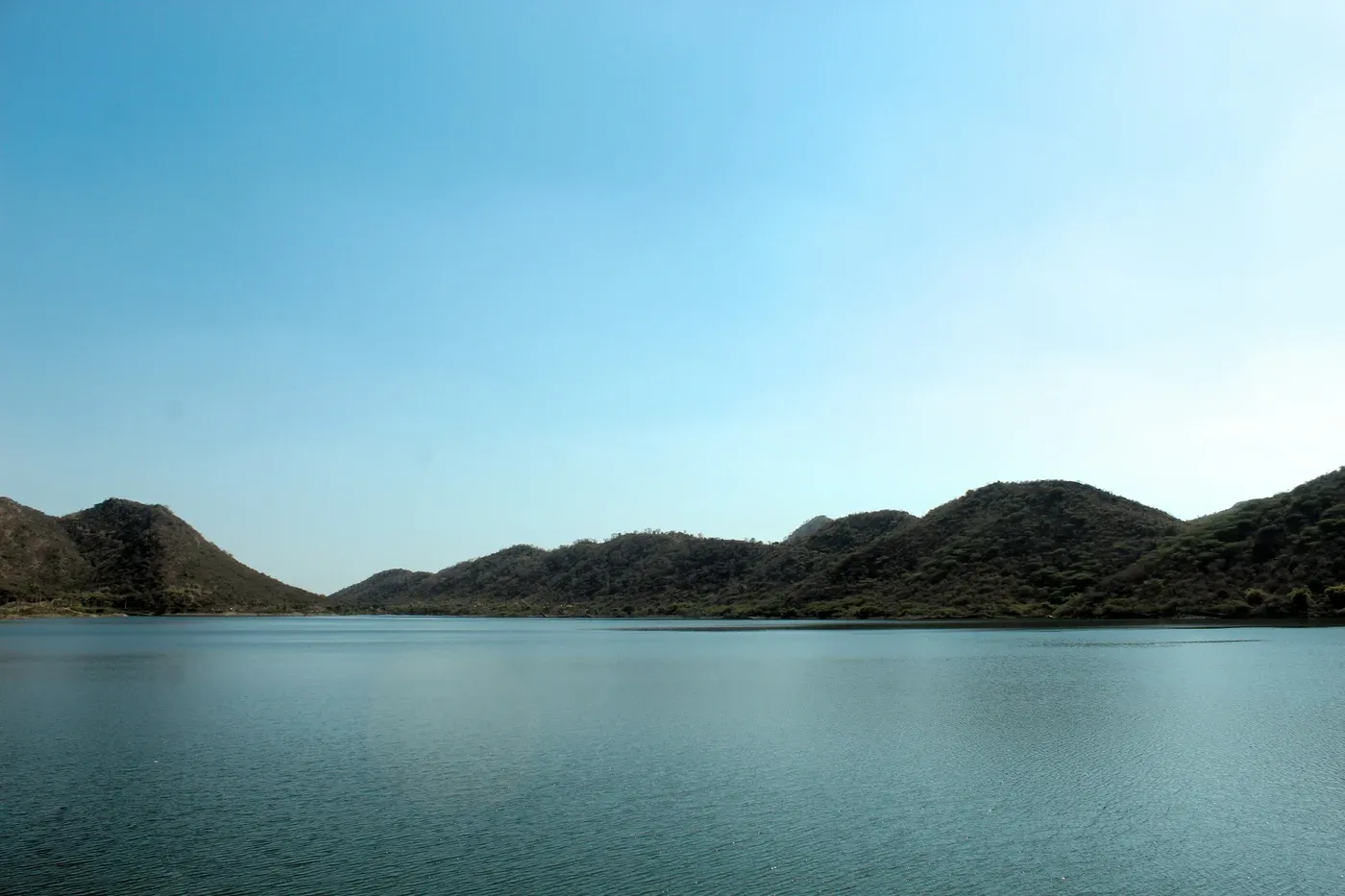
Badi Lake below the hills on a clear morning.
Photo: Chirag Purohit / Unsplash
The forest department sells the ticket at the lake. In its 2024 rates, an Indian adult pays ₹145, a student ₹55 and a foreign visitor ₹550. A car costs ₹330 more, and a scooter ₹70. Allow about 30 minutes by road from Jagdish Temple.
Reach it before sunrise if you want the view to yourself. One traveller arrived at 6:30 am in February and found the car parks already filling up.
"Come early if you want a photo of yourself, as it can get crowded." (A traveller at Badi Lake, February 2026)
The climb up Bahubali Hill takes about 15 minutes. With young children, or if the climb is too much, stay by the water on the dam. The tourism ministry advises against taking children up the hill.
Udai Sagar Lake
Udai Sagar Lake, also spelled Udaisagar, is one of Udaipur's oldest lakes, and the last one in its chain. Maharana Udai Singh II built its dam between 1559 and 1565, across a narrow gap between two hills at the entrance to the Udaipur valley. The lake is about 4 km long and 2.5 km wide.
From Jagdish Temple, the drive takes about 35 minutes. Come for the wide view from the dam and a quiet picnic, as local families do at weekends.
Jaisamand and Rajsamand: day trips to the big lakes
Jaisamand Lake and Rajsamand Lake are each about 1 h 30 min by road from Jagdish Temple, with no traffic. Jaisamand is 55 km away and Rajsamand 66 km. They are the two giant lakes of Mewar. Go only if you have a spare day, and pick one. I'd pick Jaisamand, for the dam.
Jaisamand Lake
Its old name is Dhebar. Maharana Jai Singh built its dam across the Gomati river and finished it in 1691. The historian James Tod called it the largest lake in India.
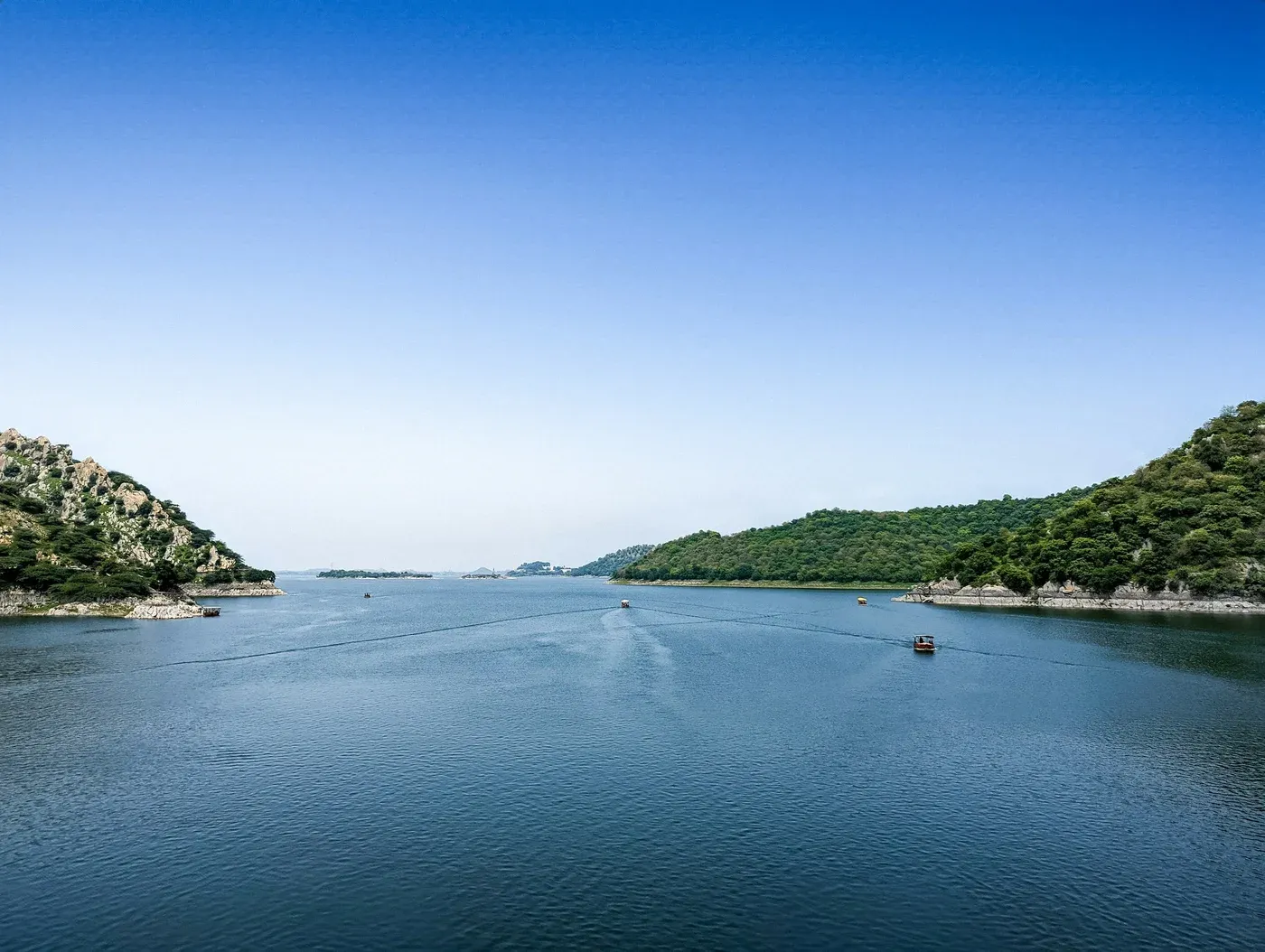
Jaisamand Lake between its green hills.
Photo: Rahul Upadhyay / Unsplash
The dam is the reason to go. Carved stone elephants with raised trunks line it near the water, beside a temple to Shiva and six chhatris (domed pavilions). Out on the lake, people of the Bhil Mina community live on one island, and another has a resort. On the shore are two small palaces, the Hawa Mahal and the Ruthi Rani ka Mahal.
Boats leave from the lake's jetty, and life jackets are compulsory. The Jaisamand Wildlife Sanctuary beside the lake runs jeep safaris, which you can book on the Rajasthan government's booking portal.
Rajsamand Lake
Rajsamand is at Kankroli, on the way to Nathdwara. Maharana Raj Singh I built it between 1662 and 1676, to give work and food to people in a famine. A 1908 gazetteer calls it "the oldest known famine relief work in Rajputana".
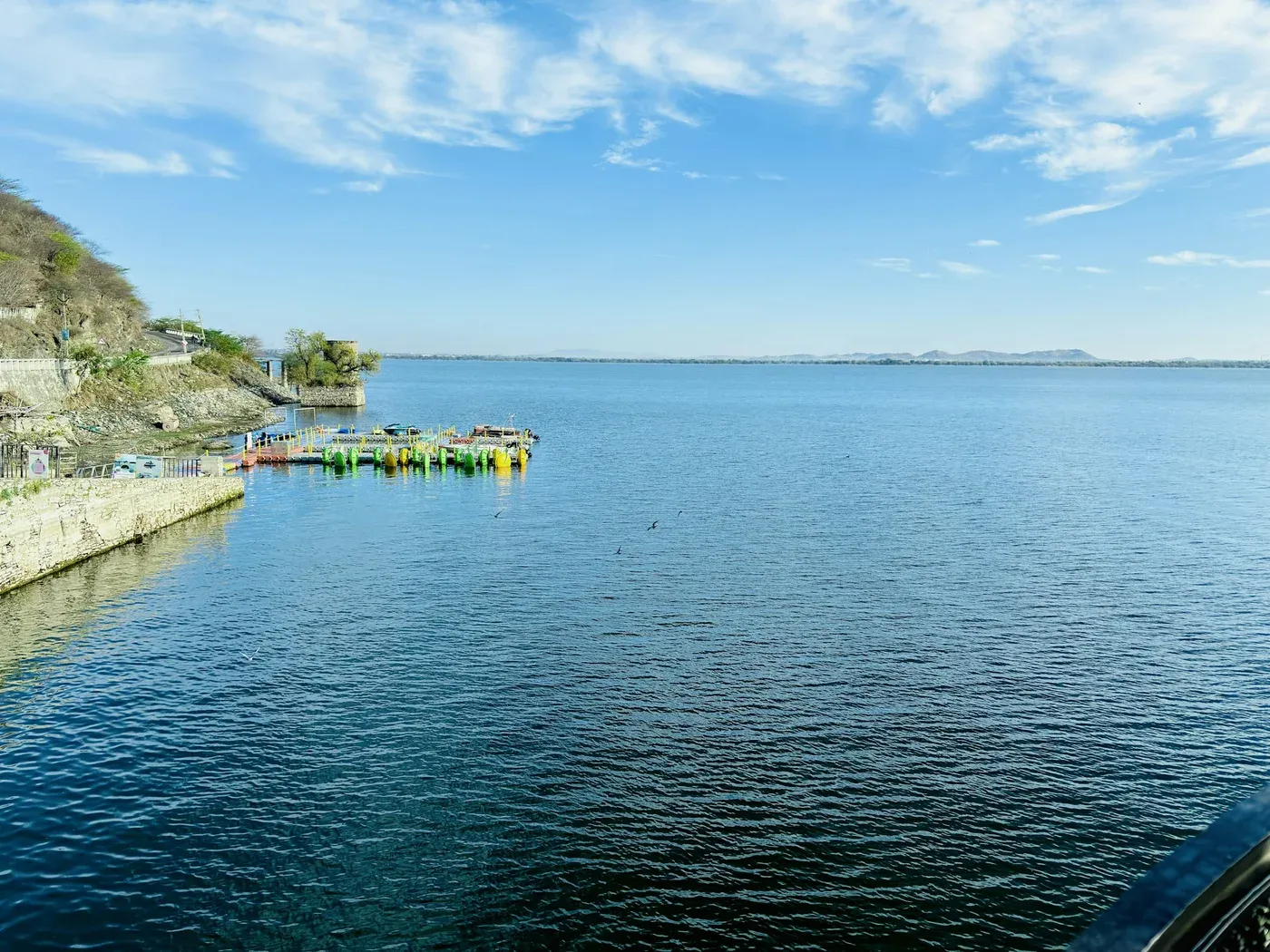
Rajsamand Lake from the ghats, with boats at the jetty.
Photo: Mandeep Singh / Unsplash
Its marble ghats are called the Nauchowki. Along them, 25 stone slabs carry the Raj Prashasti, a long Sanskrit poem by Ranchhod Bhatt on the history of Mewar's rulers. It also tells how the lake was built. Today the lake has water sports, such as speedboats, jet skis and banana rides. During the Second World War, the lake served as a seaplane base.
Udaipur lakes on foot, by auto and by car
Walk between the three old-city lakes, and take an auto or a cab to all the others. From Gangaur Ghat on Pichola, Swaroop Sagar is an 11-minute walk and Rang Sagar a 14-minute walk. Swaroop Sagar to Rang Sagar takes 12 minutes. On the way you cross the lake at Chand Pole, on the road bridge or on Daiji footbridge next to it.
Doodh Talai, Fateh Sagar and Badi Lake are too far to walk, so take an auto. The drive times are in the table above. For Udai Sagar, Jaisamand or Rajsamand, hire a car for the trip there and back.
Where to eat by the Udaipur lakes
Eat by the water on Pichola, Rang Sagar and Fateh Sagar. These places are picks from our best restaurants in Udaipur guide.
On Lake Pichola, Jheel's Ginger Coffee Bar has a patio on the bank, so come for coffee as the sun goes down. Cafe Edelweiss, next to Gangaur Ghat, is the breakfast stop. For dinner with the City Palace lit up across the water, book Ambrai, Upre or Hari Garh, a short walk apart near Hanuman Ghat.
On Rang Sagar, Tribute looks over the lake's islands and bird colonies; order the laal maas. Khamma Ghani is a 4-minute walk away, and I'd go there for the food.
On Fateh Sagar, Jhumar and Raaj Bagh both look over the lake, and Raaj Bagh opens at 7:30 am for breakfast. In the evening, eat at the street stalls of Mumbaiya Bazaar, below.
At Badi Lake, stalls sell masala chai and Maggi to the sunrise crowd. For Udai Sagar, Goverdhan Sagar and the far lakes, eat in the old city before you go.
Fateh Sagar street food
For street food at Fateh Sagar, go to Mumbaiya Bazaar, also called Bombay Bazaar. This row of food stalls faces the lake, across the road at the Moti Magri end of the dam road. Locals come here for coffee in a kulhad (clay cup), served hot under creamy foam with chocolate syrup and chocolate powder on top.
Start at the chaat stalls. Try bhel (puffed rice tossed with chutney and onion) or sev puri (crisp puris with potato, chutney and thin fried noodles). Then take your coffee for a walk along the lake. The stalls make cold coffee too. The road beside the bazaar jams every evening, so get out of your auto at the dam and walk along the lake to the stalls.
Area: Fateh Sagar, across the road from the lake at the Moti Magri end of the dam road
Price: cheap; check the board at each stall
Order: kulhad coffee, cold coffee, bhel, sev puri
Things to do around the Udaipur lakes
Each lake has one or two things worth adding to your visit. Fees are for an Indian adult.
- Lake Pichola: the City Palace is an 8-minute walk from Gangaur Ghat. The Dharohar folk dance show at Bagore Ki Haveli, on the ghat, starts at 7 pm and costs ₹125.
- Doodh Talai: the Karni Mata ropeway goes up to the hilltop temple, and families ride the pedal boats and water balls.
- Fateh Sagar: the Neemach Mata ropeway, up to the hilltop temple of the goddess, costs ₹220 return and runs until 10 pm. Moti Magri has a light and sound show at 7:30 pm in winter, and Saheliyon Ki Bari and Shilpgram are a short ride away.
- Badi Lake: climb Bahubali Hill, about 15 minutes, for the view over the lake. Sajjangarh, the Monsoon Palace, on its hill near the lake, looks out over the lakes and the city; tickets stop at 5 pm.
- Jaisamand: book a jeep safari in the wildlife sanctuary beside the lake.
- Rajsamand: walk the Nauchowki ghats and try a speedboat or a jet ski.
Which Udaipur lake for whom
On a first trip, you need only two lakes: Pichola and Fateh Sagar. Add a third that fits who you are travelling with.
| You are | Go to | Why |
|---|---|---|
| A first-time visitor | Lake Pichola | The palaces, and the boat to Jag Mandir |
| A couple | Fateh Sagar at sunset, or a private City Palace boat (₹6,500 for up to 7 people) | From the dam road, the sun sets over at least 1.0 km of open water, from winter to summer |
| A family with young children | Doodh Talai, then Fateh Sagar | Pedal boats and the ropeway, then the boat to Nehru Garden |
| Parents over 60 | Fateh Sagar, and the Neemach Mata ropeway | A lakeside evening, and the ropeway instead of about 1,000 steps |
| A photographer | Badi Lake at sunrise; Gangaur Ghat at a winter sunset | Bahubali Hills at first light; in winter, about 1.6 km of lake between you and the setting sun |
| Looking for a quiet hour | Swaroop Sagar and Rang Sagar, or Udai Sagar | Few boats and fewer crowds |
| A history lover | Rajsamand or Jaisamand | A poem carved in stone, and carved elephants on a dam finished in 1691 |
Udaipur lakes by season and time of day
October to February is the best time: the lakes are full after the monsoon, and December days reach about 24°C. About 90% of Udaipur's rain falls from June to September, most of it in July and August, so that is when the lakes fill.
Time your visit to the light. In winter, from Gangaur Ghat, the sun sets over about 1.6 km of open lake; in June, over only about 200 m. On Fateh Sagar's dam road, the sun sets over 1.0 km to 1.8 km of water, from winter to summer.
| Month | Sunrise | Leave the old city by (for a Badi Lake sunrise) | Sunset |
|---|---|---|---|
| January | 7:21 am | 6:35 am | 6:08 pm |
| February | 7:10 am | 6:25 am | 6:30 pm |
| March | 6:46 am | 6:00 am | 6:45 pm |
| April | 6:14 am | 5:25 am | 6:58 pm |
| May | 5:52 am | 5:05 am | 7:12 pm |
| June | 5:45 am | 5:00 am | 7:26 pm |
| July | 5:55 am | 5:10 am | 7:28 pm |
| August | 6:09 am | 5:20 am | 7:12 pm |
| September | 6:20 am | 5:35 am | 6:42 pm |
| October | 6:32 am | 5:45 am | 6:11 pm |
| November | 6:50 am | 6:05 am | 5:50 pm |
| December | 7:11 am | 6:25 am | 5:50 pm |
Times are for the 15th of each month. The leave-by time allows the 30-minute drive to Badi Lake and the climb.
Avoid the middle of the day from April to June, when May afternoons reach about 37°C. Go out at sunrise or after 4 pm instead. The one exception is the City Palace boat, which runs only until 3 pm in summer, so take the 10 am boat.
If it rains, skip the boats. See the lakes from above on the Karni Mata ropeway, or from a lakeside café on Pichola.
Once you know your month, plan your Udaipur trip for your dates.
Boating rules and safety on the lakes
Do not swim in the lakes. Bathing with soap and washing clothes are banned in Pichola, Fateh Sagar, Goverdhan Sagar and Badi Lake. Pichola and Fateh Sagar also supply the city's drinking water.
Life jackets are compulsory on every boat, for adults too. Put yours on before the boat leaves the jetty, and keep children seated.
Keep some cash in small notes: Ambrai Ghat has charged a ₹10 entry fee. Carry a bottle of water, too.
The ghats are also places of prayer. At Gangaur Ghat and the other old ghats, respect the local customs and dress modestly.
One day of Udaipur's lakes
You can see five lakes in one winter day without rushing. This order fits the boat hours and the sunset:
- Sunrise at Badi Lake. Leave the old city 45 minutes before sunrise: by 6:05 am in mid-November and 6:25 am in mid-December. Have chai at the stalls and climb Bahubali Hill.
- Late morning on Pichola. Take the City Palace boat to Jag Mandir; in winter it runs from 10 am to 2 pm.
- A walk and lunch. Walk from Chand Pole along Swaroop Sagar to Rang Sagar, and eat at Tribute or Khamma Ghani.
- Sunset at Fateh Sagar. Take an auto, about 15 minutes. Ride the boat to Nehru Garden first, then walk the dam road as the sun goes down.
The total for this day is ₹1,005 in tickets for an Indian adult, on the latest published fares. That is ₹145 at Badi Lake, ₹600 for the City Palace boat with ₹50 palace entry, and ₹210 for the Nehru Garden boat. A foreign adult pays ₹1,620. Children pay less on both boats: ₹300 on the City Palace boat and ₹105 to Nehru Garden. If you drive yourself, add ₹330 for the car at Badi Lake.
Arriving at noon? Do steps 3 and 4 only: the old-city lakes after lunch, then Fateh Sagar for the sunset.
Like this day? Turn it into your own Udaipur plan, and move the stops to suit you.
More guides for your trip
Every boat, ghat and fare on Pichola is in our Lake Pichola boat ride guide. For the rest of the city, see Udaipur tourist places, and for trains and flights, how to reach Udaipur.
Walking times and road distances are from OpenStreetMap routing, from Jagdish Temple; drive times are Google Maps (no traffic); rain is Open-Meteo's 2016–2025 record. Dates and builders come from the 1908 gazetteers and official pages, and fares were checked on 23 November 2026.
Common questions
What is the name of the main lake in Udaipur?
What is Udai Sagar Lake?
How many lakes are there in Udaipur?
Why is Udaipur called the city of lakes?
Which is the biggest lake near Udaipur?
Are the lakes in Udaipur man-made?
Can you swim in the lakes of Udaipur?
Which lake is best for sunset in Udaipur?
Sources
- K. D. Erskine, A Gazetteer of the Udaipur State (1908), on the Internet Archive — who built Pichola, Fateh Sagar, Udai Sagar, Rajsamand and Jaisamand, and when; the dams
- Imperial Gazetteer of India, Vol. XXIV (1908), on the Internet Archive — Udaipur founded in about 1559; the Banjara tradition; the Connaught dam, 1889
- Gaurishankar Hirachand Ojha, Udaipur Rajya ka Itihas (1928, in Hindi), on the Internet Archive — the sadhu story; Dewali ka talab; the boat gate on the canal; the Raj Prashasti slabs
- Udaipur district administration: lakes (2010 copy) — Swaroop Sagar and Badi Lake builders; the Connaught Bund
- Central Pollution Control Board: study of Udaipur's lakes (2023) — how the lakes link, the gates, the sizes of the small lakes, the flow to Udai Sagar and the Ganga
- Incredible India (Ministry of Tourism): Fateh Sagar Lake — the three islands
- Incredible India: Badi Lake — Jiyan Sagar, named for Jana Devi
- Rajasthan Tourism: Udaipur — Udai Sagar's size; Doodh Talai's gardens; Moti Magri
- Rajasthan Tourism: Rajsamand — the Nauchowki, water sports, seaplanes in the Second World War
- HRH Group: boat charters — City Palace boat fares (2025–26) and times
- Rajasthan government booking portal — the Jaisamand Wildlife Sanctuary and its safaris
- Rudyard Kipling, From Sea to Sea, Vol. 1 (1900), on the Internet Archive — the Venice quote
- Open-Meteo: Historical Weather API — ten-year rain and temperature averages, 2016–2025 (weather data by Open-Meteo.com, CC BY 4.0)
Dreaming of Udaipur?
Let Travelsa build your perfect Udaipur itinerary in minutes.