Amer Fort Jaipur (11 km): Sheesh Mahal, Light and Sound Show, History
What changed
- — corrected the climb from Amer Fort to Jaigarh: over 100 metres, about half an hour on foot.
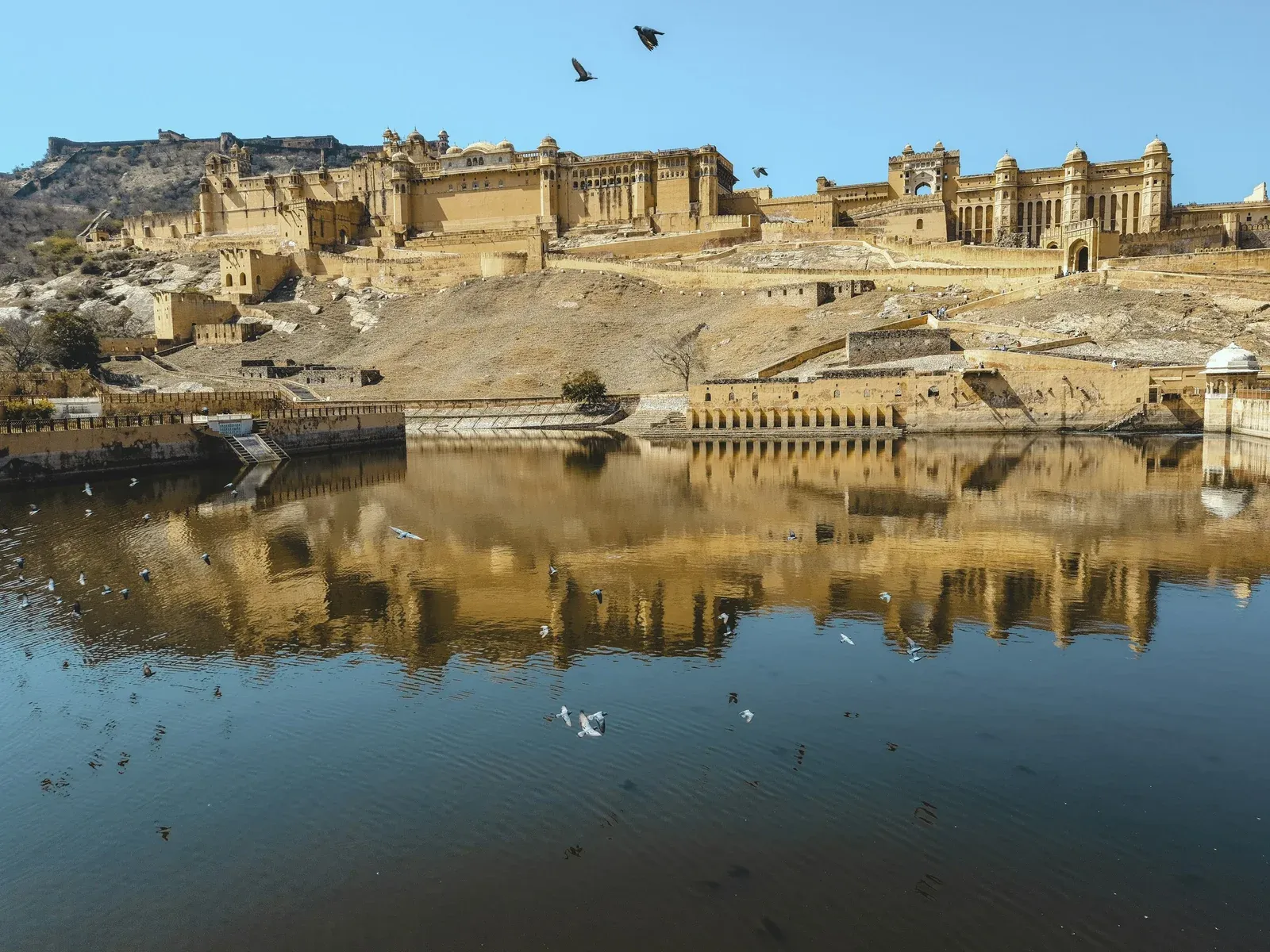
For about 7 centuries, the Kachhwaha kings held Amer, until they founded Jaipur in 1727. Their palace, Amer Fort or Amber Palace, is 11 km north of Jaipur Junction, about 35 minutes by road with no traffic. Walk up to Amer Fort from the lake at 8 am. In May, the fort already averages 36°C by 10 am.
In this guide
Amer Fort at a glance
Where: Amer, 11 km north of Jaipur Junction and 7.2 km from Hawa Mahal
Time needed: 3 hours, or half a day with Amer town
Best time: 8 am in any month; all day from November to February
Entry: ₹200 Indian adult · ₹100 Indian student · ₹1,000 foreign adult · free below 7 · the Jaipur composite ticket covers it (all Jaipur fees and timings)
Hours: opens 8 am (7 am under the 2026 summer order); official closing times differ, so reach the gate by 3 pm; closed on Dhulandi, the day of Holi colours
Free days: World Heritage Day (18 April), International Museum Day (18 May), World Tourism Day (27 September) and Rajasthan Diwas
Getting there: car or cab, or city bus 3A from Ajmeri Gate or Badi Chaupar
Built: mostly from the late 1500s to the early 1700s, by the Kachhwaha rulers of Amer
World Heritage: a UNESCO site since 2013, as one of the Hill Forts of Rajasthan
Access: steps on the walk up, and steps and ramps inside, steepest up to the Man Singh Mahal. Please ask at your stay and at the fort about steps and ramps. A car or jeep up to Chand Pol saves the climb
Amer Fort map and the 9 stops in walking order
You walk Amer Fort in one long line, from the lake up to the oldest palace at the top. The 9 stops below are in that order. Keep going past the Sheesh Mahal. The Man Singh Mahal at the far end is the oldest part, and the quietest.
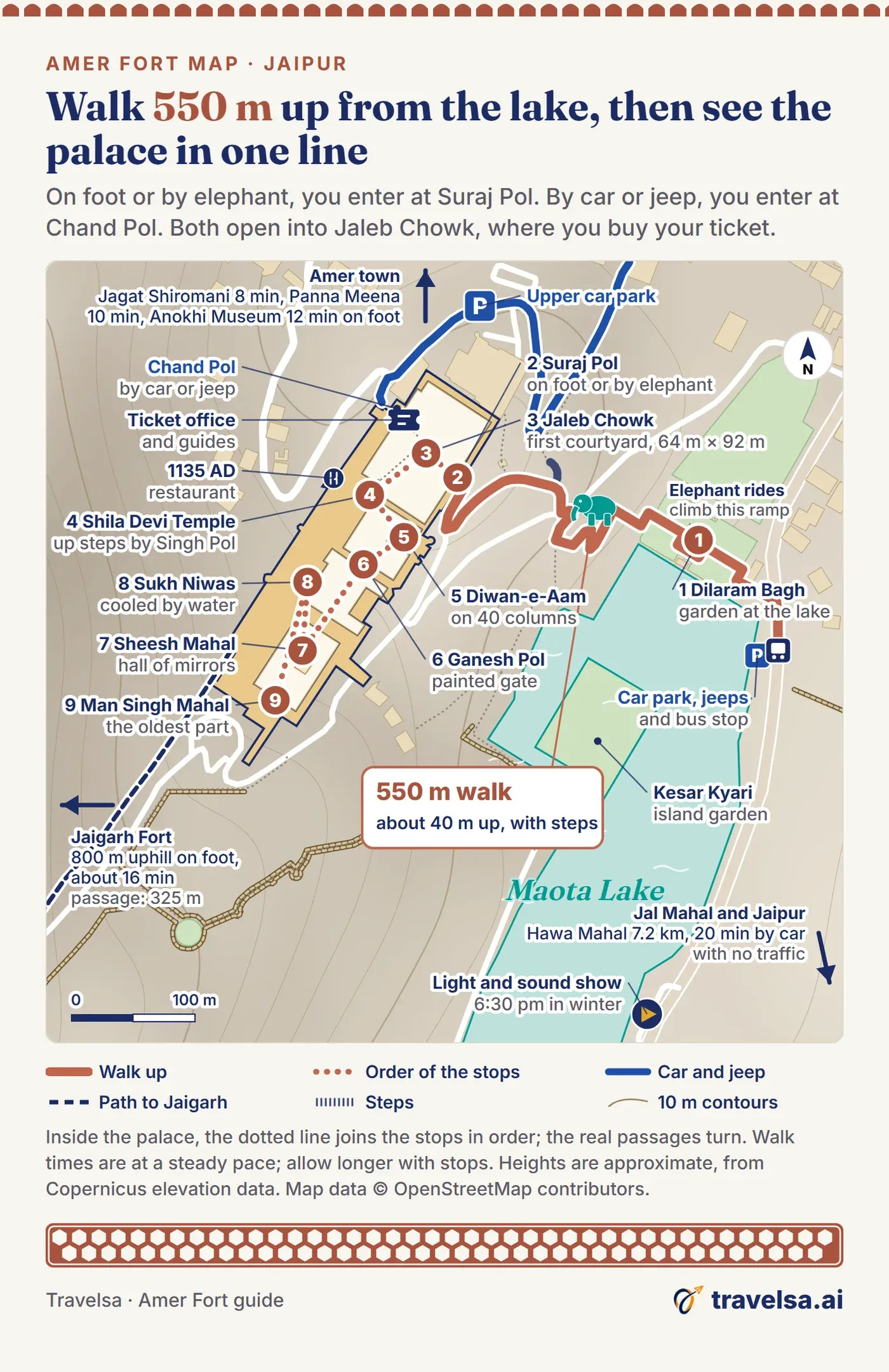
Amer Fort, stop by stop: the walk up, the car road, the ticket office and the 9 stops. Tap to enlarge.
| # | Stop | What it is | Built |
|---|---|---|---|
| 1 | Dilaram Bagh | Garden by Maota Lake at the foot of the hill; the path up starts here | 1664 (Mirza Raja Jai Singh I) |
| 2 | Suraj Pol | The Sun Gate: main gate on foot | 1622 to 1667, reworked 1699 to 1743 |
| 3 | Jaleb Chowk | First courtyard (64 m × 92 m) for parades and gatherings | 1622 to 1667, reworked 1699 to 1743 |
| 4 | Singh Pol and Shila Devi Temple | Painted gate and steps up to the royal family's temple | Temple in Raja Man Singh I's reign (1589 to 1614) |
| 5 | Diwan-e-Aam | Hall of public audience on 40 columns | 1622 to 1667 (Mirza Raja Jai Singh I) |
| 6 | Ganesh Pol | Painted gate into the private palace | 1622 to 1667, renovated 1699 to 1743 |
| 7 | Sheesh Mahal (Jai Mandir) | Mirror-work hall; Jas Mandir sits above it | 1622 to 1667 |
| 8 | Sukh Niwas | Hall facing the Sheesh Mahal; water ran over a marble slab to cool it | 1622 to 1667 |
| 9 | Man Singh Mahal | The oldest part of the main palace; later the queens' quarters (zenana) | 1589 to 1614 (Raja Man Singh I) |
The dates come from the fort's UNESCO file. Where a later ruler reworked a stop, both periods are given.
An Amer Fort morning, hour by hour
- 7:45 am: start up from Dilaram Bagh by the lake, about 550 m of path and steps.
- 8 am: buy your ticket in Jaleb Chowk, near Chand Pol, as the gate opens.
- 8:15 to about 11:15 am: walk the 9 stops in order, from Jaleb Chowk to the Man Singh Mahal.
- 11:15 am: walk down into Amer town for Panna Meena Ka Kund and the Anokhi Museum (closed on Mondays).
- 12:30 pm: lunch at The Stag Rooftop Cafe & Lounge, just outside the fort.
Want Amer in a full Jaipur day? Build your Jaipur plan on Travelsa, day by day.
Amer Fort history and who built it
The Kachhwaha Rajputs held Amer from the 11th century, and it was their capital by the early 1200s. It stayed their seat until Sawai Jai Singh II founded Jaipur in 1727. Most of the palace you walk through went up over about 150 years, from the late 1500s to the early 1700s. So Amer is centuries older than Jaipur.
Amer before the palace
Amer began as a Meena town. The UNESCO file records it as a thriving Meena settlement by 967 AD. It later passed to the Kachhwaha Rajputs, and Kakil Dev is believed to have laid the first fort walls in the 11th century. A 1908 gazetteer records a custom from those years. For some time after the Kachhwahas came to rule Amer, a member of the Meena community marked the tilak on each new ruler's forehead.
The UNESCO file says Raj Dev, who ruled from 1179 to 1216, moved the capital here from Khoh. Some historians give that move to Kakil Dev instead.
Nobody is certain where the name comes from. Some link it to Ambikeshwar, a name of Shiva, whose old temple stands in Amer town. Other stories link it to the goddess Amba. Amber and Amer are the same place, and the state tourism site says to say "Amer".
Who built Amer Fort
Palace building began in 1558, under Raja Bharmal, the UNESCO file says. In 1562, his daughter married the Mughal emperor Akbar. That alliance between Amer and the Mughals shaped the fort, and you see it in the Mughal-style halls and gardens inside a Rajput fort.
The state's tourism pages date the main palace to 1592, under Raja Man Singh I. Man Singh I, one of Akbar's top commanders, ruled from 1589 to 1614. His palace is the oldest part of the main palace still standing. You reach it last.
Mirza Raja Jai Singh I, who ruled from 1622 to 1667, planned the palace as it stands now. He built the Diwan-e-Aam, the Sheesh Mahal, the Sukh Niwas and the two gardens by the lake. You'll walk through every one of them.
A French traveller of the 1860s, Louis Rousselet, retold a local story about these halls. In it, the emperor Jahangir grew jealous of their beauty, so Jai Singh had the pillars plastered over. Treat it as a legend: Jahangir's reign ended in 1627, when Jai Singh was 16.
Sawai Jai Singh II reworked Suraj Pol and Chand Pol, the 2 main gates, and moved the court to his new city in the plains. Later rulers still came back to Amer for the 9 days of Navratri. The state made Amer a protected monument in 1968. Press reports put the visitors at about 2 million in 2023-24.
Amer Fort inside: what to see, stop by stop
Allow 3 hours inside, and wear shoes with grip. The floors are old stone, and some ramps are steep. You'll pass these stops in the order of the table.
Suraj Pol and Jaleb Chowk
You enter on foot through Suraj Pol, the Sun Gate, on the east side. By jeep or car, you come in through Chand Pol, the Moon Gate, on the opposite side. Both open into Jaleb Chowk, the first courtyard, 64 metres by 92 metres. The army once paraded here.
You buy your ticket at the office near Chand Pol, inside the courtyard, or online on the state's booking portal. The licensed guides wait by the office.
Shila Devi Temple
Shila Devi Temple is up a flight of steps to the right of Singh Pol, a painted gate off Jaleb Chowk. Shila Devi, also called Shila Mata, is the guardian goddess of the Jaipur royal family. Raja Man Singh I brought her image to Amer from Bengal, after his campaigns there. Bengali priests came with her to perform her rituals. Silver covers the temple doors.
For centuries, people came here for her blessing before a wedding or a long journey. Today, students still come before exams. Both Navratris, in spring and autumn, bring large crowds of devotees. If you visit then, go early and expect a long queue.
The state's temple department lists darshan from 6 am to noon and from 4 pm to 8 pm. The palace gate itself opens at 8 am. Timings can change on festival days.
Take off your shoes before the shrine, as at any Hindu temple. Cover your shoulders and knees as a courtesy, and ask the staff before you take photos inside.
Diwan-e-Aam
In the Diwan-e-Aam, the hall of public audience, the king met his people. Its roof rests on 40 columns. The outer pairs are red sandstone and the inner ones cream marble. Neither stone is from the Amer area, so bringing them in showed the king's wealth.
Walk to the far edge for your first wide view of Maota Lake and the island garden below. That garden is Kesar Kyari, once called Mohan Bari, after one of Jai Singh I's architects. Take your photos here.
Ganesh Pol
Ganesh Pol is the painted gate between the public courtyard and the king's private palace. Its frescoes are painted in natural colours. Look up at the screened room on top, the Suhag Mandir. From there, the royal women watched events in the Diwan-e-Aam without being seen.
Inside, the passage turns 2 corners before it opens out. That was a defence. An enemy who broke in could not charge straight through.
Sheesh Mahal at Amer Fort
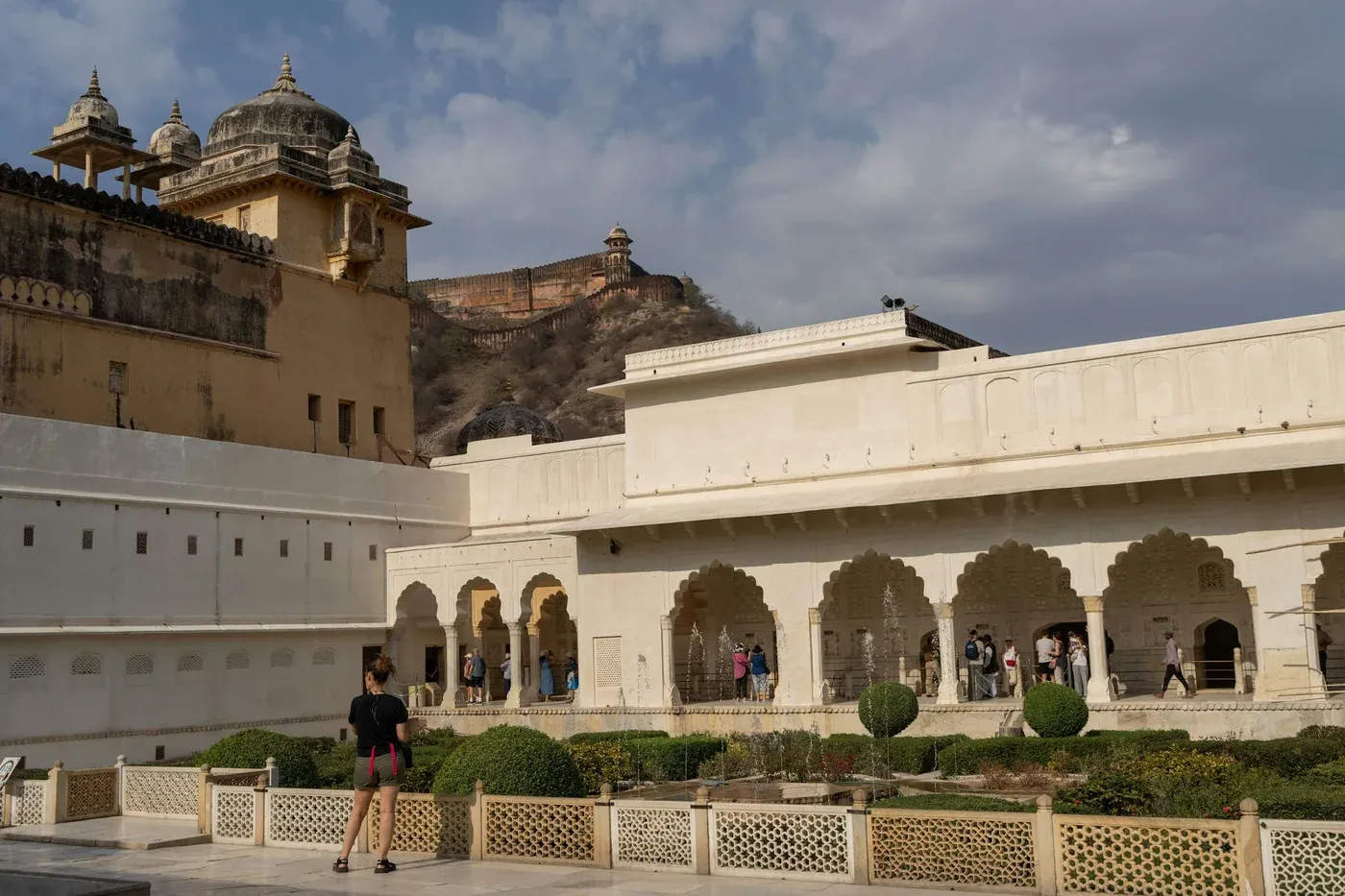
The Diwan-e-Khas court, between the Sheesh Mahal and Sukh Niwas.
Photo: Siddhesh Mangela / Unsplash
Where: stop 7, just past Ganesh Pol
Built: 1622 to 1667, under Mirza Raja Jai Singh I
Ticket: included in your Amer Fort ticket
Look for: the "magic flower" carving at the foot of a pillar
The Sheesh Mahal, also called Jai Mandir, is the hall of mirrors. Mirror work covers its walls, ceiling and columns. Parts of the hall may be roped off, so expect to look in from the edge rather than walk through.
The state's heritage records call this hall the Diwan-e-Khas, where the king met people in private. Upstairs, the Jas Mandir has marble screens that look out over the lake.
The mirrors were made to catch lamplight. Picture one flame showing in thousands of small mirrors across the walls and ceiling.
Guides point out the "magic flower" panel. Cover parts of it with your hands, and it seems to turn into different shapes. Ask a guard or your guide to show you.
Sukh Niwas and the Man Singh Mahal
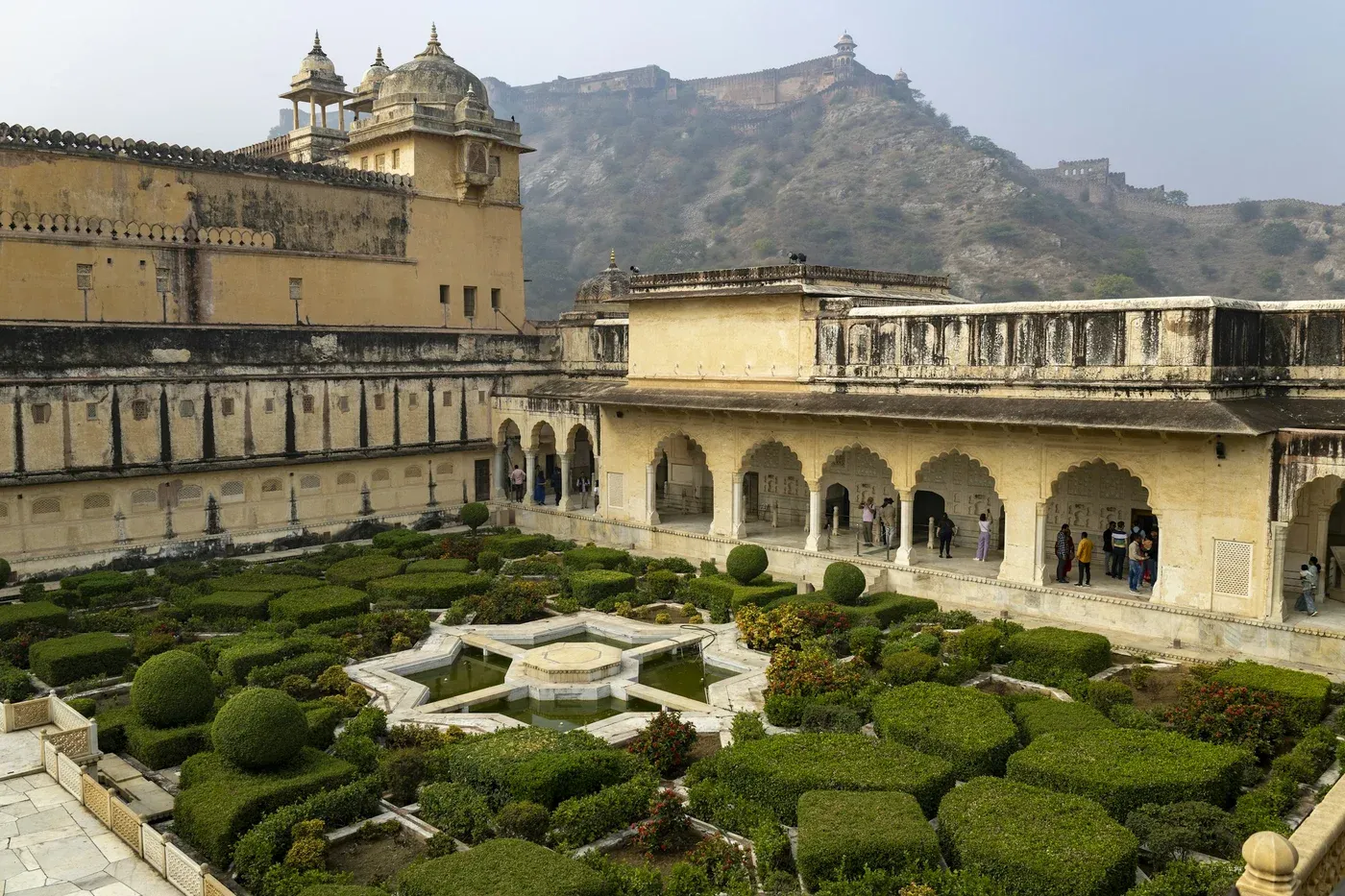
Sukh Niwas and its garden, with Jaigarh on the ridge above.
Photo: Martijn Vonk / Unsplash
Sukh Niwas, which some guides call the Sukh Mahal, faces the Sheesh Mahal across a garden. It was built to stay cool. Water ran down a pierced marble slab in its back wall and out along a marble channel into the garden. Its entrance door is sandalwood.
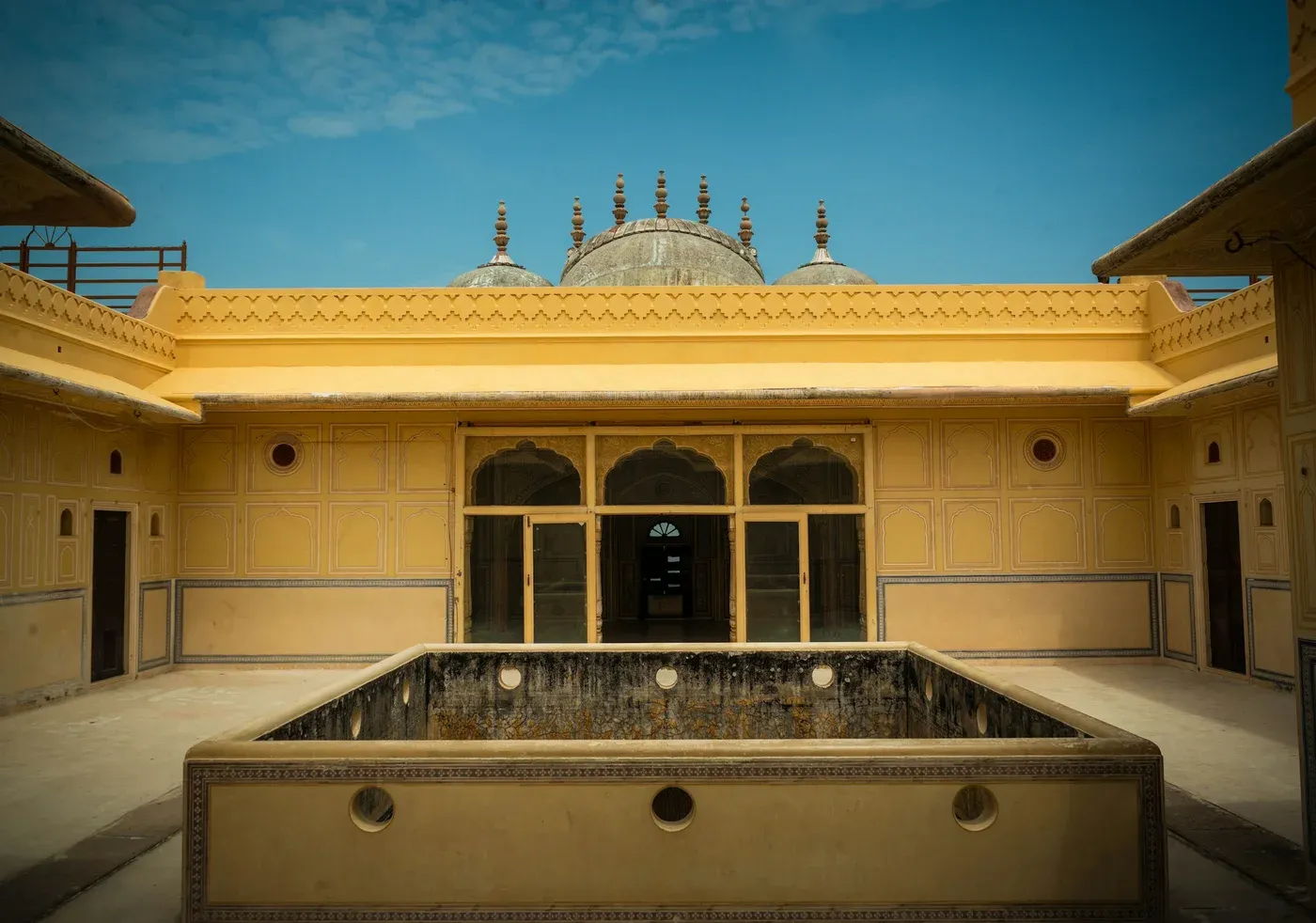
A courtyard inside Amer Fort.
Photo: Harsh Vardhan Yadav / Unsplash
You reach the Man Singh Mahal last, at the far end, up a winding ramp. Man Singh I built it as his own palace, and it is the oldest part of the main palace. Later, the queens lived here, in the zenana. Small courtyards, one for each queen, open off a main courtyard with a pillared pavilion, the baradari, at its centre. Look for what is left of the blue and yellow Persian tiles on the corner pavilions.
All the water came up from Maota Lake, in 3 stages. Animals hauled leather bags up the lower stages, and a Persian wheel with clay pots lifted it at the top. The middle stage alone has 4 lift houses, each 10 to 13 metres tall, which together raised the water about 45 metres. You can see the lift houses near Dhruv Pol, the gate that joins them to the Diwan-e-Khas court.
Amer Fort best time to visit, by the hour
Go at 8 am in any month. The whole day works only from November to February. Amer sits on a bare hill, and you spend most of the visit in open courtyards. Ten years of hourly weather data for the fort show how fast it heats up:
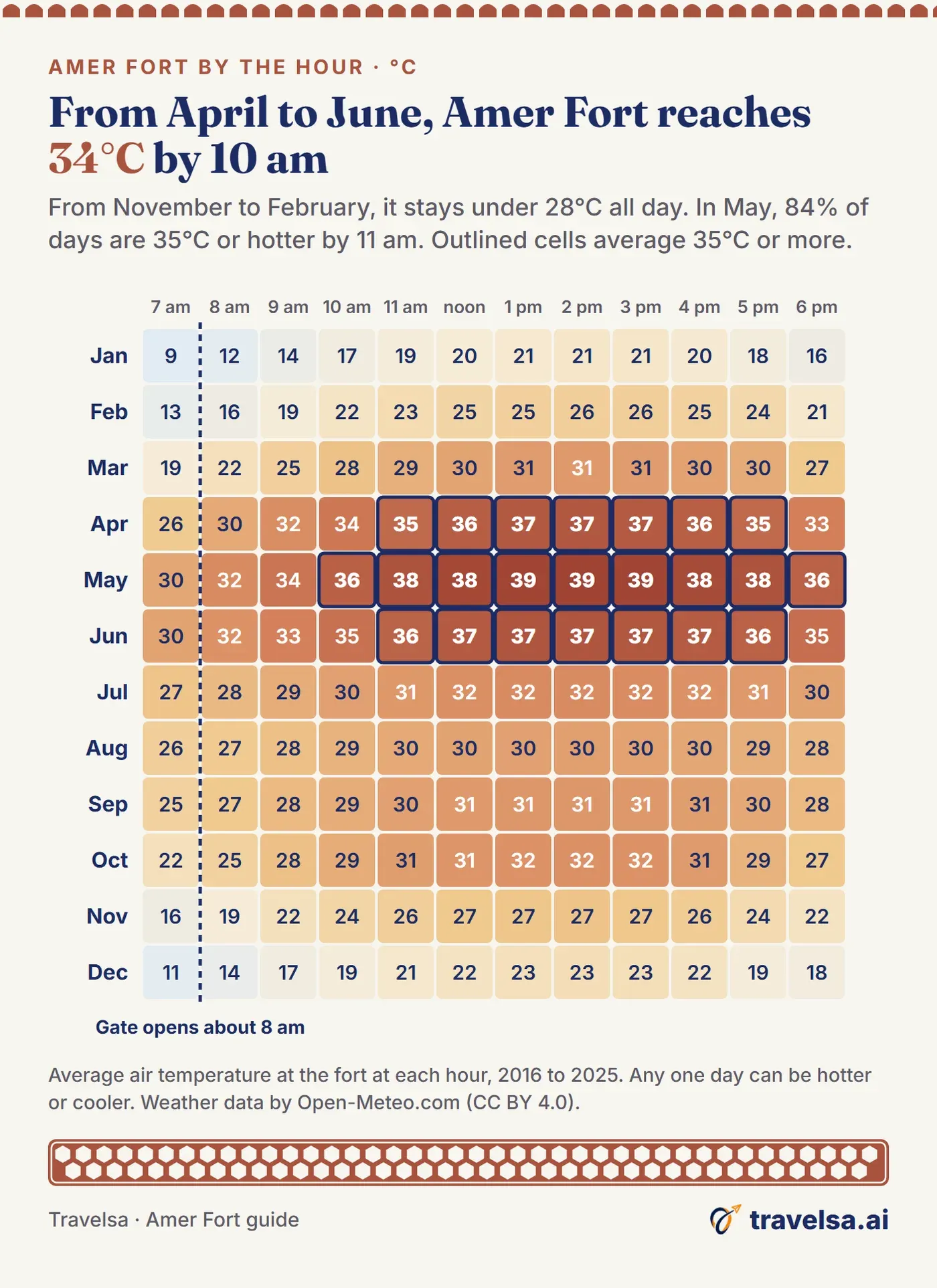
Amer Fort by the hour, 10-year averages. Tap to enlarge.
| Month | 7 am | 8 am | 9 am | 10 am | 11 am | Noon |
|---|---|---|---|---|---|---|
| January | 9°C | 12°C | 14°C | 17°C | 19°C | 20°C |
| February | 13°C | 16°C | 19°C | 22°C | 23°C | 25°C |
| March | 19°C | 22°C | 25°C | 28°C | 29°C | 30°C |
| April | 26°C | 30°C | 32°C | 34°C | 35°C | 36°C |
| May | 30°C | 32°C | 34°C | 36°C | 38°C | 38°C |
| June | 30°C | 32°C | 33°C | 35°C | 36°C | 37°C |
| July | 27°C | 28°C | 29°C | 30°C | 31°C | 32°C |
| August | 26°C | 27°C | 28°C | 29°C | 30°C | 30°C |
| September | 25°C | 27°C | 28°C | 29°C | 30°C | 31°C |
| October | 22°C | 25°C | 28°C | 29°C | 31°C | 31°C |
| November | 16°C | 19°C | 22°C | 24°C | 26°C | 27°C |
| December | 11°C | 14°C | 17°C | 19°C | 21°C | 22°C |
| Month | 1 pm | 2 pm | 3 pm | 4 pm | 5 pm | 6 pm | Days at 35°C or more at 2 pm |
|---|---|---|---|---|---|---|---|
| January | 21°C | 21°C | 21°C | 20°C | 18°C | 16°C | 0% |
| February | 25°C | 26°C | 26°C | 25°C | 24°C | 21°C | 0% |
| March | 31°C | 31°C | 31°C | 30°C | 30°C | 27°C | 18% |
| April | 37°C | 37°C | 37°C | 36°C | 35°C | 33°C | 79% |
| May | 39°C | 39°C | 39°C | 38°C | 38°C | 36°C | 88% |
| June | 37°C | 37°C | 37°C | 37°C | 36°C | 35°C | 71% |
| July | 32°C | 32°C | 32°C | 32°C | 31°C | 30°C | 14% |
| August | 30°C | 30°C | 30°C | 30°C | 29°C | 28°C | 1% |
| September | 31°C | 31°C | 31°C | 31°C | 30°C | 28°C | 7% |
| October | 32°C | 32°C | 32°C | 31°C | 29°C | 27°C | 8% |
| November | 27°C | 27°C | 27°C | 26°C | 24°C | 22°C | 0% |
| December | 23°C | 23°C | 23°C | 22°C | 19°C | 18°C | 0% |
Average temperature at Amer Fort at each hour, 2016 to 2025. The last column is the share of days that were 35°C or hotter at 2 pm.
In May, 84% of days are already at 35°C by 11 am. So start up from the lake just before 8 am, and be out of the open courtyards by 11.
December is the opposite. At 8 am it is 14°C, so carry a light jacket and take your time. You can even come after lunch. Landing at noon in winter? Reach Amer by 2 pm, see the fort, and stay on for the 6:30 pm English show.
In the rains, from July to September, take extra care on the stone ramps when they are wet.
Amer Fort's long face over Maota Lake looks east-south-east. So it is in sun in the morning, in shade by early afternoon, and backlit at sunset. In December and January, the low, warm light is still on the walls at the 8 am opening.
Arrive early for the crowds, too. Visitors report the crowds building from about 9:30 to 10 am, so the first hour is the calmest.
"Come early or late for the best light on the walls and significantly fewer tourists." (A traveller who visited Jaipur's 3 forts)
Picked your month? Plan your Jaipur days for those dates.
Jaipur to Amer Fort distance and how to reach
From Hawa Mahal, you drive 7.2 km to Amer Fort, about 20 minutes with no traffic. A car or cab is the easiest way. Agree the waiting time with your driver before you go up, because the visit takes 3 hours.
| From | Distance | Drive (no traffic) |
|---|---|---|
| Hawa Mahal (old city) | 7.2 km | 20 min |
| Jaipur Junction railway station | 11 km | 35 min |
| Sindhi Camp bus stand | 10 km | 30 min |
| Jaipur airport | 19 km | 50 min |
| Jal Mahal | 4.6 km | 15 min |
| Jaigarh Fort | 7.0 km | 20 min |
| Nahargarh Fort | 10 km | 25 min |
Drive times are Google Maps times with no traffic, rounded up. Your trip may take longer, depending on when you leave, traffic, road works, weather and stops.
The drive from your hotel depends on the area:
| Hotel area | Distance | Drive (no traffic) |
|---|---|---|
| Kukas (Delhi road resorts) | 9.2 km | 20 min |
| Old city (Pink City) | 8.5 km | 25 min |
| Bani Park and the railway station | 11 km | 35 min |
| Rambagh | 12 km | 35 min |
| C-Scheme | 13 km | 35 min |
| Malviya Nagar and Jawahar Circle | 18 km | 50 min |
| Mansarovar | 22 km | 55 min |
Measured from the centre of each area, so add a few minutes for your own street.
From the airport, you'll drive 19 km, about 50 minutes. Plan your Jaipur arrival day with Amer in the first morning.
Amer Fort by city bus
City bus 3A runs to Amer every 20 minutes, says the city bus company's route list of August 2026. You can board at Ajmeri Gate or Badi Chaupar in the old city. From Jaipur Junction, the metro takes you 4 stops to Badi Chaupar for ₹15. The bus runs past Jal Mahal to Amer, and the state tourism site gives about 40 minutes for the ride.
Get off at the Amer Fort stop on the main road, beside Dilaram Bagh (also spelt Dalaram Bagh). From there, a path and steps climb about 550 m to Suraj Pol.
The metro does not go to Amer. Its old-city stop is Badi Chaupar, where you can take bus 3A or a cab. Our guide on how to reach Jaipur covers the metro from the railway station.
Amer Fort elephant ride, jeep or walk up
Walk up if you can. The path is short, and you see the lake best on foot. From Dilaram Bagh at the lake, a stone path and steps climb to Suraj Pol. From the road, the path is about 550 m long and climbs about 40 metres, roughly a 12-storey building. Visitors report 10 to 20 minutes for the walk up.
If you come by car or cab, your driver can take the road up to Chand Pol, the state tourism site says. If you come by bus or auto, a jeep from the car park at the bottom drives you up, with no climb. Jeeps have no official rate. 2 visitors in 2025 and 2026 paid about ₹650 for the jeep, up and back. Agree the price before you get in.
Elephant rides go from the base of the hill up to Suraj Pol. News reports in September 2025 put the fare at ₹2,500 a ride, and most rides finish by about 11 am. Animal-welfare groups have raised concerns about the rides. I'd take the jeep or walk instead.
Amer Fort to Jaigarh Fort on foot
Jaigarh Fort is on the hill above Amer, 800 m away on foot. The path climbs over 100 metres, so allow about half an hour with stops. By road, you go 7.0 km round the hill, about 20 minutes with no traffic.
A passage about 325 metres long links the 2 forts. The royal family could leave through it for Jaigarh, unseen, during an attack. Part of the passage has been restored and opened to visitors, so ask at the ticket office which part is open.
At Jaigarh, see Jaivana, the giant cannon on wheels cast in Jaigarh's own foundry. Jaivana sits about 175 metres above the Amer road. From up there, you look straight down into Amer Fort. Jaigarh needs its own ticket, or the City Palace combined ticket. Our ticket guide has the prices.
Amer Fort light and sound show
Where: at the foot of the fort, by Maota Lake
Length: about 55 minutes, in English first, then in Hindi
Ticket: ₹250 a person on BookMyShow, plus a ₹35.40 booking fee
Getting back: keep your car or cab waiting, because travel writers report app cabs are hard to find at the forts
The light and sound show runs every evening, and lights on the walls tell the story of Amer. These are the times on Rajasthan Tourism's page:
| Months | English show | Hindi show |
|---|---|---|
| October to February | 6:30 pm | 7:30 pm |
| March and April | 7:00 pm | 8:00 pm |
| May to September | 7:30 pm | 8:30 pm |
From 1 to 10 October, you get only one show, in English, at 8:30 pm.
The fort by day and the show at night come to ₹485.40 in all for one Indian adult. For an Indian couple, the total is ₹970.80. The voice is Amitabh Bachchan's, according to a 2021 report.
Be in your seat 15 minutes early. In April, June and July, the English show starts less than 10 minutes after sunset, while the sky is still light. In September, November and December, it starts in full dark, about an hour after sunset. So in the light months, the later Hindi show is the darker one.
My pick: see the fort in the morning and come back for the show on another evening. Doing both on one day keeps you at Amer from 8 am to about 7:30 pm.
Add the show to your Jaipur plan as an evening of its own.
Evening light at Maota Lake
At Maota Lake and Kesar Kyari, the sun drops behind the hills about an hour before sunset, in every month. For sunlit photos of the lake, come by mid-afternoon in winter and by about 5:30 pm in summer.
Official pages give different closing times for the palace itself. So check our Jaipur timings guide before you plan an evening inside. If you walk down after dark, carry a torch or use your phone light, because parts of the stairway are dim. Agree the return time with your driver before the show.
Amer town, Panna Meena Ka Kund and Jagat Shiromani
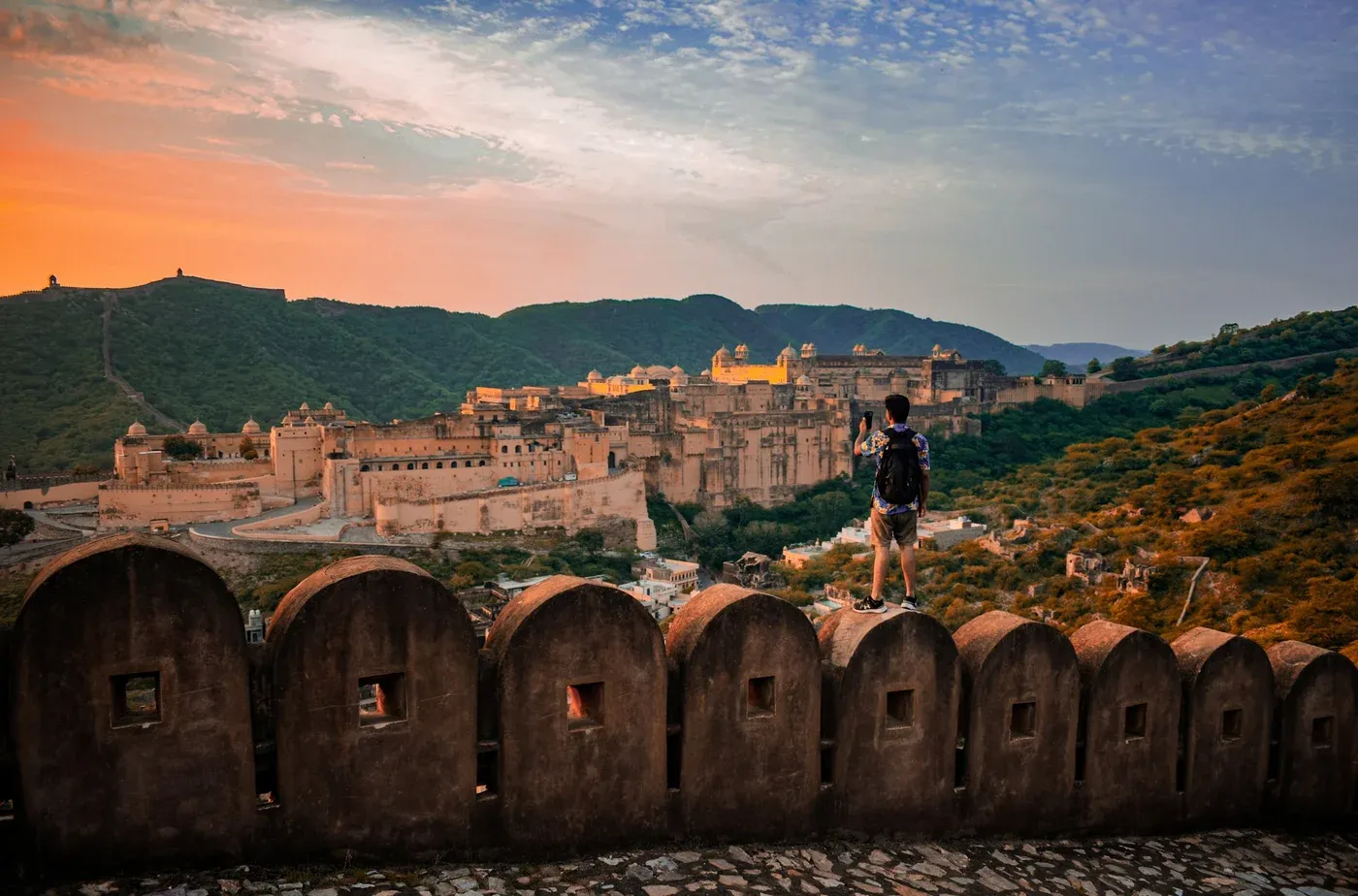
Amer Fort from the watchtower above Sagar lake.
Photo: Gaurav Sharma / Unsplash
Amer town lies below the fort, and its 3 best sights are 8 to 12 minutes on foot from Jaleb Chowk. Allow 1 to 2 extra hours after the fort, while the morning is still cool.
| From Jaleb Chowk to | Walk | Time on foot | Map |
|---|---|---|---|
| Jagat Shiromani Temple | 0.6 km | 8 min | Map |
| Panna Meena Ka Kund | 0.7 km | 10 min | Map |
| Anokhi Museum of Hand Printing | 0.9 km | 12 min | Map |
| Light and sound show (Kesar Kyari side) | 1.3 km | 17 min | - |
| Sagar lake | 1.5 km | 20 min | - |
Walking times on the town's lanes, from Jaleb Chowk.
Jagat Shiromani Temple
Built: about 1599 to 1608 · Idols: Krishna, Vishnu and Meera Bai
Jagat Shiromani Temple is the closest of the town's sights. Queen Kanakwati, a wife of Man Singh I, built it in memory of their son, Jagat Singh. The marble toran, the carved arch at the entrance, is cut from a single piece of stone. Meera Bai is remembered here as the poet-saint. Devotees believe this Krishna idol is the one Meera Bai worshipped in Mewar.
Ambikeshwar Mahadev Temple
Ambikeshwar Mahadev is the old Shiva temple in Amer town that many link to the town's name. Devotees revere its Shivling as swayambhu, self-manifested. It sits well below today's ground level, surrounded by water from an ancient underground source. In Sawan, the monsoon month, the water rises in the sanctum. Devotees come to see it as Shiva's natural jalabhishek, the sacred bathing of the Shivling.
Panna Meena Ka Kund
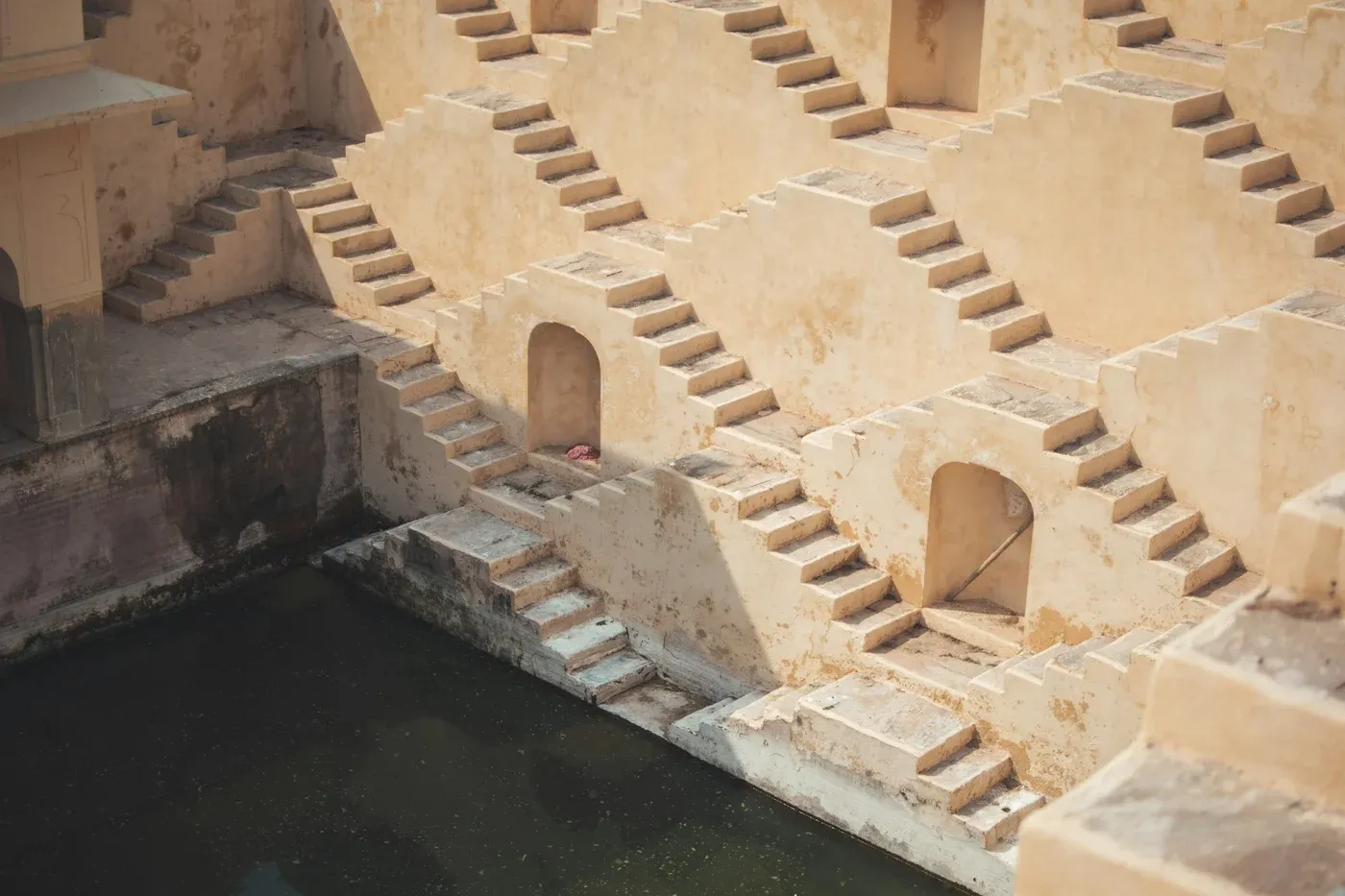
Panna Meena Ka Kund, 10 minutes on foot from Jaleb Chowk.
Photo: Damini / Unsplash
Entry: free · Tip: look from the top; a guard usually stops visitors from walking down the steps
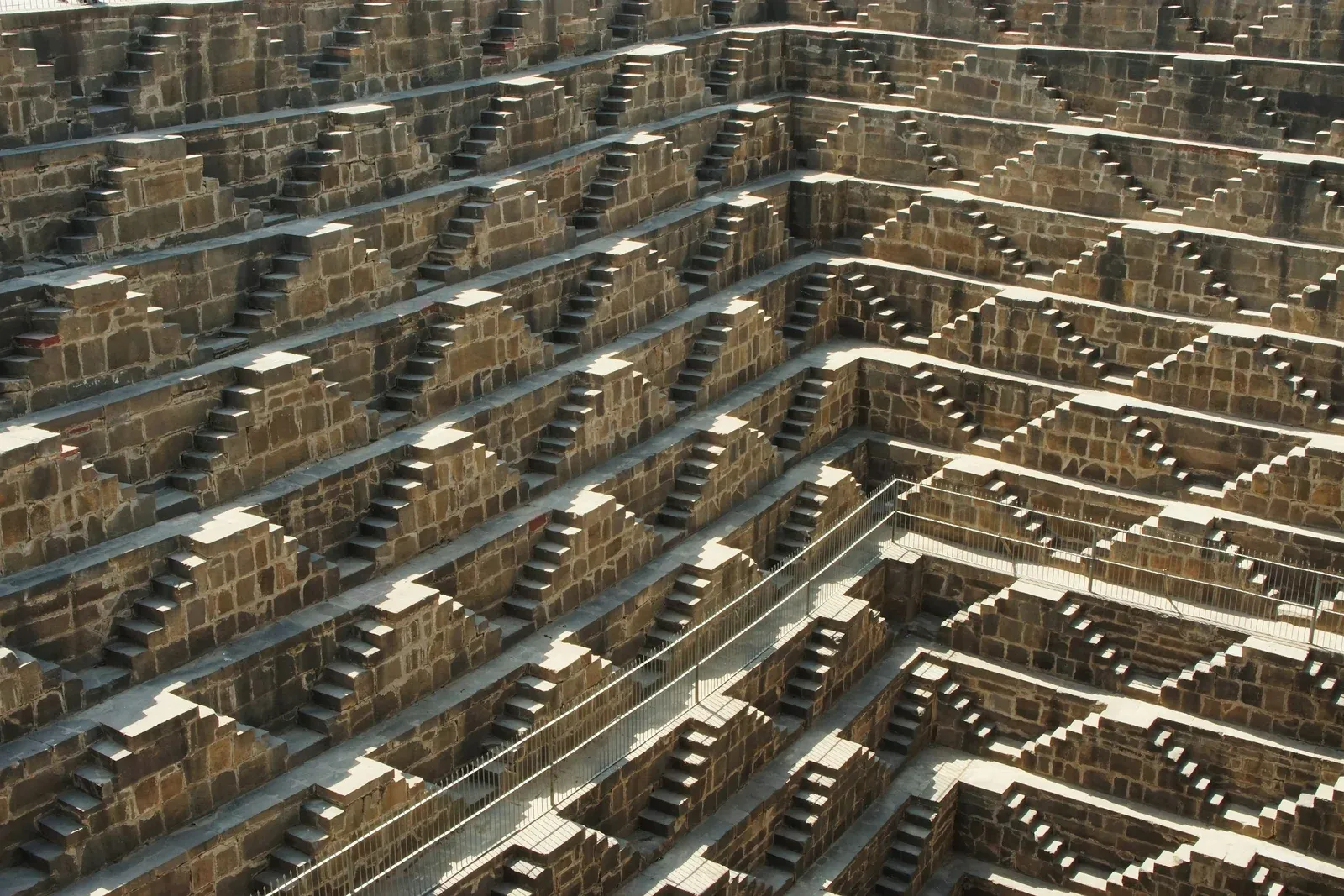
Panna Meena Ka Kund is a stepwell with zigzag steps, 10 minutes on foot from Jaleb Chowk.
Anokhi Museum of Hand Printing
Open: 10:30 am to 5 pm, Tuesday to Saturday; 11 am to 4:30 pm on Sunday
Closed: Mondays, and every year from 31 May to 15 July
The Anokhi Museum of Hand Printing is in a 16th-century haveli just past the stepwell. You'll see Jaipur's block printing, and the staff give a free tour when they can.
Turn the fort, the town and the old city into one day plan if you're doing Amer in the morning.
Amer Fort restaurants and food
1135 AD, a restaurant inside the fort near Jaleb Chowk, is my pick for a special Rajasthani dinner at Amer. Plan around 2 hours for it. For lunch after your morning at the fort, try The Stag Rooftop Cafe & Lounge, just outside it. It serves Rajasthani dishes, with a view of the fort.
Toilets are inside the palace, near Singh Pol. Carry water, because the courtyards have little shade. Watch for monkeys near food, and keep snacks in your bag.
Amer Fort with elders and small children
Elders can manage Amer Fort if you take the jeep to Chand Pol and skip the climb. Inside, you still meet steps, slopes and uneven stone floors. Please ask at your stay and at the fort about steps and ramps.
With small children, go at 8 am, and keep them close on the terraces and wall stairs, where there are few railings. Children below 7 enter free.
Guides at Amer Fort
You can see Amer Fort on your own, using the walking order on this page. Either way works.
A guide helps if you want the stories behind each room. Licensed guides wait at Jaleb Chowk by the ticket counter. No official rate is published, so agree the price and the length of the tour with your guide before you start walking. Ask to see the guide's licence card.
Amer Fort audio guide
On site: no audio-guide ticket is listed on the state's booking portal
Free app: Audio Odigos, from the Ministry of Tourism · English, Hindi, Japanese and Korean · works offline
The Ministry of Tourism named Amer Fort among the first 5 sites for its audio guide app in 2018. The app is free, but it was last updated in 2021, and its store page does not list its sites. So download it at your hotel and check that Amer Fort is on it before you rely on it.
Staff inside may offer to show you a closed room for a tip. You can say no and walk on.
More guides for your trip
- Places to visit in Jaipur, with distance and map: Hawa Mahal, City Palace and Nahargarh, by area.
- Jaipur composite ticket and Amer Fort ticket price: every fee, the timings and when the combined ticket saves money.
- Delhi to Jaipur by train, bus, car or flight.
Common questions
Who built Amer Fort?
Are Amer Fort and Amber Palace the same?
How much time do you need at Amer Fort?
What is the Jaipur to Amer Fort distance?
What is the best time to visit Amer Fort?
How much walking is there at Amer Fort?
Amer Fort or Nahargarh Fort: which should I see?
How far is Panna Meena Ka Kund from Amer Fort?
Sources
- UNESCO nomination file: Hill Forts of Rajasthan — Amber's history by phase (967 AD to 1968), each gate, courtyard and palace with its builder and dates, Jaleb Chowk's size, the 40 columns of the Diwan-e-Aam, the water lifts, the gardens, the 325-metre passage to Jaigarh (pages 2.203 to 2.241 and 2.329 to 2.331)
- UNESCO World Heritage List: Hill Forts of Rajasthan — Amber Palace and the Rajput-Mughal court style; the Amber Development and Management Authority (checked 19 Nov 2026)
- Rajasthan Tourism: Amber Palace — Suraj Pol on foot and Chand Pol by car, the 4 courtyards, part of the tunnels open to visitors, buses from Ajmeri Gate and MI Road in about 40 minutes (checked 19 Nov 2026)
- Rajasthan Tourism: Jaipur — "Amber (pronounced Amer)", the 1592 start under Man Singh I, the Jagat Shiromani Temple, its marble toran and its idols (checked 19 Nov 2026)
- Jaipur Metro fare notice — ₹15 from the Railway Station stop to Badi Chaupar (fares from 31 January 2025; checked 2026-11-19)
- Rajasthan Tourism: light and sound shows — Amber show times by season, and the English-only show from 1 to 10 October (checked 17 Nov 2026)
- Rajasthan Tourism: Jaipur (elephant rides) — Amber Palace from 8 am; most elephants finish their rides by about 11 am in season (checked 17 Nov 2026)
- Incredible India: Amber Fort — the 1592 start, the Sheesh Mahal's mirrors, the sandalwood door of Sukh Niwas (checked 19 Nov 2026)
- Rajasthan government booking portal — Amer Fort entry fees for Indian and foreign adults and students; free entry for children below 7 and on the 4 free days; the composite ticket covering Amer; the 7 am summer hours on the ticket card (checked 2026-11-17 and 2026-11-19)
- Rajasthan government booking portal: Amber Fort — opening at 8 am; closed on Dhulandi (checked 17 Nov 2026)
- Jaipur City Transport Services: present route list — route 3A via Ajmeri Gate, Badi Chaupar and Jal Mahal to Amber, every 20 minutes (list dated August 2026; checked 2026-11-19)
- Anokhi Museum of Hand Printing: opening times — hours, closed days and the yearly closure (checked 19 Nov 2026)
- Anokhi Museum of Hand Printing: getting there — just past Panna Meena Ka Kund; the free tour when staff are free (checked 19 Nov 2026)
- BookMyShow: Sound & Light Show, Amber Fort & Palace Complex — ₹250 a ticket plus a ₹35.40 booking fee; 55 minutes; English and Hindi (checked 19 Nov 2026)
- Backpack and Snorkel: Amber Fort walking tour — the ticket office near Chand Pol; elephants up to Suraj Pol; about 15 minutes' walk up (checked 19 Nov 2026)
- Google Maps — drive distances and times with no traffic, and the walk to Jaigarh (checked 17 Nov 2026)
- OpenStreetMap — the fort's plan for our map, the 550 m path and steps up from the lake, the Amer Fort bus stop by Dilaram Bagh, the toilets near Singh Pol, and walking routes in Amer town (checked 19 Nov 2026)
- Open-Meteo — hourly temperature at Amer Fort, 2016 to 2025, and heights of points on the climb (Copernicus elevation data); weather data by Open-Meteo.com, CC BY 4.0 (checked 19 Nov 2026)
- Rajasthan Devasthan Department: Shila Devi temple — Shila Mata; brought from Bengal by Raja Man Singh I; darshan 6 am to 12 pm and 4 pm to 8 pm; the Navratras (checked 19 Nov 2026)
- Imperial Gazetteer of India: Rajputana, 1908 (full text) — the Meena custom of marking the tilak of each new ruler of Amber (checked 19 Nov 2026)
Dreaming of Jaipur?
Let Travelsa build your perfect Jaipur itinerary in minutes.