Treks in Jaipur: 9 Trekking Places, Where Each Starts and When to Go
Of the treks in Jaipur, the best first one is Hathni Kund. It's 2.4 km there and back from Charan Mandir, on the hill road to Nahargarh Fort. For a fort at the top, walk up to Nahargarh from Purani Basti, or to Amagarh from Galta Gate. Trek from November to February, and start at sunrise.
In this guide
Treks in Jaipur at a glance
Jaipur's treks are short morning walks in the Aravalli hills. Most start within a 30-minute drive of Hawa Mahal, the Palace of Winds in the old city. Pick by the climb, not the length. Chulgiri is short but steep, and Hathni Kund is longer but easy.
| # | Trail, and where it starts | Length and climb (there and back) | Time there and back | Level |
|---|---|---|---|---|
| 1 | Hathni Kund, from Charan Mandir, on the Nahargarh hill road | 2.4 km; 65 m, mostly on the way back | 1 to 2 hours | Easy |
| 2 | Garh Ganesh Temple, from Gaitore ki Chhatriyan (Royal Gaitor), Brahmpuri | About 365 steps; about 65 m | About 1 hour | Easy to moderate |
| 3 | Nahargarh Fort on foot, from the foot of the cobbled path, Purani Basti | About 5 km; about 115 m | 1 to 2 hours | Moderate |
| 4 | Sun Temple and Galtaji, from Galta Gate | About 3 km; a short climb over the ridge | About 1 hour | Easy |
| 5 | Amagarh Fort, from Galta Gate | 8.2 km; 243 m | 2 to 3 hours | Moderate |
| 6 | Chulgiri Jain temple, from the foot of the steps, near the Ghat ki Guni tunnel | 1.4 km (over 400 steps); 144 m | 30 minutes to 1 hour | Moderate |
| 7 | Amer Fort to Jaigarh Fort, from Maota Lake, below Amer Fort | 6.1 km loop; 279 m | 2 to 2.5 hours | Moderate |
| 8 | Sagar, Kuntalgarh and Bhuteshwar Nath, from Kheri Gate, opposite the Anokhi Museum, Amer | About 6 km loop; hilly, along the old walls | 3 to 4 hours | Moderate |
| 9 | Kedarnath Shiv Mandir, from JNU (Jaipur National University) Road, Jagatpura | 3.2 km loop; 173 m | 3 to 4 hours with stops | Moderate |
Length, climb and time are for the whole walk, there and back, at a steady pace with short stops. The drive to each start is in the checklist section below. For a flat walk with no climb, see the Kishan Bagh dune walk after the treks.
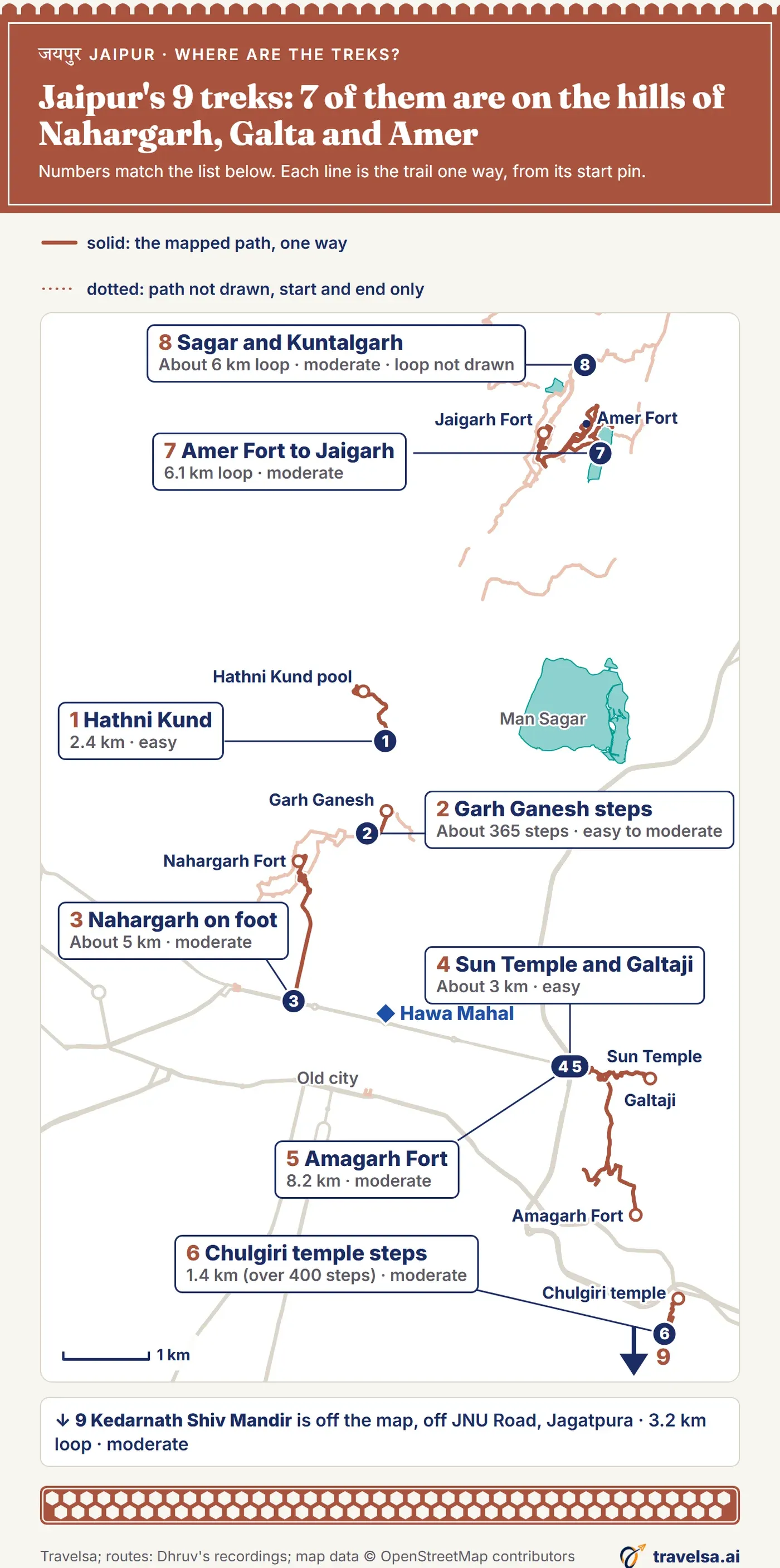
Where Jaipur's 9 treks are: 7 of them are on the hills of Nahargarh, Galta and Amer. Tap to enlarge.
Planning a Jaipur trip around a morning trek? Put the trek and the rest of your days into one plan on Travelsa.
Which Jaipur trek suits you
Choose by who's walking and what you want at the top.
- First trek, or with children: Hathni Kund. It's easy, and the pool at the end gives children something to walk to.
- Sunrise over the old city: the cobbled path to Nahargarh, or the Garh Ganesh steps.
- Temples on the way: Galta Gate to the Sun Temple and Galtaji, or the Chulgiri steps.
- A long morning with a fort at the end: Amagarh from Galta Gate, or the Kuntalgarh loop at Amer.
- Two forts on one walk: Amer to Jaigarh. Carry your fort tickets.
- Unmarked paths: go with a group that knows the way. Try the Jal Mahal viewpoint (3 to 4 hours), Kanak Ghati, or Ban ki Ghati (4 to 5 hours, the hardest).
- Elders, or anyone who finds steps hard: Kishan Bagh, which is flat. A road also reaches the Chulgiri temple, so you can drive up.
I'd start with Hathni Kund on a first visit. Then, once you know the hills, try Amagarh.
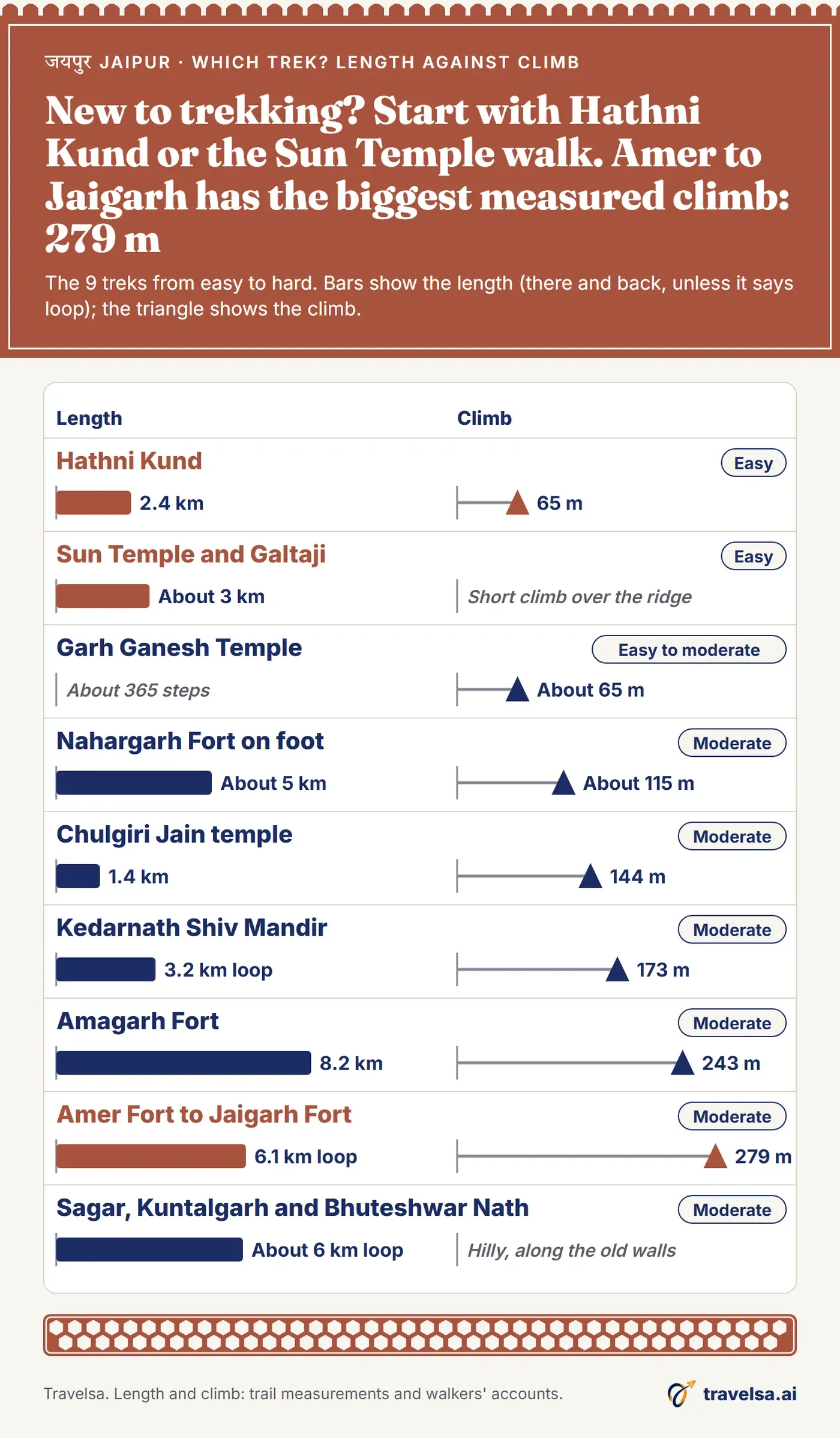
Which trek? Hathni Kund and the Sun Temple walk are easy first treks; Amer to Jaigarh has the biggest measured climb, 279 m. Tap to enlarge.
If you're new to hiking in Jaipur, join a local trekking club or walking group for your first walk. Several run guided walks on weekend mornings, from Charan Mandir to Hathni Kund and up to Chabutra. You meet other walkers, and someone knows the path.
Trekking in Jaipur by month and hour
Trek in Jaipur from November to February, and start at sunrise. That's the whole rule. From April to June the heat comes early: in May, 77% of mornings are already 30°C by 8 am. So in summer, pick a short trail and start at first light.
| Month | Sunrise | Sunset | 7 am | 11 am | What to do |
|---|---|---|---|---|---|
| January | 7:17 am | 5:54 pm | 9°C | 18°C | Best month: cold at dawn, so carry a jacket |
| February | 7:04 am | 6:18 pm | 12°C | 23°C | Best month: cold at dawn, so carry a jacket |
| March | 6:37 am | 6:35 pm | 19°C | 28°C | Good: start by 7 am and be back down by noon |
| April | 6:03 am | 6:51 pm | 26°C | 35°C | Too hot for long trails. Do a short one at sunrise, down by 8:30 am |
| May | 5:39 am | 7:07 pm | 29°C | 37°C | Too hot for long trails. Do a short one at sunrise, down by 7:30 am |
| June | 5:32 am | 7:22 pm | 29°C | 35°C | Too hot for long trails. Do a short one at sunrise, down by 7:30 am |
| July | 5:42 am | 7:23 pm | 26°C | 30°C | Monsoon: green and humid, and the rock gets slippery. Back down by 10 am |
| August | 5:58 am | 7:05 pm | 25°C | 29°C | Monsoon: green and humid, and the rock gets slippery. Back down by noon |
| September | 6:12 am | 6:32 pm | 24°C | 30°C | Good: start by 7 am and be back down by 11 am |
| October | 6:26 am | 5:59 pm | 22°C | 30°C | Good: start by 7 am and be back down by 11 am |
| November | 6:47 am | 5:37 pm | 16°C | 25°C | Best month: cool all morning |
| December | 7:08 am | 5:36 pm | 10°C | 20°C | Best month: cold at dawn, so carry a jacket |
Temperatures are 10-year averages for the hills around Nahargarh. A hilltop with no shade feels hotter than the number.
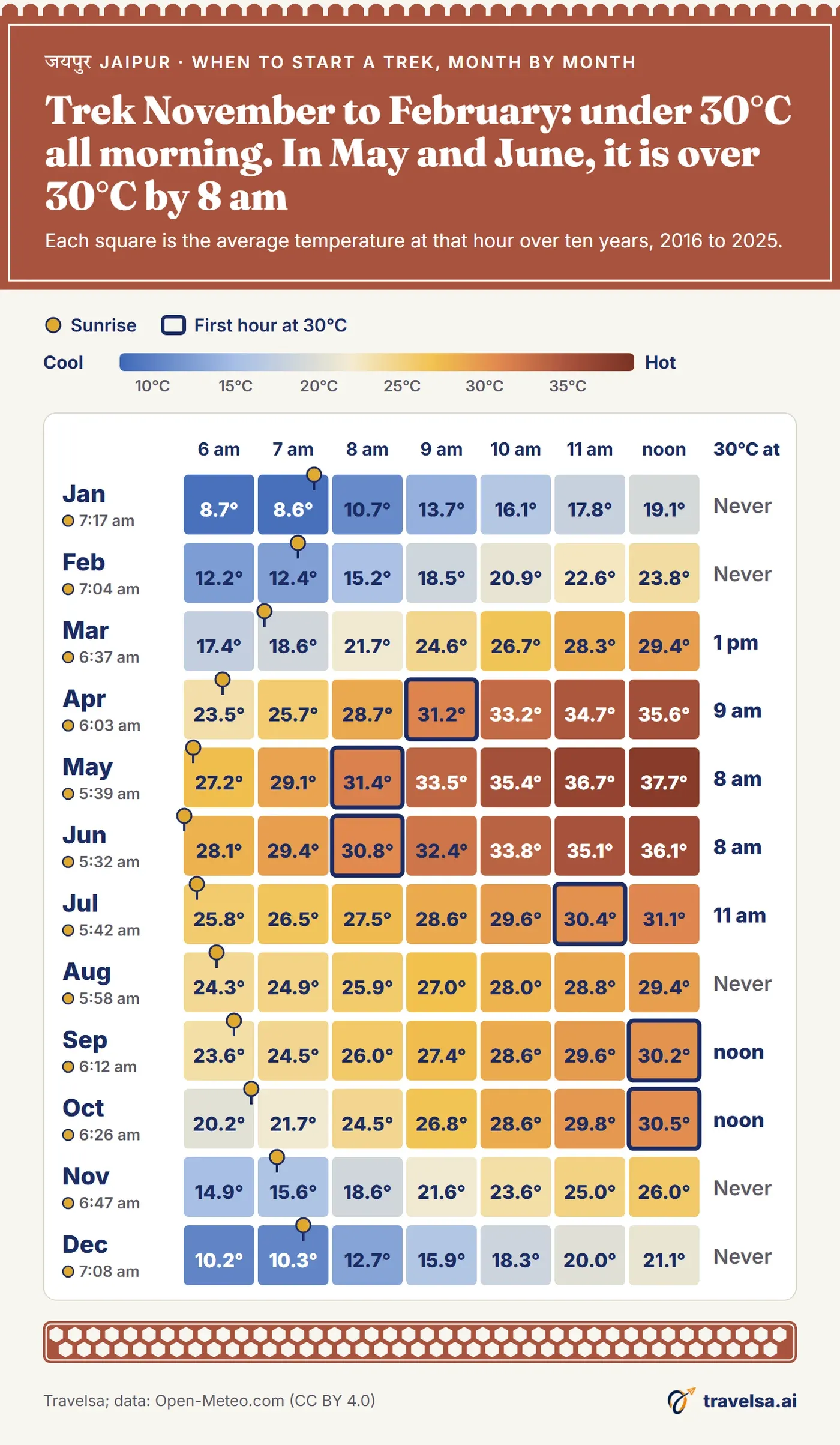
When to start: November to February stay under 30°C all morning; in May and June it is over 30°C by 8 am. Tap to enlarge.
December and January are the coldest mornings, about 9°C at 7 am in January. So carry a light jacket and take it off as you climb. The sun rises at 7:08 am in mid-December, so leave home by 6:30 am to reach a start point at first light.
If your mornings are full, the late afternoon works in winter too. Walk up the Nahargarh path or to the Sun Temple above Galta for the sunset, at 5:36 pm in mid-December, and come down before dark.
The monsoon months are the green ones, and the only time Hathni Kund's waterfall runs. They also make the rock slippery, so read the waterfall section before you go.
Picking your Jaipur dates? See which days suit a sunrise trek in your Travelsa plan.
Permits and tickets for Jaipur treks
You cannot buy a trekking ticket or permit for Jaipur's hill trails. The hills around Nahargarh and Amer are a wildlife sanctuary, and the forest behind Galta is a leopard reserve. So treat every trail as forest. Walk in daylight, go in a group, keep to the main path, play no music and carry your rubbish back down. If a sign or a forest guard closes a path, turn back.
The places at the ends of some trails sell their own tickets. Nahargarh Fort and the two forts at Amer charge entry if you go inside, and Kishan Bagh is a ticketed park. Galtaji and the Chulgiri temple have no entry ticket. At the temples, respect the local customs.
Jhalana, the safari forest on the city's edge, is the one forest you cannot walk on your own. You see it only on a jeep safari, which you book on the state's booking site. The Amagarh trail is different: local walkers use it every week. Our activities in Jaipur guide has the safari shifts.
The 9 treks in Jaipur, one by one
The trails are in the same order as the table.
1. Hathni Kund Jaipur trek from Charan Mandir
2.4 km there and back · about 65 m of climbing · 1 to 2 hours · easy · 30 minutes from Hawa Mahal
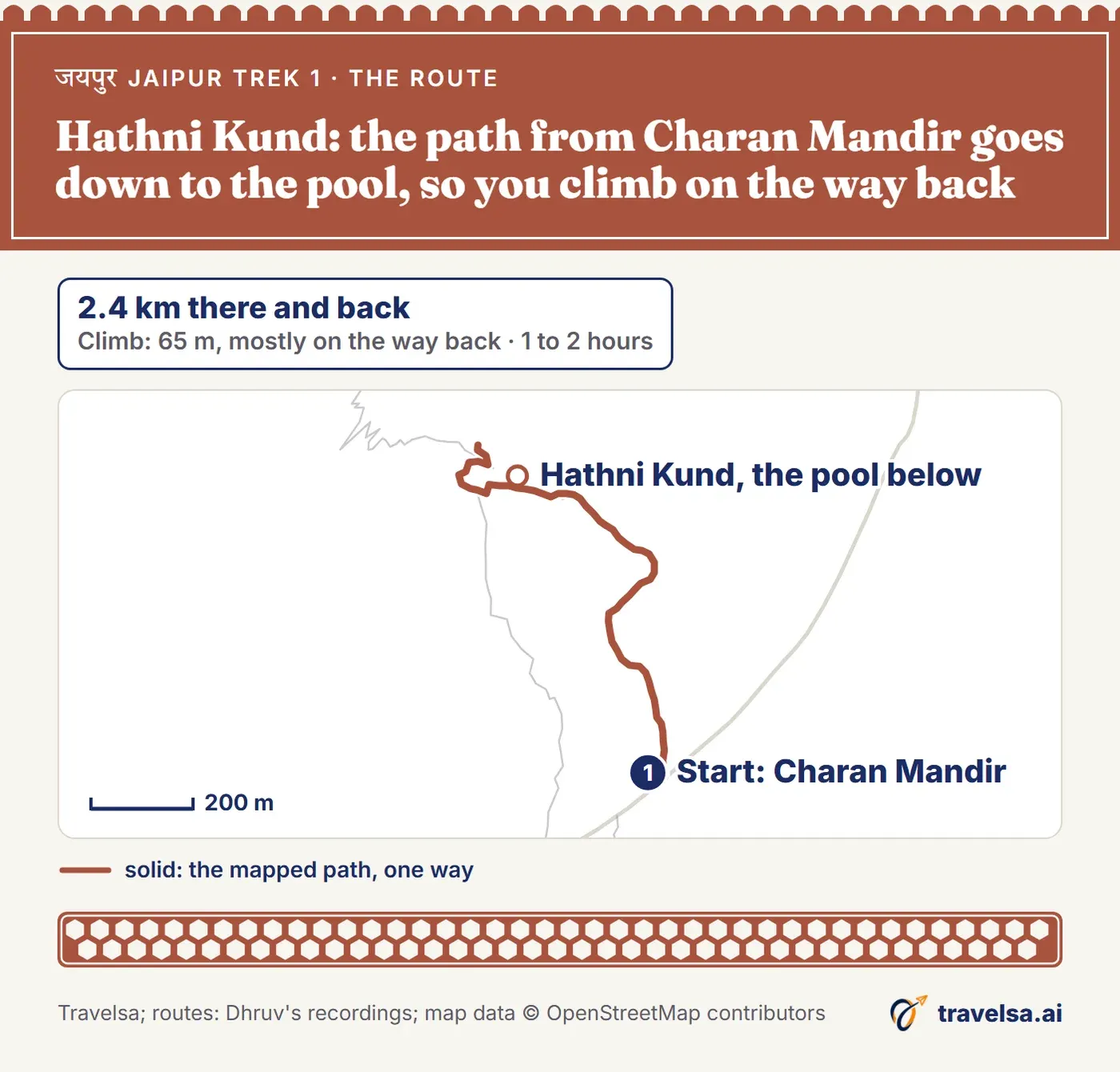
The Hathni Kund path from Charan Mandir down to the pool.
Hathni Kund is a rock pool in a narrow valley, fed by a waterfall that runs in the monsoon. Park in front of Charan Mandir, a hill temple on the road up to Nahargarh Fort, about 2 km before the fort. Take the forest path to the left of the temple. Partway along, you pass an old well: that well tells you you're on the right path. Then the path drops between big rocks into the valley.
Here's the surprise: the pool is about 48 m below the temple. So you walk down first, and most of the climbing comes on the way back. Keep some water and energy for the return.
Devotees come to Charan Mandir to worship what they believe are Lord Krishna's footprints. At the pool, a small Shiva temple is beside the waterfall. The Dravyavati, the river that runs through Jaipur, rises in these hills, and many locals say Hathni Kund is where it starts.
The route from Charan Mandir is open, and guided groups walk it most weekends. Charan Mandir is up a hill road, so come by app cab or a car with a driver, and ask the driver to wait. The gravel gets slippery, wet or dry, so wear shoes with grip. Start by 7 am on a monsoon Sunday, before the crowds reach the pool.
"As we reached early, there were not so many people at that moment." (A walker who came for the monsoon waterfall)
2. Garh Ganesh Temple steps from Gaitore
About 365 steps · about 65 m of climbing · about 1 hour there and back · 20 minutes from Hawa Mahal
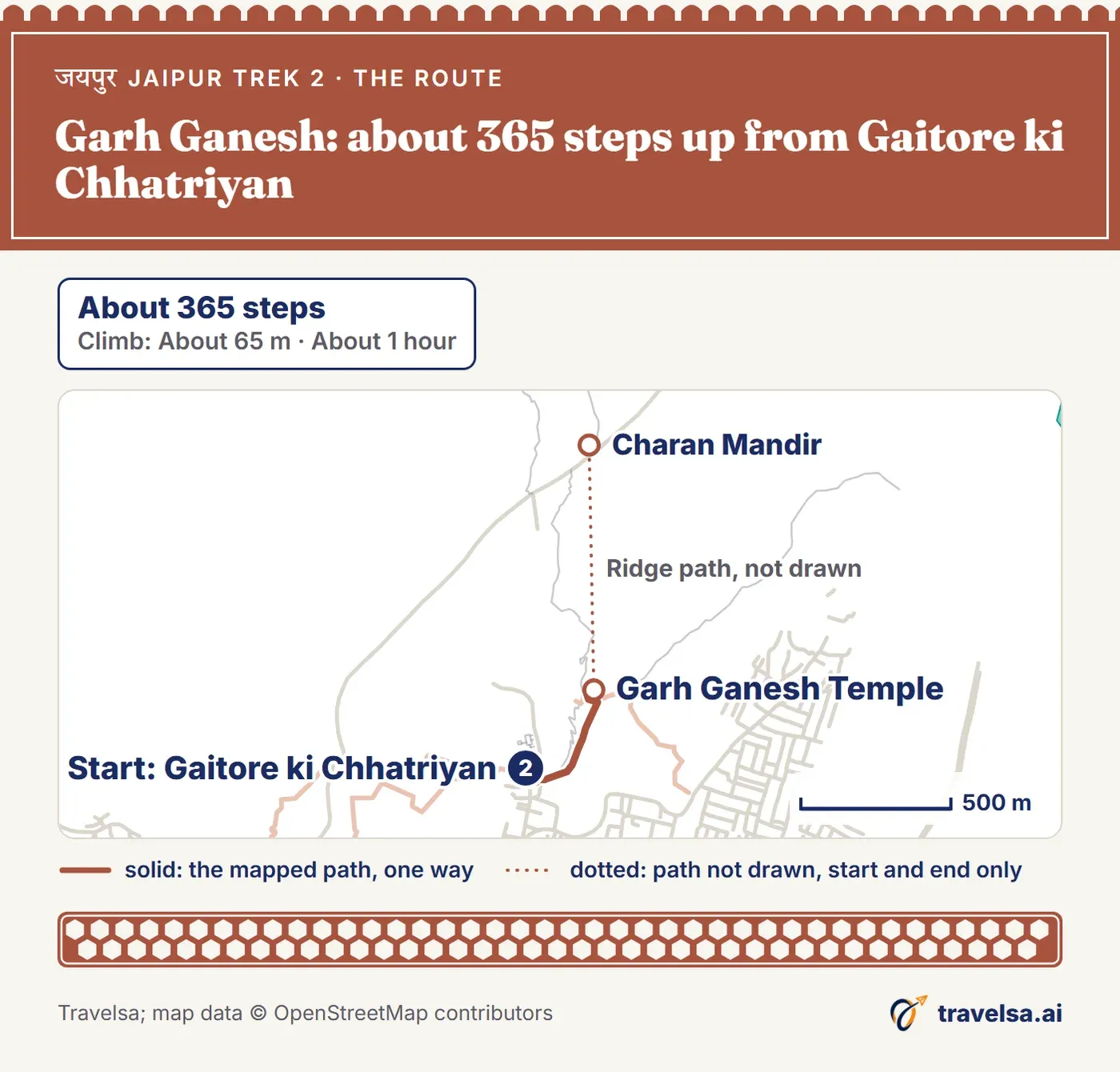
The Garh Ganesh steps from Gaitore ki Chhatriyan, and the ridge on to Charan Mandir.
Garh Ganesh is a Ganesh temple on the hill above Jaipur's old city. Its steps start at Gaitore ki Chhatriyan, the cenotaphs (domed memorials) of Jaipur's kings. You can park at the foot of the hill.
Sawai Jai Singh II, who founded Jaipur, built the temple in the 18th century. Devotees worship Ganesh here as a child, with no trunk, as the temple describes him. Wednesday is Ganesh's day, so it's the busy one, and Ganesh Chaturthi brings a five-day fair.
Walkers are on the steps from before sunrise, but the temple doors open at 7:30 am (6:30 am on Wednesdays). It closes at noon and opens again from 4 pm to 8:30 pm. Photos are not allowed inside.
After about 50 steps the path splits. The stairs go straight up to the temple, and a dirt trail climbs beside them. Cement benches along the stairs give you places to rest.
Two longer walks start here. Chabutra is a ruined stone platform on the hill above the temple, with a view of Nahargarh Fort and Jal Mahal. It takes about 2 to 3 hours there and back.
The ridge walk to Charan Mandir keeps going past the temple for 2 to 3 km, one way. A metal fence runs beside the path. You pass the Doordarshan (TV) tower, then cross the road to Charan Mandir and walk on to Hathni Kund if you like. Walk back the same way, or ask your driver to meet you at Charan Mandir.
"In simple words, I can say that the trek was simple and beautiful. Even you can plan with your family." (A walker on the Garh Ganesh to Charan Mandir ridge)
3. Nahargarh trek on the cobbled path from Purani Basti
About 5 km there and back · about 115 m of climbing · 1 to 2 hours · moderate · 10 minutes from Hawa Mahal
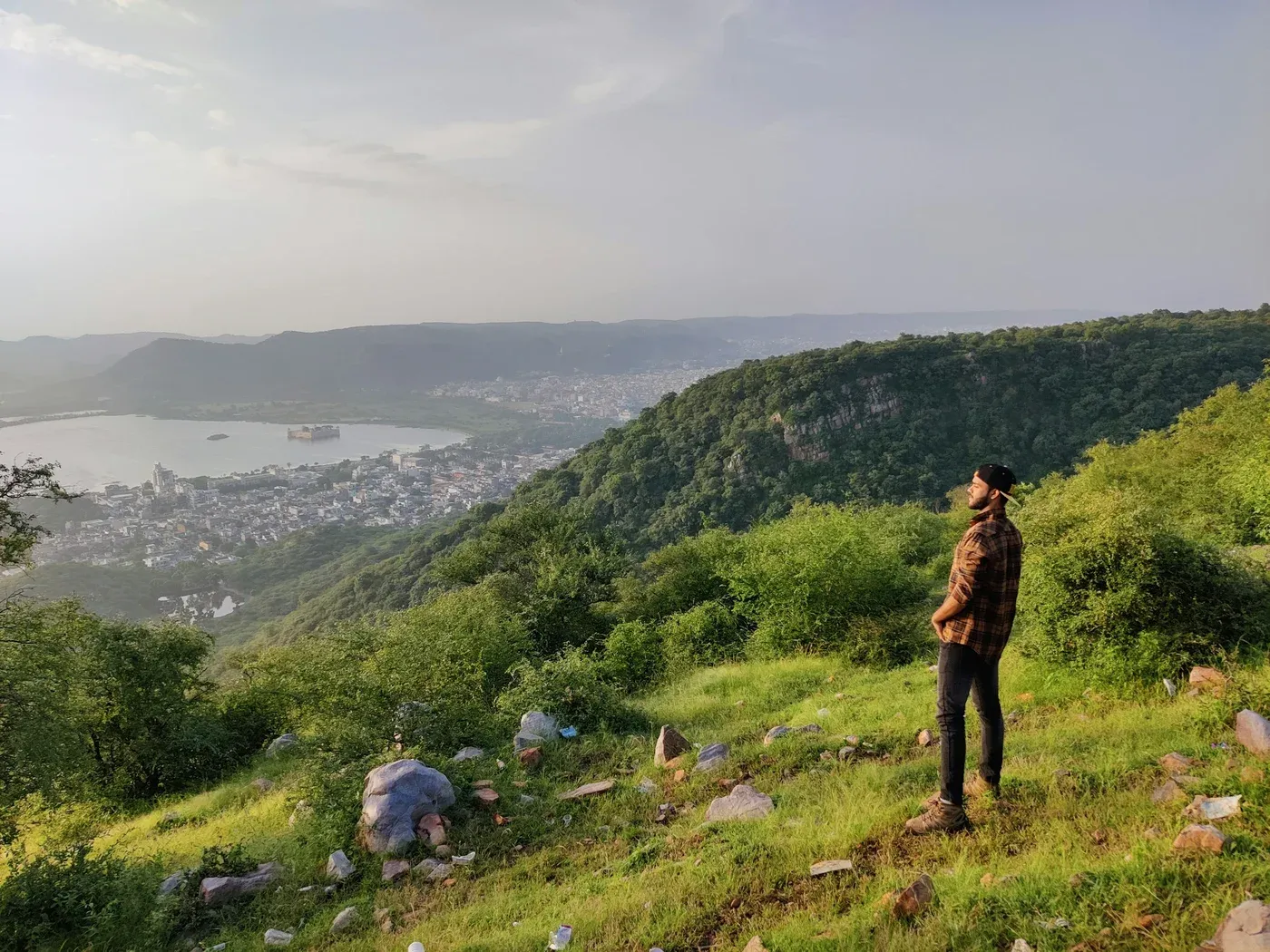
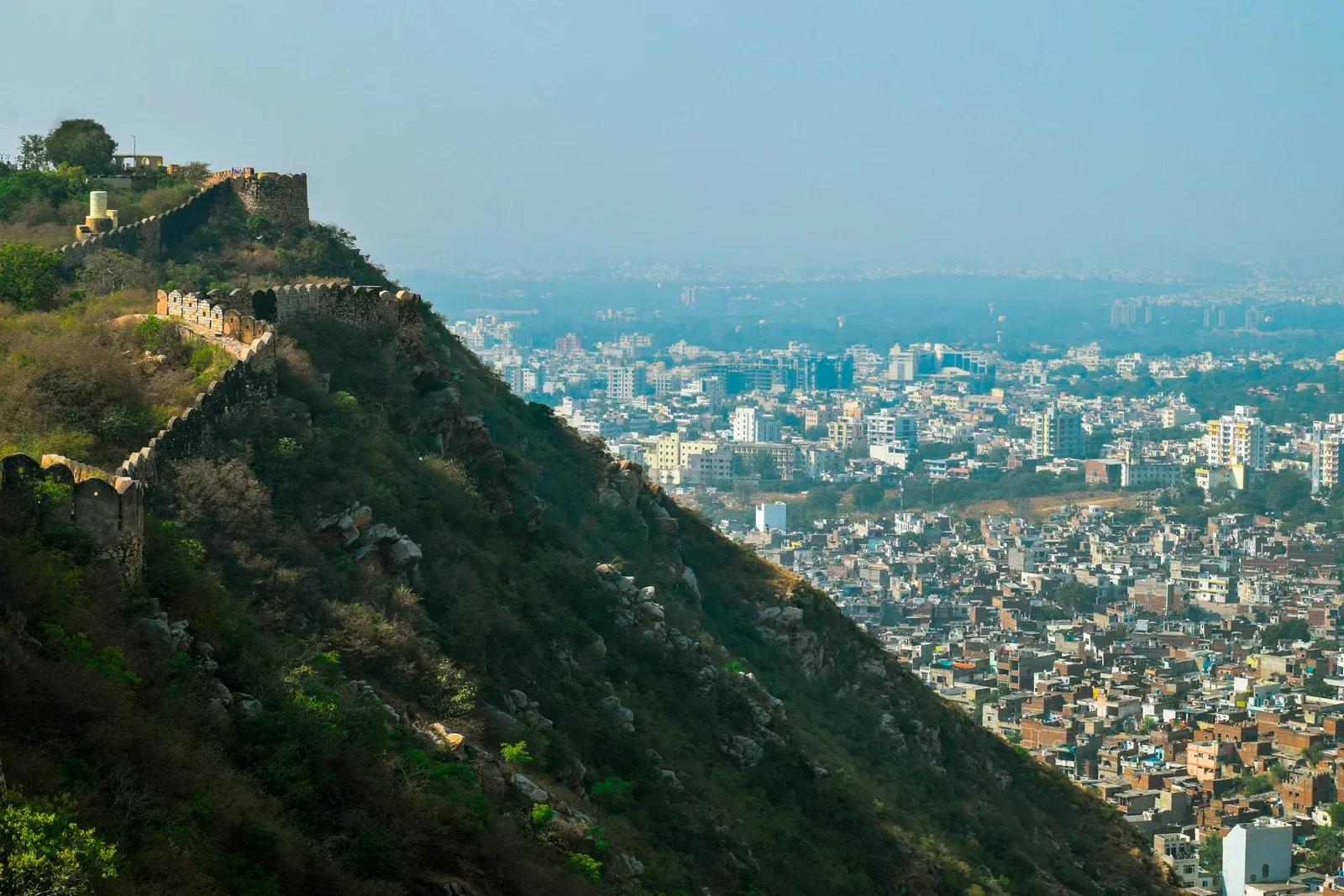
Morning on the hills along Nahargarh Road, with Man Sagar and the city below.
Photo: Yash Sharma / Unsplash
The old way up to Nahargarh Fort is a cobbled, zigzag path from Purani Basti, an old-city neighbourhood at the foot of the hill. It's the closest fort walk to the old city, and you can do it before breakfast. The path starts a 5-minute walk from Chhoti Chaupar metro station. Scooters and motorbikes use the path too, so keep to one side on the bends.
From the walls, the whole Pink City is at your feet. My pick for a first sunrise in Jaipur is this path, because you're on the walls within an hour of leaving the old city.
The fort opens at 10 am. So if you start at 7 am, you reach the walls long before the gates open, and the dawn walk is for the view. To go inside as well, start at about 9:30 am. Entry is ₹100 for an Indian adult and ₹600 for a foreign visitor. Fees and hours were checked on 24 November 2026 on the state's booking site, so confirm yours there before you go.
You can also keep walking past the fort, along the hill road to Charan Mandir and Hathni Kund. That turns the walk into a long morning, so ask a cab to meet you at Charan Mandir. For the fort itself, see our forts in Jaipur guide.
Want sunrise at Nahargarh in your plan? Add a dawn walk to your Jaipur days on Travelsa.
4. Galta Gate to the Sun Temple and Galtaji
About 3 km there and back · a short climb over the ridge · about 1 hour · easy · 10 minutes from Hawa Mahal
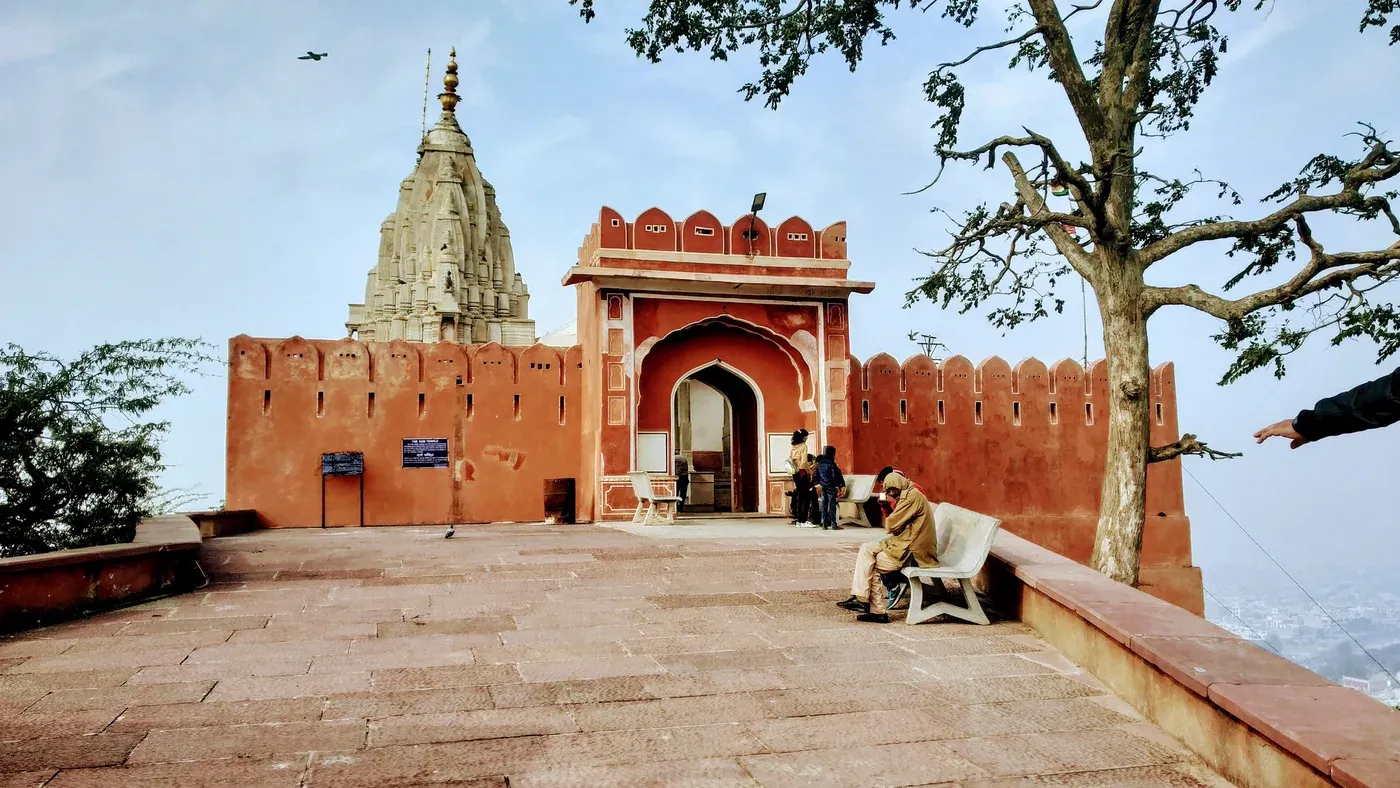
The Sun Temple on the hill above Galta, where the walk from Galta Gate tops out.
Photo: Shashank.sharma060, CC BY-SA 4.0, Wikimedia Commons
From Galta Gate, a paved path climbs the ridge to the Sun Temple (Surya Mandir) at the top. Then it drops down the other side to Galtaji, known to visitors as the Monkey Temple. About 15 minutes up, the path splits. Go right for the Sun Temple.
Galtaji is a pilgrim site in a narrow valley. The sage Galav meditated here. Pilgrims come to bathe in its 7 holy kunds (sacred bathing tanks), fed by springs said never to run dry. Diwan Kriparam, a courtier of Sawai Jai Singh II, built the temples, and the Sun Temple too.
Galtaji opens from 5 am to 9 pm. Makar Sankranti in January is its busiest day, so start early then.
Monkeys snatch food, so keep snacks inside your bag.
"This is a 30-minute, uphill walk, but it’s not too difficult." (A visitor who walked up from Galta Gate)
Galtaji has no entry ticket. If someone at the gate asks you for an "entry fee", it is not an official charge, so say no politely and walk on.
Two longer trails also start from Galta Gate. The Twin Towers are two old broadcast towers on the hills, about 8 km there and back. From the towers you get a view all round.
Chor Ghati starts behind the Galtaji temple and climbs to a broken fort with a view of Nahargarh and Garh Ganesh. Walkers lose this path at a fork about an hour in. Skip Chor Ghati on your first visit, or go with someone who has walked it.
5. Amagarh Fort trek from Galta Gate
8.2 km there and back · about 245 m of climbing · 2 to 3 hours · moderate · 10 minutes from Hawa Mahal
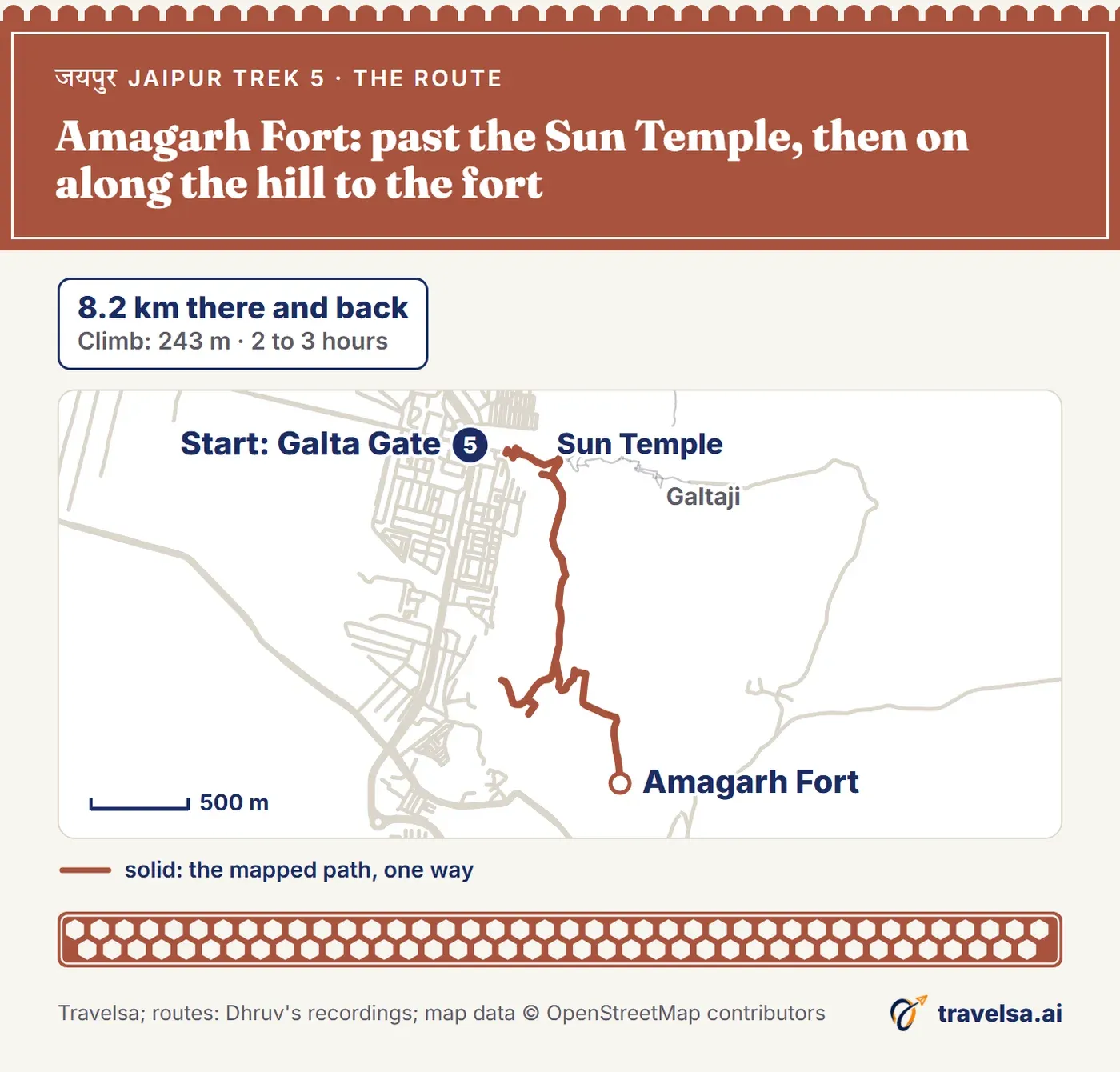
The Amagarh path from Galta Gate, past the Sun Temple, to the fort.
Amagarh is a small hill fort above Galta, and the walk there is long but easy to follow. My pick for a long morning is this one. Start at Galta Gate and take the path to the Sun Temple. About 2 km past the temple, the trail splits: left goes to the Twin Towers, and right goes to Amagarh. A short climb at the end brings you up to the fort.
The Meena community worships Amba Mata here as its family goddess, and the fort takes its name from her.
The Amagarh trail has no shops, so carry 2 litres of water each. This forest is part of the Jhalana-Amagarh leopard reserve, so walk in daylight and in a group. Our forts in Jaipur guide has the fort's story.
6. Chulgiri Jain temple steps
1.4 km there and back · over 400 steps · about 145 m of climbing · 30 minutes to 1 hour · moderate · 25 minutes from Hawa Mahal
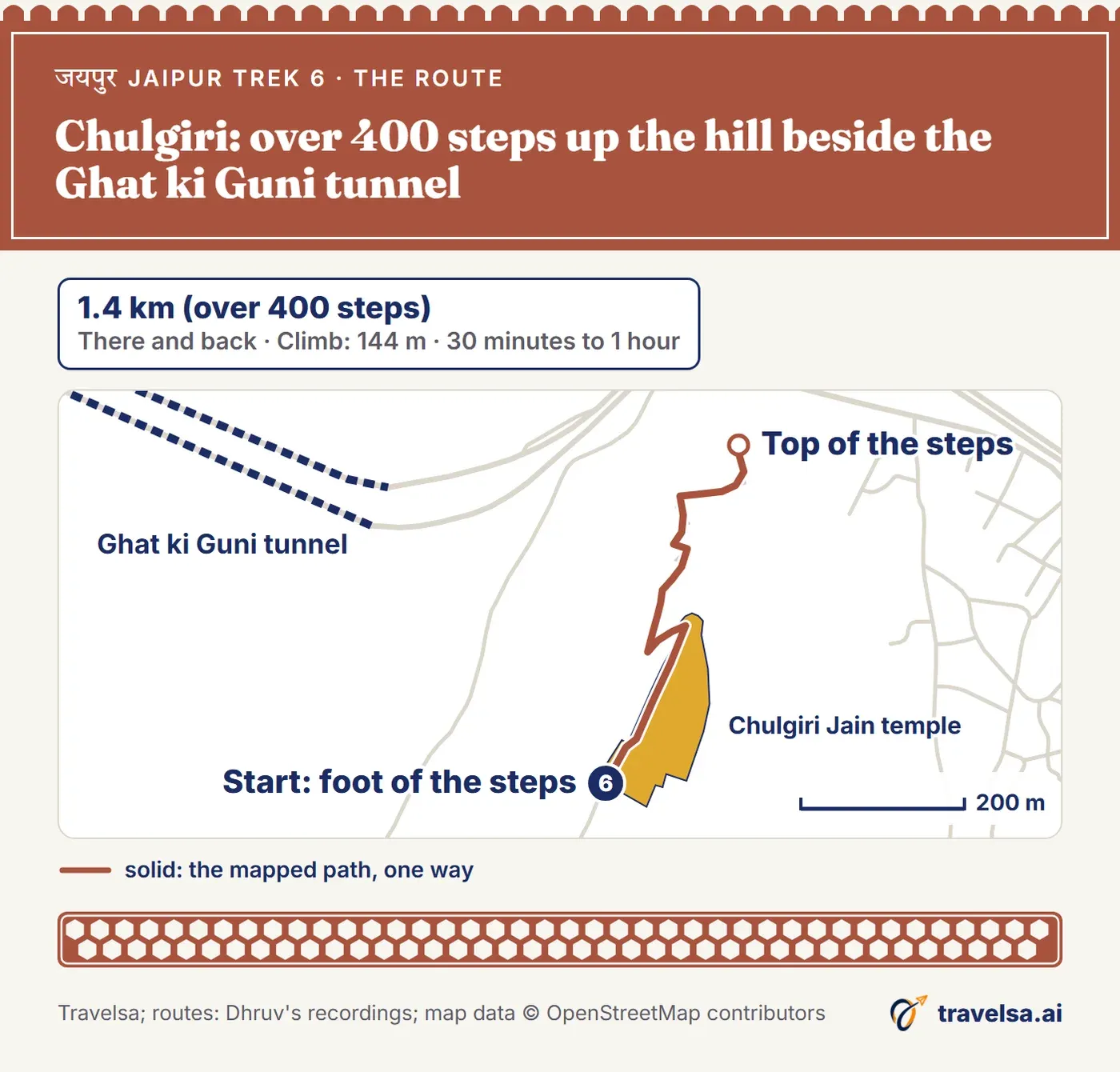
The Chulgiri steps, from the foot of the hill to the top, above the Ghat ki Guni tunnel.
Chulgiri is a Digambar Jain temple to Lord Parshvanatha, on a hill near the Ghat ki Guni tunnel on Agra Road. It's one of the shortest trails here, and one of the steepest, so the Chulgiri trek is harder than its length suggests. Steps climb straight up the hill, and after about 200 of them you look down on the tunnel and the road.
In 1953, the Jain monk Acharya Deshbhushan chose this hill for his penance and named it Chulgiri. The temple has no entry fee and opens from 6 am to 6 pm. Early morning is for Jain worship, so ask at the door before you go in.
A road also climbs to the top, so you can drive up if steps are hard for you.
7. Amer Fort to Jaigarh Fort on foot
6.1 km loop · about 280 m of climbing · 2 to 2.5 hours · moderate · 25 minutes from Hawa Mahal
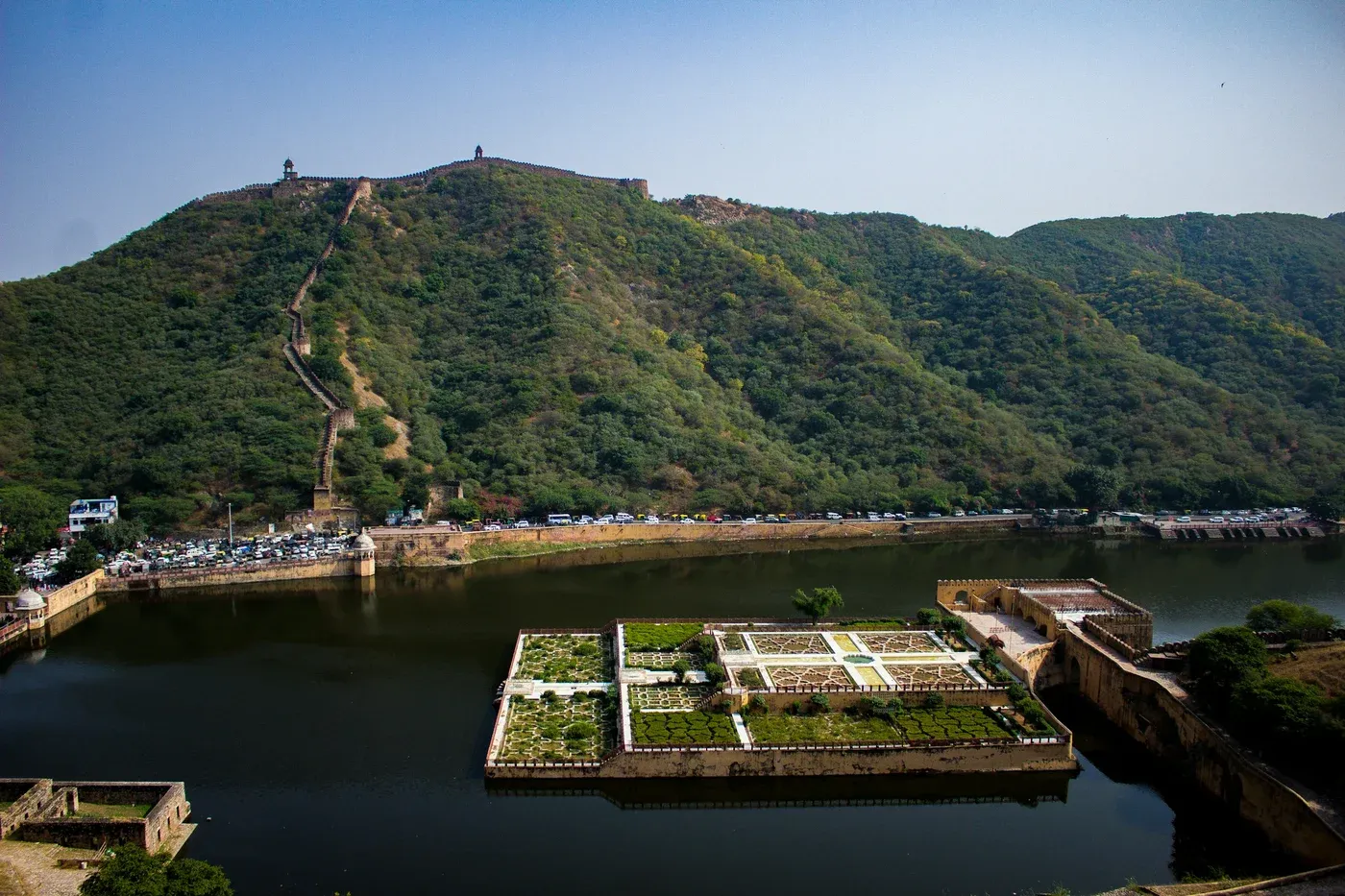
The fort walls climb the ridge from the lake below. Your walk to the top follows them.
Photo: Pranav Gupta / Unsplash
The Amer to Jaigarh walk links Jaipur's two big forts. Start at Maota Lake, below Amer Fort, climb through Amer, and take the cobbled path up to Jaigarh. Jaigarh is about 148 m above the lake, and walkers take 30 to 45 minutes for that part. The loop then brings you back down to Maota Lake.
Jaigarh opens at 9:30 am and closes at 5 pm. So start the walk in the morning, and keep time for the fort. You need a ticket for each fort. Our Jaipur ticket prices and timings guide has both, and our Amer Fort guide has the palace. Start when Amer opens, before the tour groups arrive.
8. Sagar, Kuntalgarh and Bhuteshwar Nath (Amer)
About 6 km loop · 3 to 4 hours · moderate · 30 minutes from Hawa Mahal
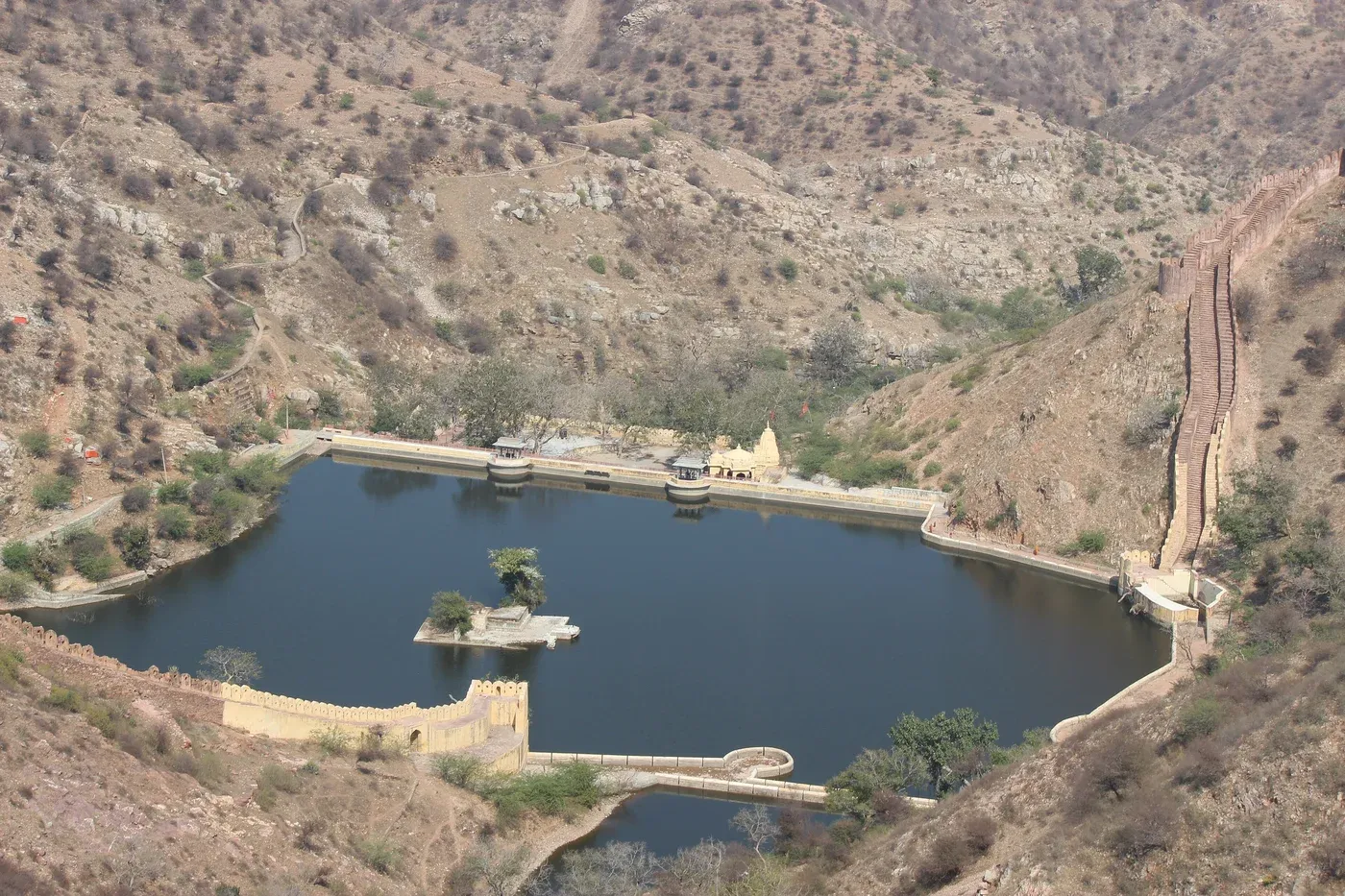
Sagar, the lake behind Amer, with the old wall climbing the ridge: the Kuntalgarh walk follows it.
Photo: Shlok Modi, CC BY-SA 4.0, Wikimedia Commons
Behind Amer, in a fold of the hills, is a lake called Sagar, and three trails start from it. Park at Sagar, or start at Kheri Gate, opposite the Anokhi Museum. Climb the stairs and turn right. About 50 m on, a big rock painted "Jai Shree Ram" marks the way.
Kuntalgarh is the full loop, about 6 km. You climb to the old Kuntalgarh gate and walk along the fort wall to its viewpoints. Then you come down past the Chohde ke Hanumanji temple to Sagar. Allow 3 to 4 hours.
Bhuteshwar Nath Mahadev is a Shiva temple in the hills, about 1 hour up from Sagar. The path is rough and easy to lose in tall grass after the rains. At the three-way junction, take the left path. Maha Shivaratri and the monsoon month of Sawan are its big days.
Amba Mata is a small hill shrine to the goddess. Signs painted "Mata Ji Ka Rasta" (the way to Mata Ji) show the path from Chohde ke Hanumanji.
Toilets are at Panna Meena ka Kund, an old stepwell, and at the Anokhi Museum, both near the start. Phone signal is weak and often drops beyond Sagar, so tell someone your route before you leave.
9. Kedarnath Shiv Mandir (Kho Nagoriyan)
3.2 km loop · about 175 m of climbing · 3 to 4 hours with stops · moderate
Locals call this hill temple to Shiva "Mini Kedarnath", after the Himalayan shrine, and it's the quietest trek on this list. The walk starts off JNU (Jaipur National University) Road in Jagatpura, across the road from the hill. Cars park along JNU Road, near the New Choudhary Dhaba (a roadside eatery). Climb with the temple in sight, because the path is easy to lose lower down. It's green after the rains and often misty on winter mornings.
Not into trekking? Try a short, easy walk
If you'd rather skip the hills, walk the flat dunes at Kishan Bagh. For a short climb on a paved path, walk from Galta Gate to the Sun Temple instead, about 1 hour there and back.
Kishan Bagh timings, entry fee and the dune walk
Kishan Bagh opens at 8 or 8:30 am in winter and at 6:30 am in summer, and it closes on Tuesdays. From about October to March, it closes at 5:30 pm. From April to September, it closes at 6:30 or 7 pm. In summer, walk it early.
Entry is ₹50 for an Indian or foreign adult and ₹25 for a student, on the state's booking site. So two adults and a student pay ₹125 in all.
It's a flat walk, not a trek: a 600 m raised walkway, then 1.2 km over the dunes, about 1 hour in all. The desert park is at the foot of the Nahargarh hills, 30 minutes by car from Hawa Mahal with no traffic. Signs along the walk explain the sand, the rocks and the desert plants. With no steps to climb, it suits elders and small children, and it has drinking water and washrooms.
Secret waterfall in Jaipur, on the Hathni Kund trek
Jaipur's secret waterfall is hidden in a narrow valley at Hathni Kund, about 48 m below Charan Mandir. The path drops between big rocks, and there the fall pours into a rock pool. It runs only after heavy rain. July is the wettest month, with about 231 mm of rain over 17 days. Come in July or August for falling water.
| Month | Rain in the month | Rainy days | What you'll find at Hathni Kund |
|---|---|---|---|
| June | 65 mm | 6 | Rains start late in the month; the fall is mostly dry |
| July | 231 mm | 17 | The wettest month: the fall runs |
| August | 189 mm | 16 | Still wet: the fall runs, and the rock is slippery |
| September | 89 mm | 8 | Drying out: water early in the month, less by the end |
| October | 22 mm | 1 | Mostly dry |
In winter the waterfall stops. You find a still pool under the rocks instead, which is calm and quiet in its own way. Monsoon Sundays are the busiest days, and the parking at Charan Mandir fills early. So go on a weekday, or reach by 7 am. The rock is wet and slippery, so wear shoes with grip and keep children by your side.
If it's raining hard on the morning, skip the rocky valley. Walk the paved path from Galta Gate or the Garh Ganesh steps instead, and save Hathni Kund for a dry morning after the rain.
Jaipur trek checklist, and getting to the start
Pack water before anything else: most trails have no shop. Tick these off the night before.
What to carry
- Water: 1 to 2 litres for each person.
- Shoes with grip, because loose gravel and rock get slippery.
- A cap and loose cotton clothes. Shade is thin on the ridges.
- A light jacket from December to February. January mornings are about 9°C at 7 am.
- Cash for parking and tea.
- Fort tickets, if you plan to go inside Nahargarh, Amer or Jaigarh.
Before you go
- Check the month in the heat table above, and start early.
- Use a toilet before you leave, as there are few on the trails. Kishan Bagh and the Amer start have them.
- Tell someone your route. Phone signal drops in some valleys.
- For Charan Mandir and Sagar, ask your driver to wait, or book your ride back first.
Find steps hard? Drive up to Nahargarh Fort, Jaigarh Fort, Charan Mandir or the Chulgiri temple instead. Or walk the flat dunes at Kishan Bagh.
How to reach each trek start
Take an auto-rickshaw or an app cab to the start, and show the driver the place name. Agree the auto fare before you get in, or ask for the meter. The Nahargarh path is the one start you can reach by metro: it's a 5-minute walk from Chhoti Chaupar station.
| Start point | Trails from here | Drive from Hawa Mahal | Distance | Map |
|---|---|---|---|---|
| Purani Basti (foot of the Nahargarh path) | Nahargarh Fort on foot | 10 min | 1.8 km | - |
| Galta Gate | Sun Temple and Galtaji, Amagarh Fort | 10 min | 2.8 km | - |
| Gaitore ki Chhatriyan (parking at the foot of the steps) | Garh Ganesh Temple | 20 min | 5.0 km | Map |
| Maota Lake (below Amer Fort) | Amer Fort to Jaigarh Fort | 25 min | 8.5 km | Map |
| Chulgiri Jain Temple (foot of the steps) | Chulgiri Jain temple | 25 min | 8.4 km | Map |
| Kishan Bagh | Kishan Bagh dune walk (flat) | 30 min | 8.2 km | - |
| Anokhi Museum of Hand Printing (Kheri Gate is opposite) | Sagar, Kuntalgarh and Bhuteshwar Nath | 30 min | 9.7 km | Map |
| Charan Mandir (on the Nahargarh hill road) | Hathni Kund | 30 min | 12 km | Map |
| JNU Road, Jagatpura (Kedarnath Shiv Mandir trail) | Kedarnath Shiv Mandir | 35 min | 12 km | - |
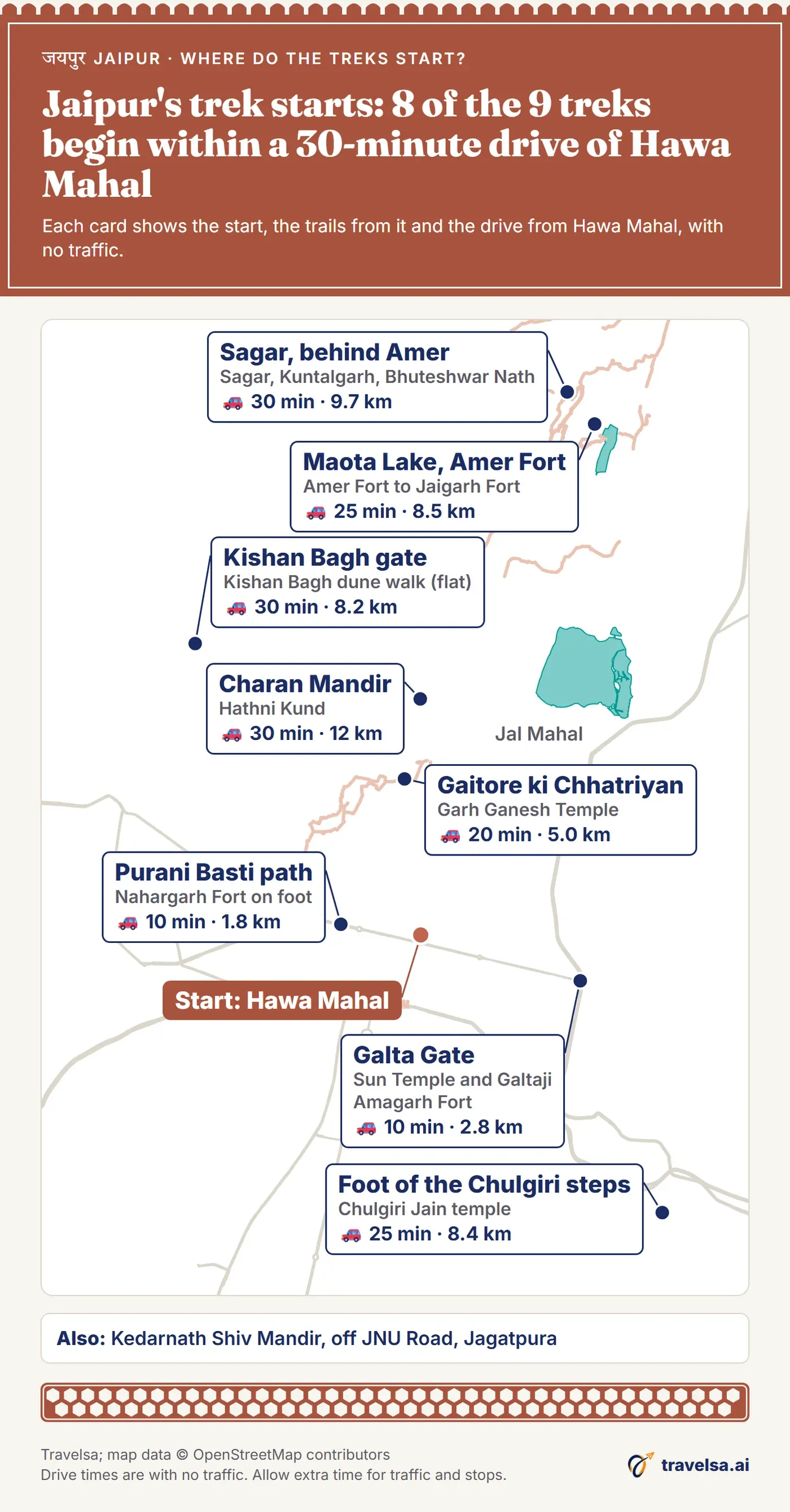
Where each trek starts: 8 of the 9 begin within a 30-minute drive of Hawa Mahal, with no traffic. Tap to enlarge.
Drive times are Google Maps times with no traffic, rounded up. Your trip may take longer, depending on when you leave, traffic, road works, weather and stops.
Turning the trek into a full day? Plan the rest of your Jaipur day on Travelsa.
Treks near Jaipur
For a longer day out of the city, walk up to Neelkanth Mahadev near Sariska, or round the ruins of Bhangarh. Neelkanth Mahadev has inscriptions from 961 CE, and only a steep path climbs to it. It opens from 10 am to 5 pm. At Bhangarh, entry is allowed only in daylight. Our places near Jaipur guide has the drive times and what to see at each.
More Jaipur guides
Common questions
Which is the best trek in Jaipur?
Is there a waterfall in Jaipur?
How many steps are there at Garh Ganesh Temple?
What are the Kishan Bagh timings and entry fee?
Can you trek to Amagarh Fort?
How long is the Hathni Kund trek?
Do you need a permit to trek in Jaipur?
What is the best time for trekking in Jaipur?
Sources
- Ministry of Environment (MoEFCC): Nahargarh Wildlife Sanctuary eco-sensitive zone notification — the sanctuary, notified on 22 September 1980, and its 52.40 sq km
- Rajasthan Forest Department: details of protected areas — the Jhalana-Amagarh Conservation Reserve
- Rajasthan government booking portal (OBMS) — Kishan Bagh and Nahargarh Fort entry fees, and Jhalana safaris
- Incredible India (Ministry of Tourism): Garh Ganesh Temple — the builder, the steps and the hours
- Garh Ganesh Temple: how to reach — the 365 steps from the foot of the hill
- Incredible India (Ministry of Tourism): Galtaji Temple — the builder and the hours
- Rajasthan Tourism: Jaipur — the Sun Temple (Surya Mandir) above Galta
- Incredible India (Ministry of Tourism): Jaigarh Fort — Jaigarh's hours
- Chulgiri Jain temple — the steps, the hours and the founding year
- Incredible India (Ministry of Tourism): Neelkanth Temple — the steep path, the hours and the 961 CE inscriptions
- Weather data by Open-Meteo.com, CC BY 4.0 — morning temperatures and rain around Nahargarh, 2016–2025
- A walker's account of the Hathni Kund trek — quoted word for word
- A walker's account of the Garh Ganesh to Charan Mandir trek — quoted word for word
- A visitor's account of Galtaji, the Monkey Temple — quoted word for word
Dreaming of Jaipur?
Let Travelsa build your perfect Jaipur itinerary in minutes.