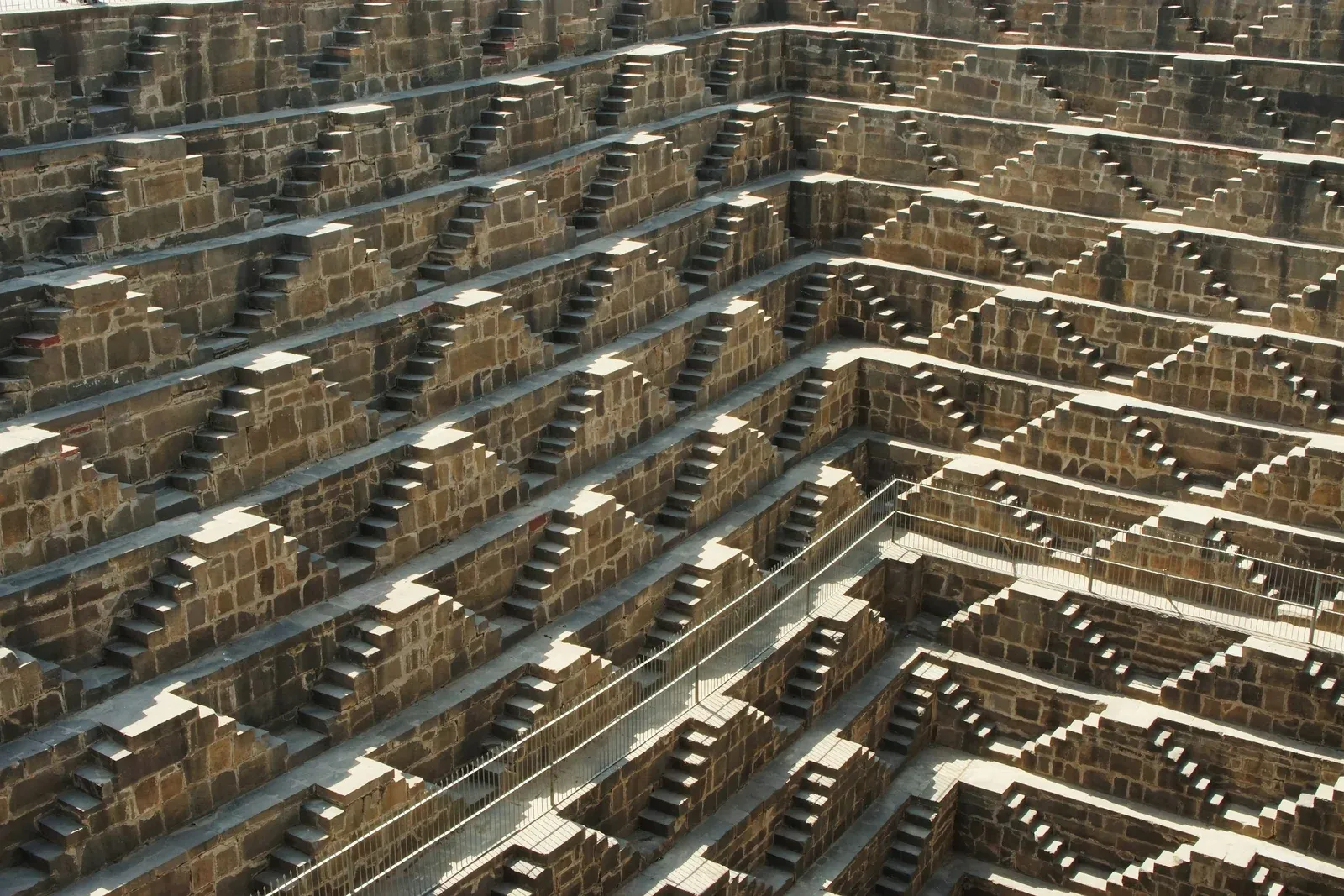
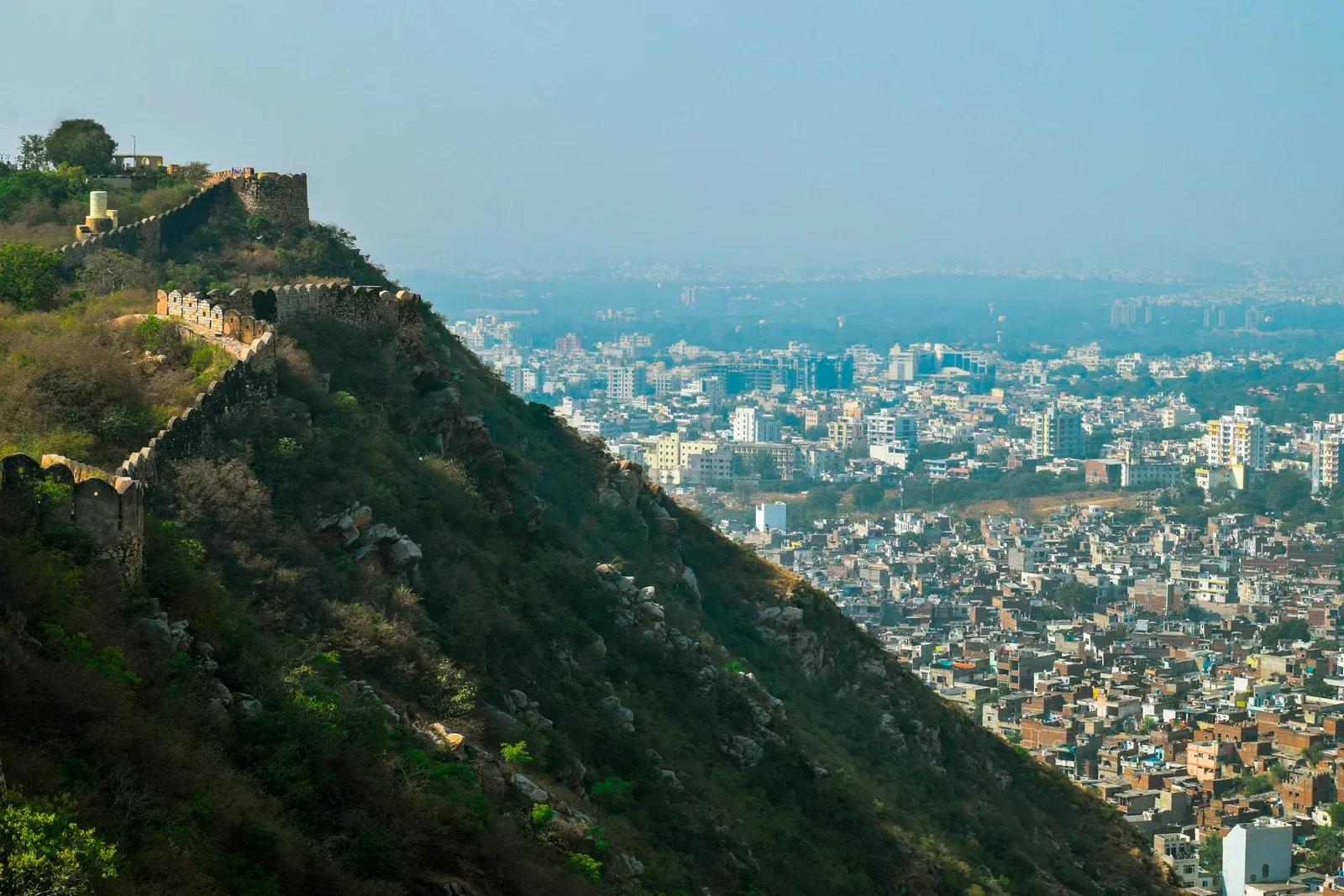
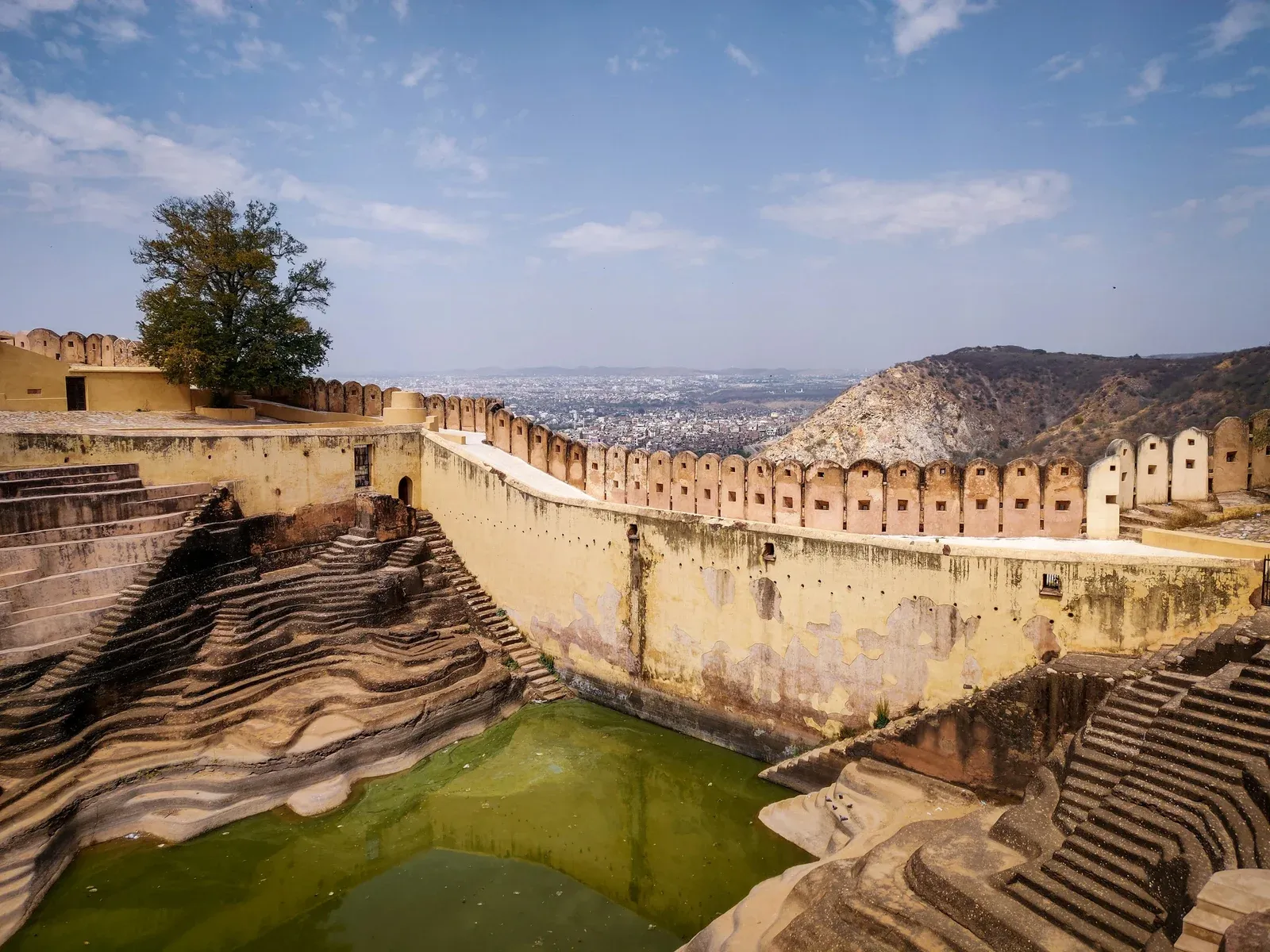
Jaipur Markets (12 Bazaars): What to Buy Where and When to Shop
The 12 main Jaipur markets are the bazaars in and around the old walled city, all within a 26-minute walk of Hawa Mahal. Buy jewellery in Johari Bazaar, juttis in Bapu Bazaar and lac bangles in Maniharon ka Rasta. Shop Monday to Saturday. Sunday is the traditional weekly off, so many shops close, though some big bazaars open daily.
In this guide
Jaipur markets at a glance
Johari Bazaar is my pick for your first hour. You'll reach it in 7 minutes on foot from Hawa Mahal, or 5 minutes from Badi Chaupar metro station. Each bazaar sells its own thing. So pick by what you want to buy, not by which one is famous.
| # | Bazaar | Buy here | Walk from Hawa Mahal | Nearest metro station |
|---|---|---|---|---|
| 1 | Johari Bazaar | Gold and silver jewellery, kundan and meenakari, gemstones | 7 min (0.5 km) | Badi Chaupar, 5 min walk |
| 2 | Sireh Deori Bazaar | Jaipuri quilts, puppets, leather bags, juttis | Right in front | Badi Chaupar, at the station |
| 3 | Tripolia Bazaar | Brass, copper and iron kitchenware; lac bangles | 7 min (0.5 km) | Badi Chaupar, 6 min walk |
| 4 | Maniharon ka Rasta | Lac bangles, made in the lane; gulaal gota before Holi | 16 min (1.2 km) | Chhoti Chaupar, 9 min walk |
| 5 | Bapu Bazaar | Juttis, bandhani and leheriya cloth, block prints, bags | 15 min (1.1 km) | Badi Chaupar, 13 min walk |
| 6 | Nehru Bazaar | Juttis, fabrics, small souvenirs | 20 min (1.5 km) | Chhoti Chaupar, 14 min walk |
| 7 | Chaura Rasta | Second-hand books, stationery, Jaipuri quilts | 12 min (0.9 km) | Badi Chaupar, 10 min walk |
| 8 | Kishanpole Bazaar | Textiles, wooden carvings, ittar (perfume oils) | 19 min (1.4 km) | Chhoti Chaupar, 6 min walk |
| 9 | Chandpole Bazaar | Marble carving and handicrafts | 25 min (1.9 km) | Chhoti Chaupar, 9 min walk |
| 10 | Ramganj Bazaar | Leather shoes; kites in Handipura before 14 January | 7 min (0.5 km) | Badi Chaupar, 6 min walk |
| 11 | Badi Chaupar and Chhoti Chaupar | Street stalls at the two old-city squares | 2 min (0.1 km) | Badi Chaupar, at the station |
| 12 | MI Road (Rajasthali) | Rajasthali, the state's fixed-price craft showroom | 26 min (1.9 km) | Chhoti Chaupar, 14 min walk |
Walking times are to the middle of each bazaar street, on the paths and streets, without stops.
Leave the car outside the walls. Hawa Mahal to Johari Bazaar is 0.6 km on foot but 1.0 km by road. The Pink Line metro stops at Badi Chaupar, Chhoti Chaupar and Chandpole, right by the bazaars. Our Jaipur metro guide has the fares and timings.
From Jaipur Junction railway station, Hawa Mahal is 4.1 km away, about 20 minutes by road with no traffic. From the airport it is 12 km, about 35 minutes. Drive times are Google Maps times with no traffic, rounded up, so your ride may take longer at busy hours.
Planning your old-city day? Fit the bazaars into your Jaipur plan, with the forts and museums around them.
Jaipur, the Pink City, and how its bazaars were planned
Sawai Jai Singh II founded Jaipur in 1727. His architect, Vidyadhar Bhattacharya, laid the city out with straight streets 34 metres wide, following the old Indian rules of building. The main bazaars still line them. In 1876 the city was painted pink to welcome the Prince of Wales. That is why you'll hear it called the Pink City.
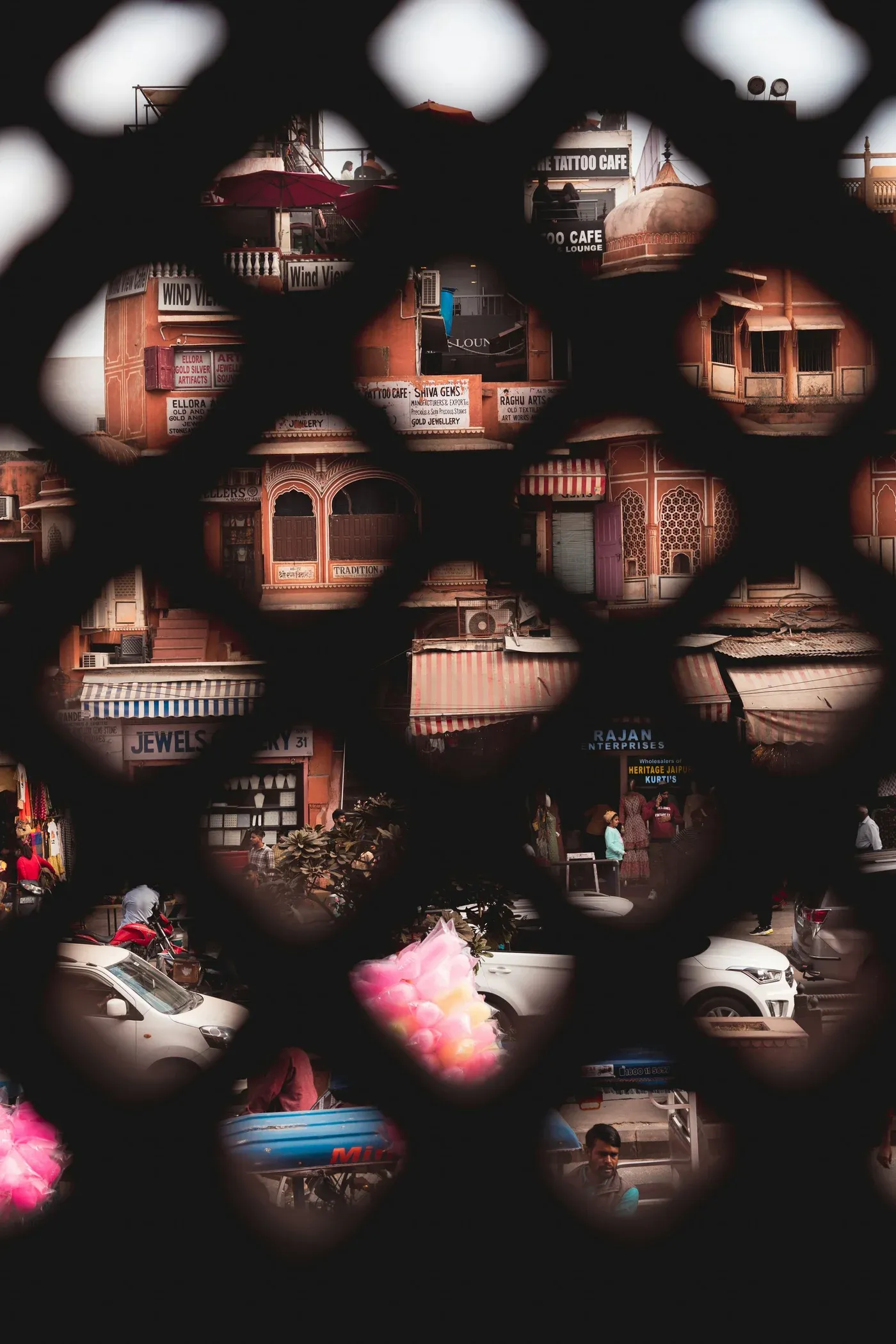
A Jaipur street seen through a stone jali, a carved lattice window.
Photo: Subhashis Das / Unsplash
Sawai Jai Singh II also invited craft workers from across India to his new city. The bangle makers, the Manihars, were among them, and their lane still carries their name. You'll pass temples on almost every street, so the city also has a second name, Chhoti Kashi.
Jaipur souvenirs and famous buys, and where to find them
These are the famous things to buy in Jaipur. You'll get the best choice where each thing is made or sold most. Four crafts here carry a GI tag: blue pottery, kathputli puppets, and Sanganeri and Bagru hand block prints. A GI tag is a government mark that ties a product to its home region.

Bangles are sold in matched sets, with a broad stone-set bangle at each end.
Drawn by Travelsa
| What to buy | Where | Good to know |
|---|---|---|
| Lac bangles | Maniharon ka Rasta (between Tripolia and Nehru Bazaar) | Made in the lane; a simple pair was about ₹50 in 2021 |
| Gold, silver and kundan jewellery, gemstones | Johari Bazaar | Ask for a bill; check the gold hallmark |
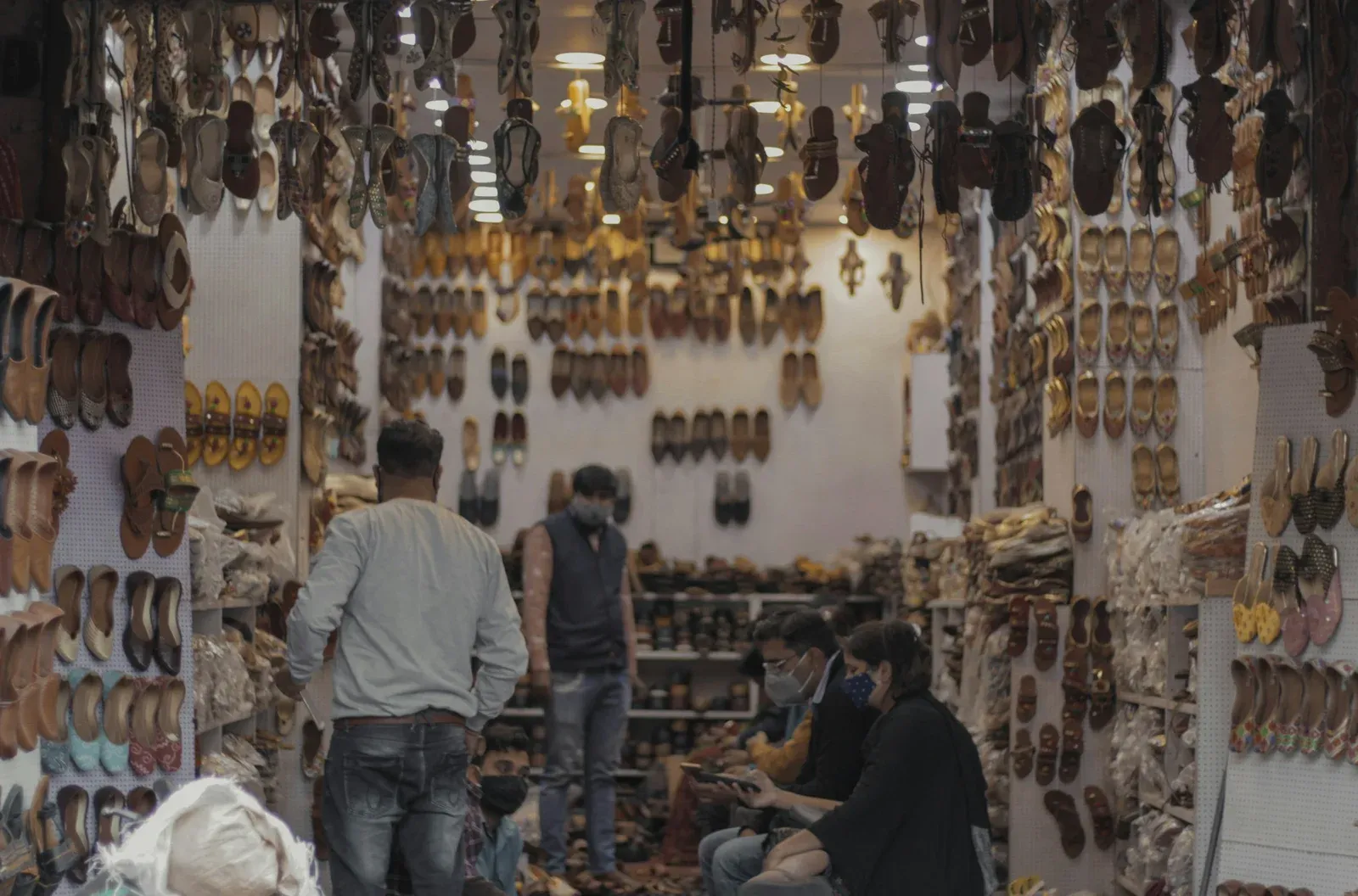
| Juttis, also called mojaris (embroidered leather shoes) | Bapu Bazaar and Nehru Bazaar | Compare 3 shops; first prices start high |
| Bandhani and leheriya cloth | Bapu Bazaar | Tie-and-dye from Rajasthan |
| Block-print cloth | Bapu Bazaar; Sanganer and Bagru for the source | Sanganeri and Bagru prints both carry a GI tag |
| Blue pottery | Rajasthali on MI Road; Jaipur Blue Pottery Art Centre | Carries a GI tag; ask the shop to pack it |
| Jaipuri quilts (razai) | Sireh Deori Bazaar and Chaura Rasta | Light quilts filled with cotton |
| Kathputli puppets | Sireh Deori Bazaar | Carries a GI tag |
| Brass, copper and iron kitchenware | Tripolia Bazaar | - |
| Marble murtis (images of deities) | Khazane Walon ka Rasta, at the far end of Indira Bazaar | Carved in the lane's workshops |
| Kites | Handipura and Haldiyon ka Rasta | From about 10 January |
| Ittar (perfume oils) | Kishanpole Bazaar | - |
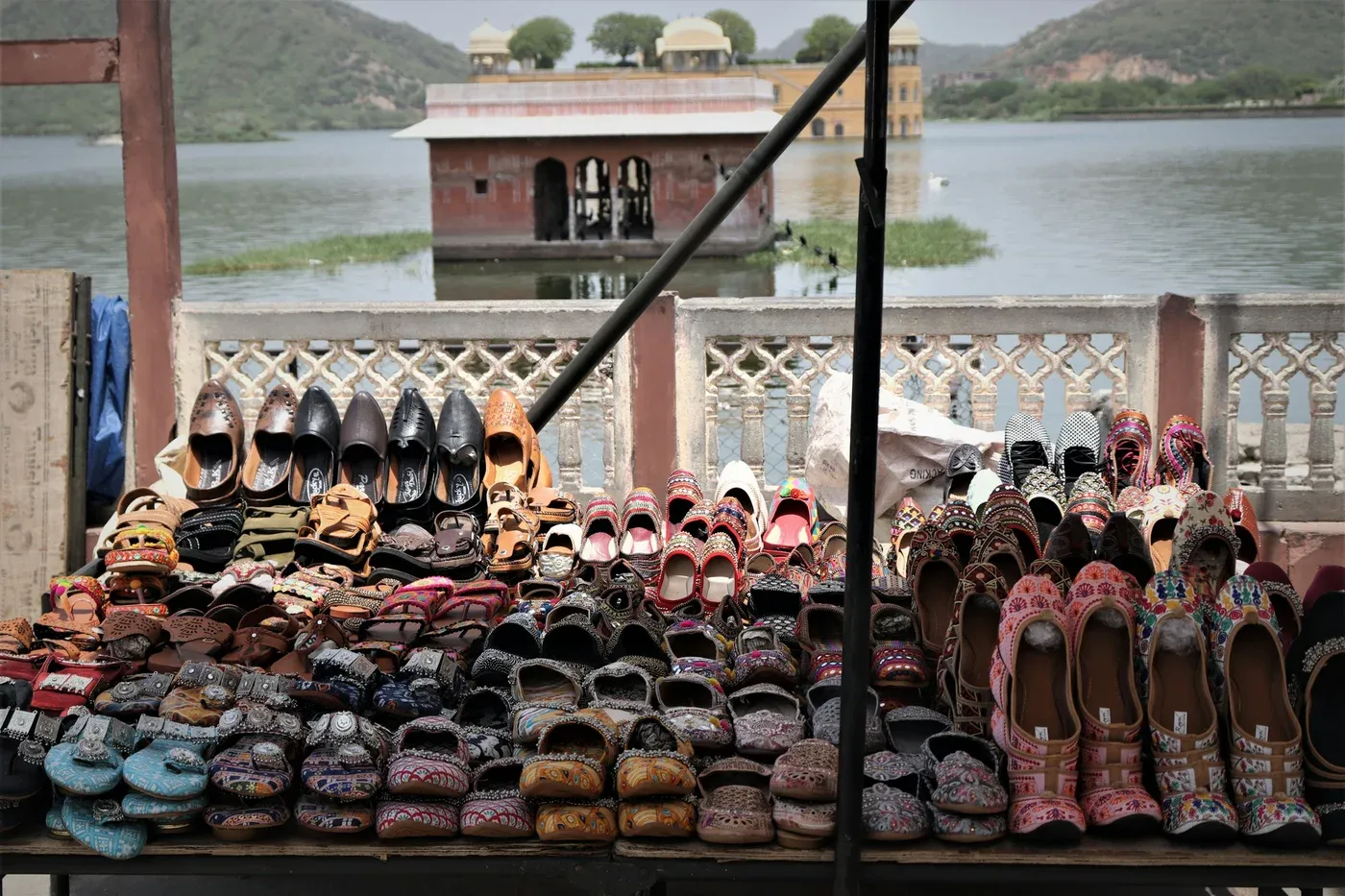
Juttis laid out on a stall in Jaipur.
Photo: Sahil Kumar / Unsplash
You'll hear these words in every shop. Juttis are embroidered leather shoes. Bandhani is tie-dye cloth, and leheriya is cloth dyed in waves. Kundan and meenakari are styles of jewellery, set with stones and with coloured enamel. Ittar is perfume oil, sold by the small bottle.
Jaipur market timings and the Sunday weekly off
Plan to shop from about 11 am to 8 pm, Monday to Saturday. Sunday is the risk. The state tourism department says the markets "are generally closed on Sundays", and a local guide calls Sunday the traditional weekly off. Parts of Johari Bazaar also close on Tuesdays, the same guide notes, so jewellery buyers should skip Tuesday too.
Some big bazaars do open on Sundays. Since 2024, state rules let shops open every day if their staff get a weekly day off, which is why some do. The city corporation's market page lists Johari, Bapu, Nehru and Kishanpole Bazaar as open every day, and only Tripolia Bazaar as shut on Sundays. That page calls its details indicative, so treat its hours as a rough guide.
| Bazaar | Hours on the city's market page | Closed day on that page |
|---|---|---|
| Johari Bazaar | 10 am to 11 pm | Open every day |
| Bapu Bazaar | 10:30 am to 7:30 pm | Open every day |
| Nehru Bazaar | 10 am to 11 pm | Open every day |
| Tripolia Bazaar | 10 am to 11 pm | Sunday |
| Kishanpole Bazaar | 11 am to 9 pm | Open every day |
| Chandpole Bazaar | From 11 am | Not given |
| Sireh Deori Bazaar | 10 am to 11 pm | Not given |
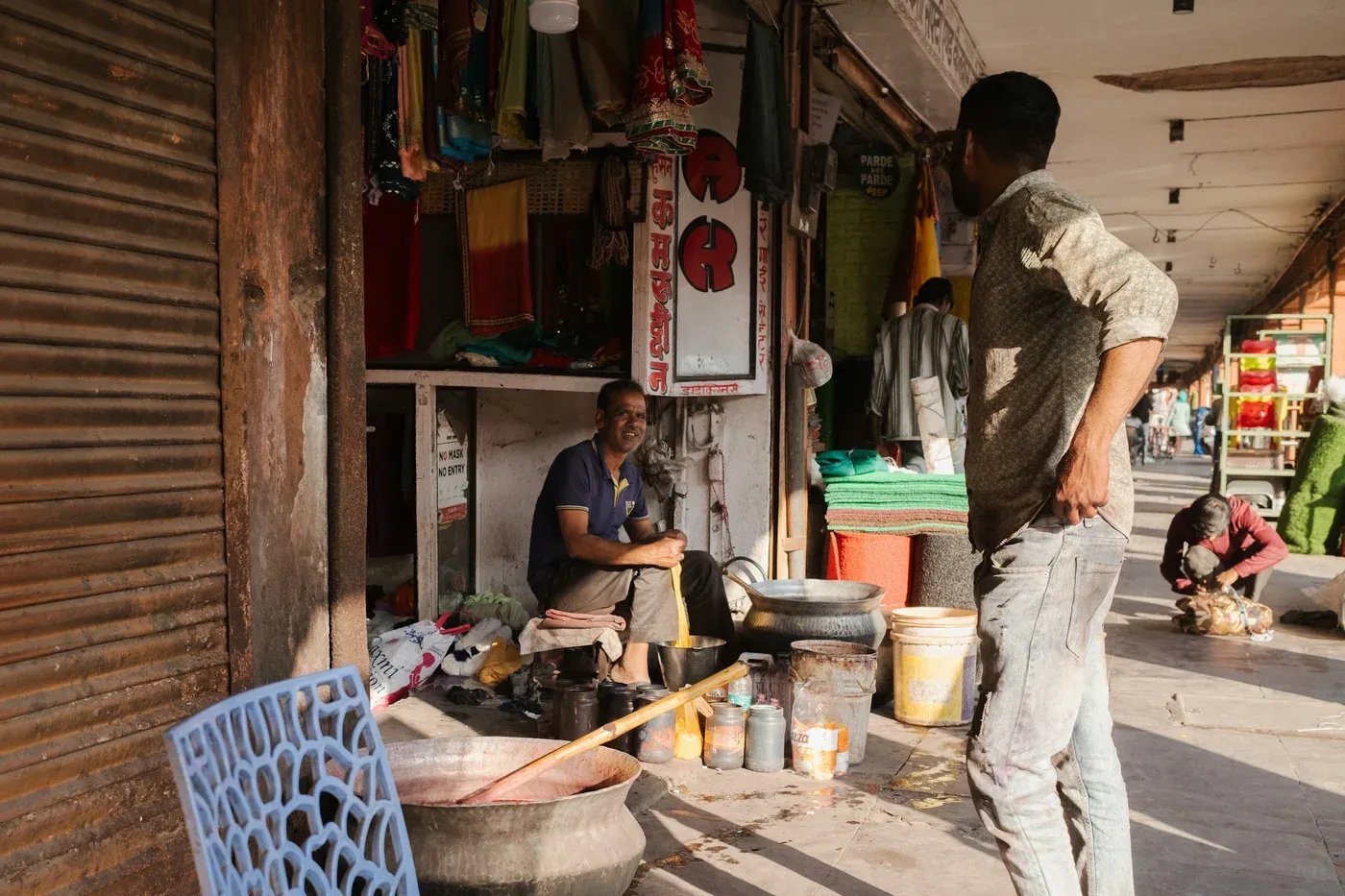
A shop under the arcades in Jaipur.
Photo: Laura Lezman / Unsplash
My advice: keep Sunday for the forts and museums, and shop on any other day. Before big festivals, the rule bends. A Jaipur daily found the main walled-city markets crowded all day on a Sunday before Devuthani Ekadashi.
Entry to every bazaar is free. In total, you pay for what you buy, your lunch and your ride, plus ₹10 if you stop at Masala Chowk.
Shops open late in the morning. For photos, walk the quiet streets at 8 am and come back to buy after 11.
The 12 local markets and shopping places in Jaipur
These are the famous markets in Jaipur. Most of the old city's bazaars line its wide main streets, and the craft lanes run off them. Some names tell you the trade. Maniharon ka Rasta is the lane of the Manihars, the bangle makers. Khazane Walon ka Rasta has been called the Lane of Treasures.
1. Johari Bazaar
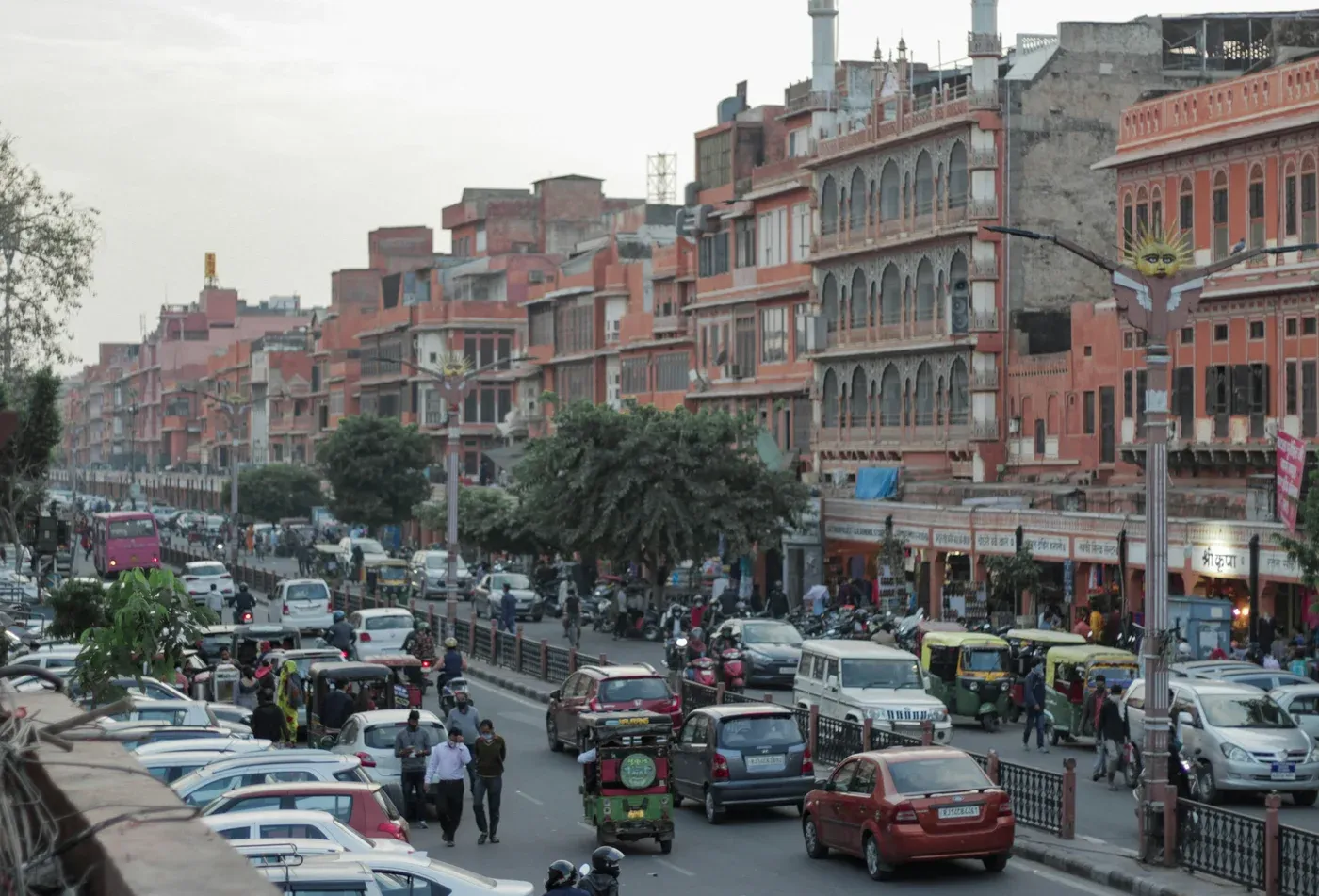
Pink shopfronts under arches along a main bazaar street in the old city.
Photo: Shubhank Vyas / Unsplash
Johari Bazaar is Jaipur's jewellery street and its gemstone market. You come here for gold and silver, kundan and meenakari pieces, and loose gemstones. Its shops are numbered and painted pink.
Laxmi Mishthan Bhandar (LMB) is on the same street, so plan your lunch here. You'll find rows of gold, silver, kundan and diamond jewellery shops in the lanes on either side. Try Gheewalon ka Rasta, Gopalji ka Rasta and Haldiyon ka Rasta. Purohit ji ka Katla, on Johari Bazar Road, is the market for wedding wear and lehengas. Before you buy anything costly here, read the gold and gemstone checks further down this page, because they can save you real money.
2. Sireh Deori Bazaar, in front of Hawa Mahal
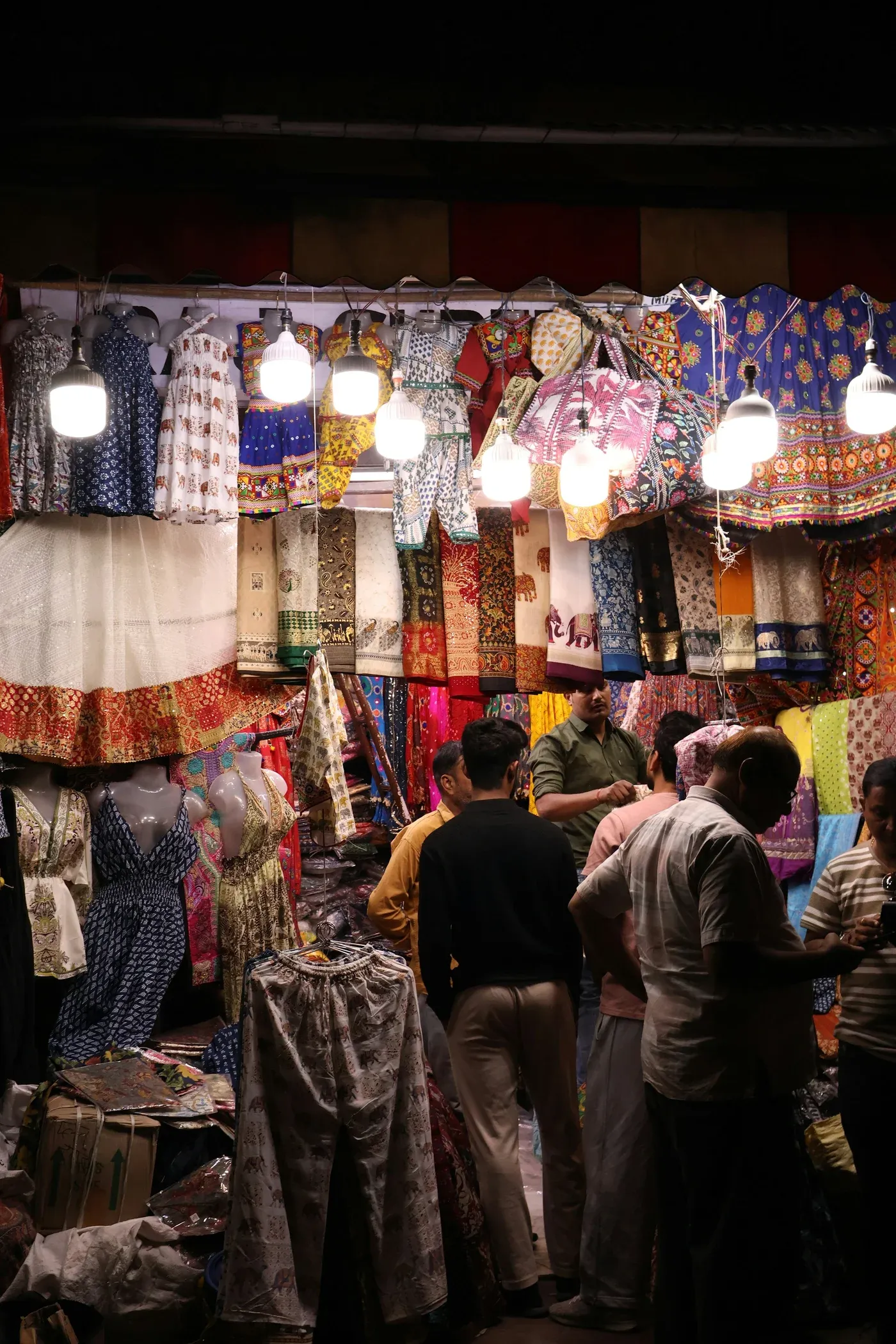
Dresses and textiles at a street stall in front of Hawa Mahal.
Photo: Harshit Katiyar / Unsplash
Sireh Deori Bazaar is the street right in front of Hawa Mahal. You'll find Jaipuri quilts, kathputli puppets, leather bags and juttis on it. Hawa Mahal's latticed windows look down on this street. Chaura Rasta sells quilts too, so look at both before you buy one.
3. Tripolia Bazaar
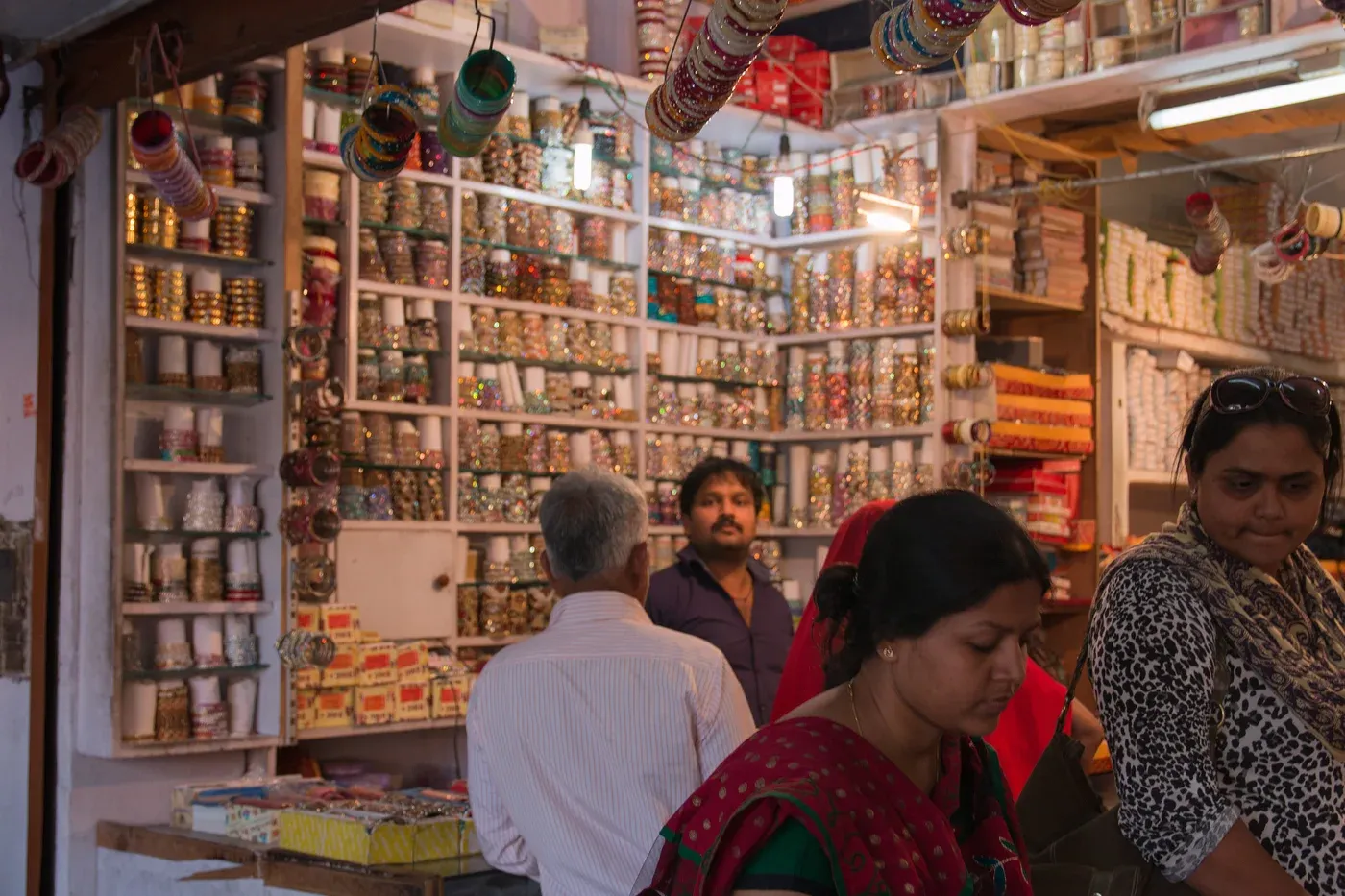
A bangle shop in Tripolia Bazaar.
Photo: Daniel VILLAFRUELA, CC BY-SA 3.0, Wikimedia Commons
Tripolia Bazaar runs between the old city's 2 big squares, Badi Chaupar and Chhoti Chaupar. You'll find brass, copper and iron kitchenware here, and lac bangles. Tripolia is the one bazaar the city's own page lists as closed on Sundays.
At Gangaur, on 9 and 10 April 2027, women worship clay images of Gan, or Lord Shiva, and Gauri, or Goddess Parvati. The procession leaves the City Palace's Zanani Deodhi and passes along Tripolia Bazaar. At Teej, in July or August, a royal procession for Goddess Parvati, here called Teej Mata, passes through Tripolia Bazaar and Chhoti Chaupar. On those days, arrive early to find a place to stand.
4. Maniharon ka Rasta, the lac bangle lane
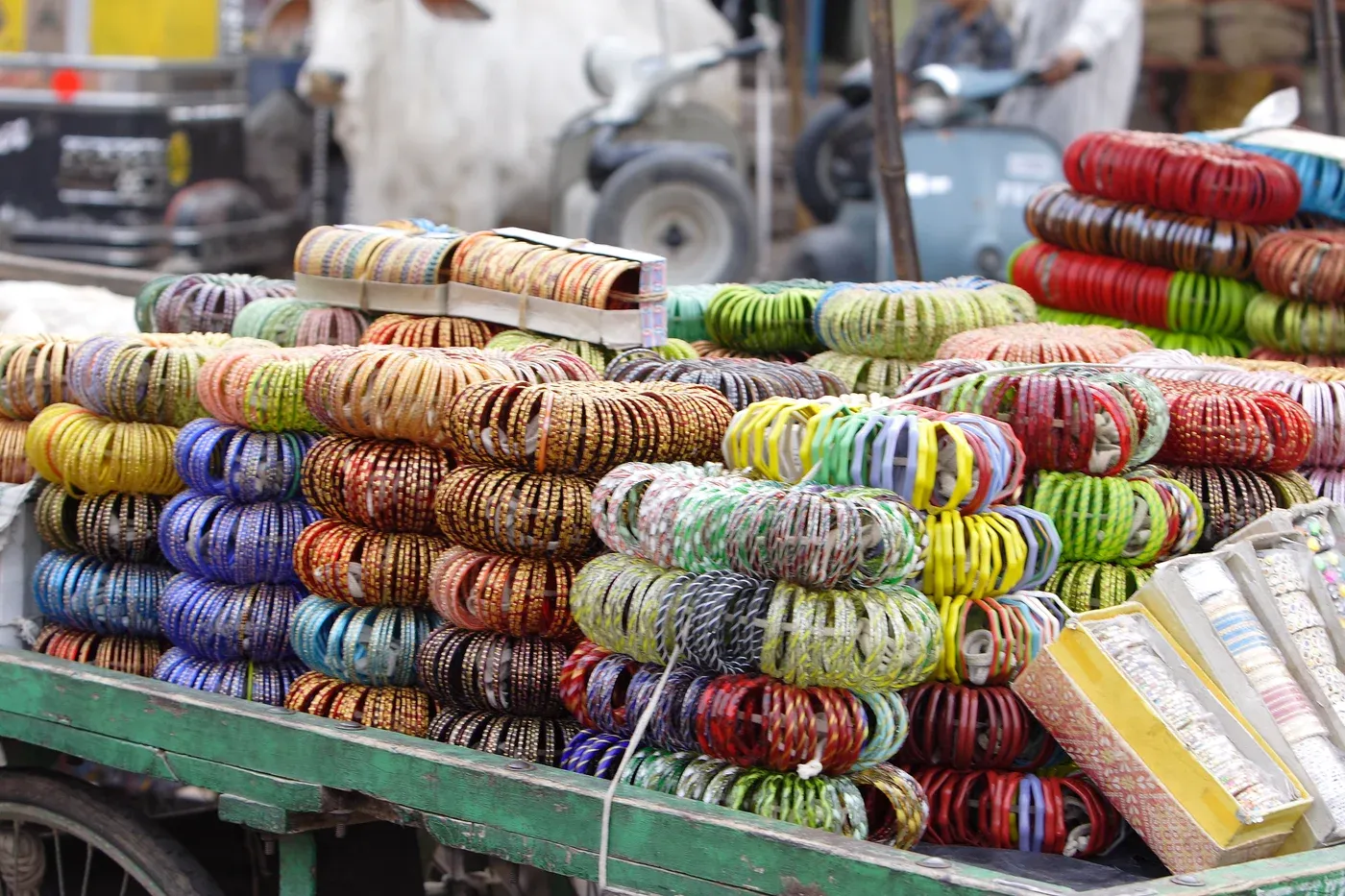
Bangles stacked on a street cart in Jaipur.
Photo: AusAID, CC BY 2.0, Wikimedia Commons
Maniharon ka Rasta is the lane between Tripolia Bazaar and Nehru Bazaar where the Manihar families make lac bangles. The men shape the bangles over small kilns. The women of the family run the shops, and a shop named "Maniharin" is run by a woman. You buy the bangle from the family that made it. Make time for this lane.
A simple pair cost about ₹50 in 2021, and heavily decorated ones ₹3,000 to ₹4,000. Before Holi, the same families make gulaal gota, an old Jaipur Holi custom: thin lac balls filled with dry colour, which people throw at Holi. They cost about ₹25 each in 2024, and the work starts at least 2 months before the festival.
5. Bapu Bazaar
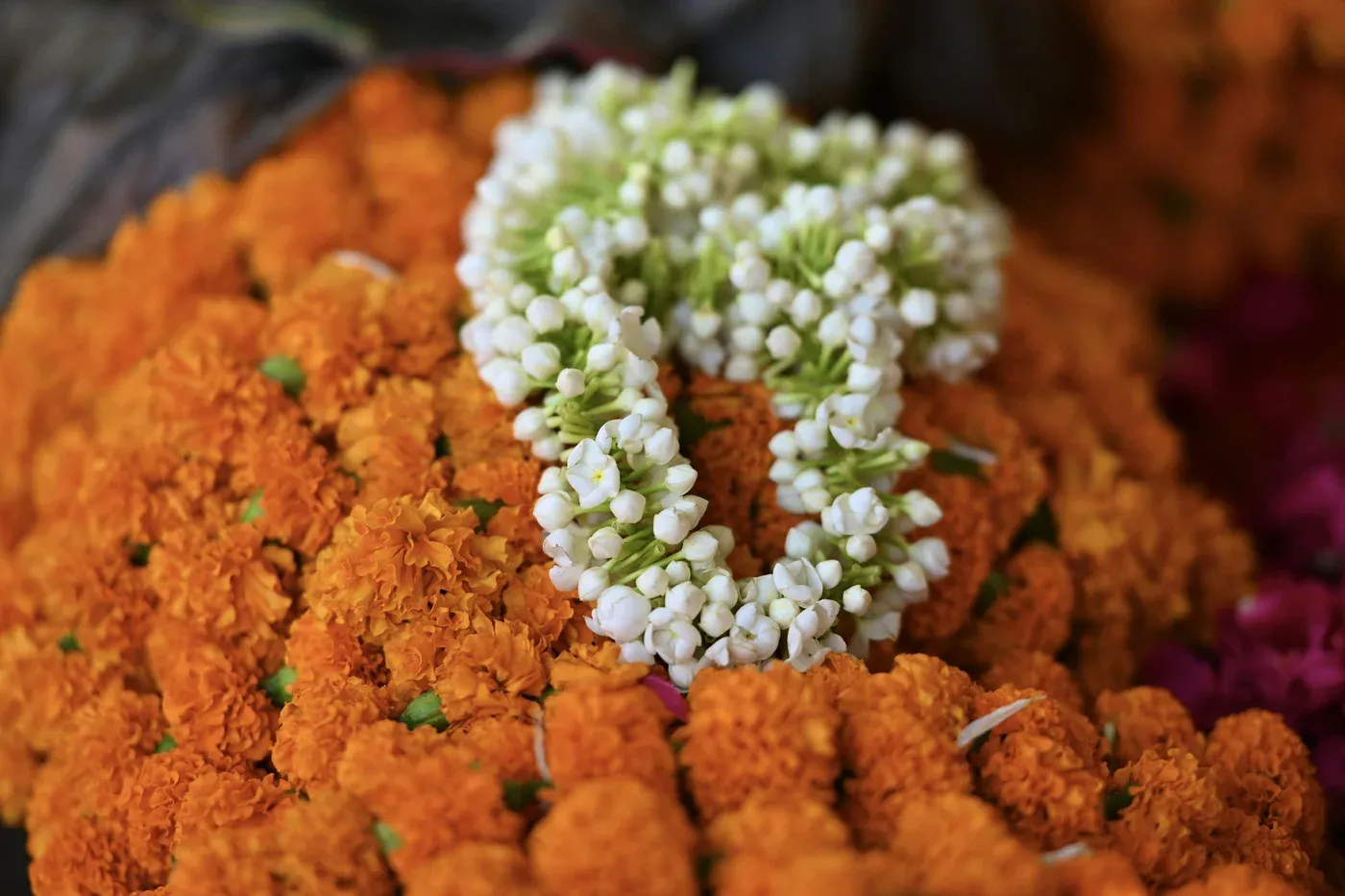
Marigold and jasmine garlands in Bapu Bazaar, Jaipur.
Photo: Jayanth Muppaneni / Unsplash
Bapu Bazaar is the place for juttis, bandhani and leheriya cloth, block prints and bags. You'll find it inside the south wall, a 4-minute walk from New Gate. Coming from Albert Hall Museum? Bapu Bazaar is the closest, 13 minutes on foot.
Prices start high on the juttis. Compare 3 shops before you choose, and buy small gifts in a group to bring the price down.
6. Nehru Bazaar
Nehru Bazaar is next to Bapu Bazaar, a 5-minute walk away. You'll find more juttis, fabric and small gifts. You can shop both on one visit. Then walk on to MI Road for a lassi.
7. Chaura Rasta
Chaura Rasta is the old city's book street. You'll find second-hand school books, stationery and Jaipuri quilts. It runs parallel to Johari Bazaar, a 12-minute walk from Hawa Mahal. Book lovers, go here.
8. Kishanpole Bazaar
At Kishanpole Bazaar you'll find textiles, wooden carvings and ittar. It runs south from Chhoti Chaupar, and Chhoti Chaupar metro station is a 6-minute walk away.
9. Chandpole Bazaar
Chandpole Bazaar is the long street you follow west to Chandpole Gate, known for its marble carvers and handicrafts. More marble workshops line Khazane Walon ka Rasta, at the far end of Indira Bazaar. Carvers there make murtis (images of gods) for temples and home shrines, in India and abroad.
These are images for worship, so ask before you take photos inside a workshop. Ask first, always. Chhoti Chaupar metro station is a 9-minute walk from the middle of the bazaar, and Chandpole station is at its west end.
10. Ramganj Bazaar and Handipura
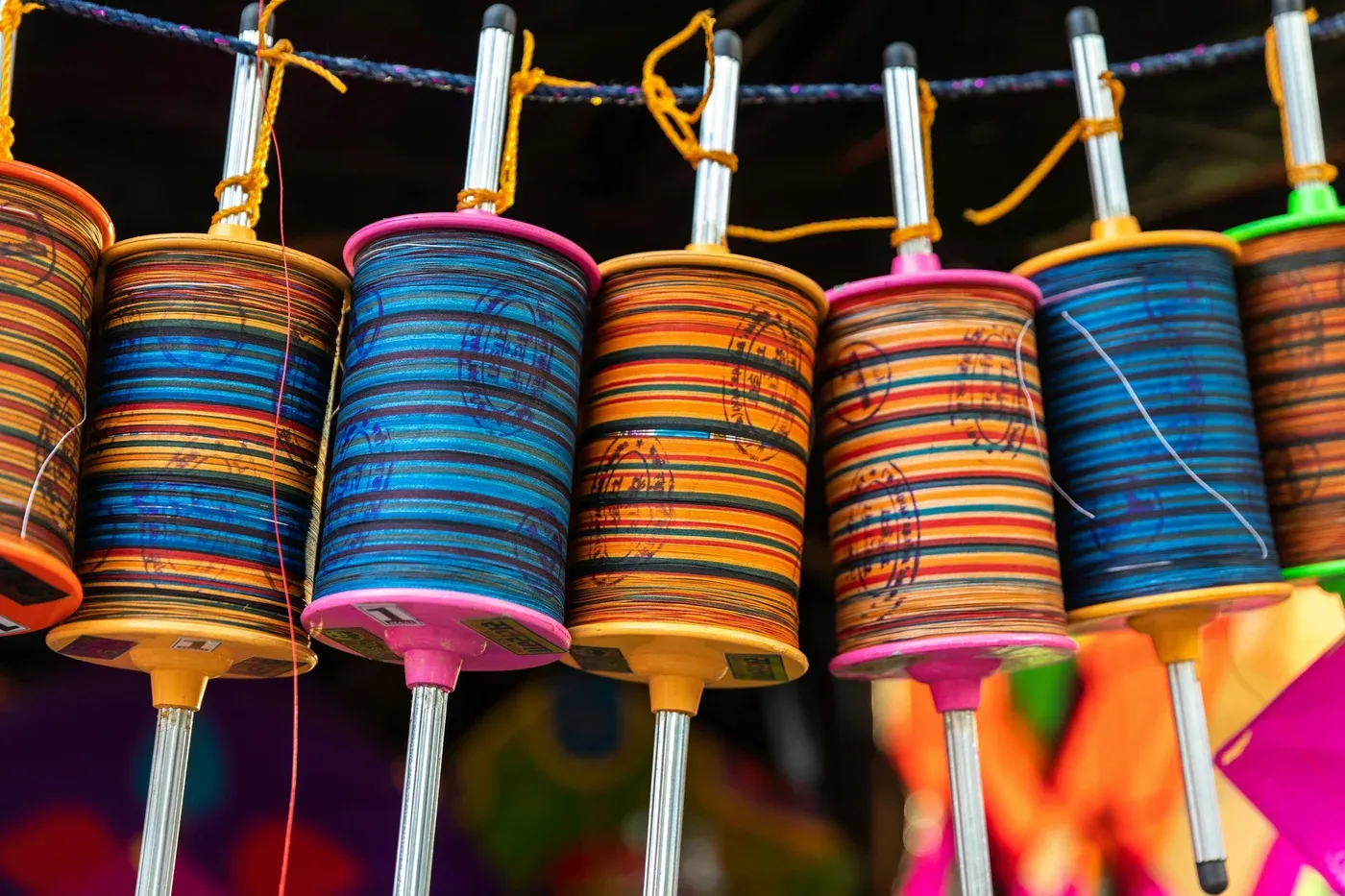
Reels of kite string in Jaipur.
Photo: Nina Luong / Unsplash
Ramganj Bazaar runs east from Badi Chaupar and sells leather shoes. You can watch the makers at work on juttis and mojaris here. Handipura, a lane off it, is the old city's kite market. From January, kites hang outside its shops, and sales pick up from about 10 January.
Buy yours here or in Haldiyon ka Rasta before Makar Sankranti, when Jaipur flies kites from its rooftops. The state tourism calendar lists the kite festival on 14 January 2027, but check the official holiday list for the year you go.
11. Badi Chaupar and Chhoti Chaupar
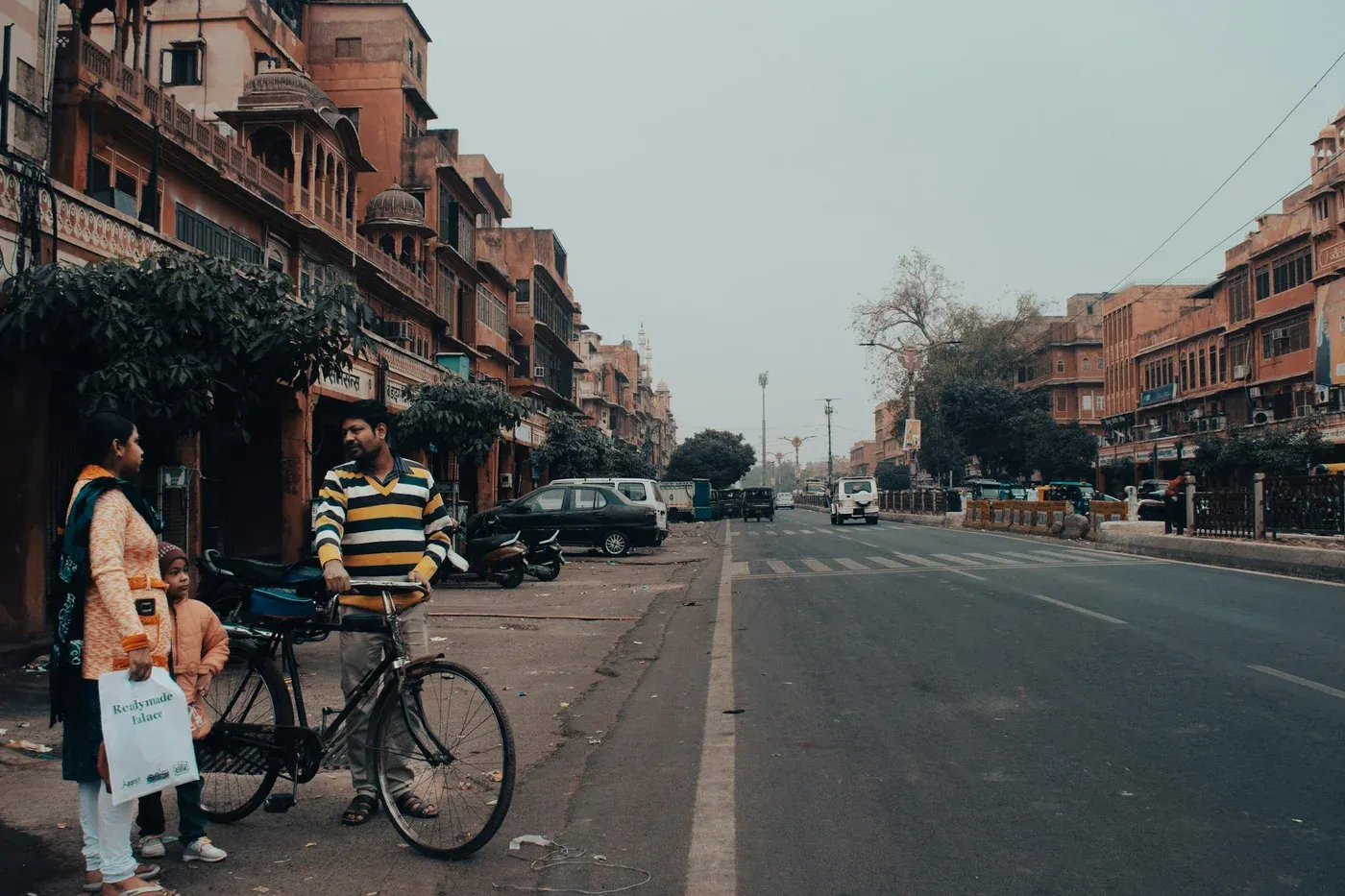
A wide old-city street at Badi Chaupar, Jaipur.
Photo: Prashant bamnawat / Unsplash
Badi Chaupar and Chhoti Chaupar are the 2 big squares of the old city, and you'll find street stalls around them. Each square has a metro station. Start or end your shopping here, because the metro saves you an auto ride back to your hotel.
12. MI Road and Rajasthali
Rajasthali, the state government's craft showroom, is on MI Road outside the south wall, a 6-minute walk from Nehru Bazaar. Prices are fixed, so you skip the bargaining. A local guide notes they cost a little more than a well-bargained bazaar price. If you start from MI Road, I'd stop here first to learn the going rate, then bargain in the bazaars.
7 bazaars in one afternoon: a walking route
This walk links 7 bazaars, from the street in front of Hawa Mahal to Badi Chaupar metro station. You'll walk 3.5 km in about 48 minutes, plus your shopping time. Allow 3 to 4 hours with lunch. No leg is longer than 9 minutes, so you never need a ride.
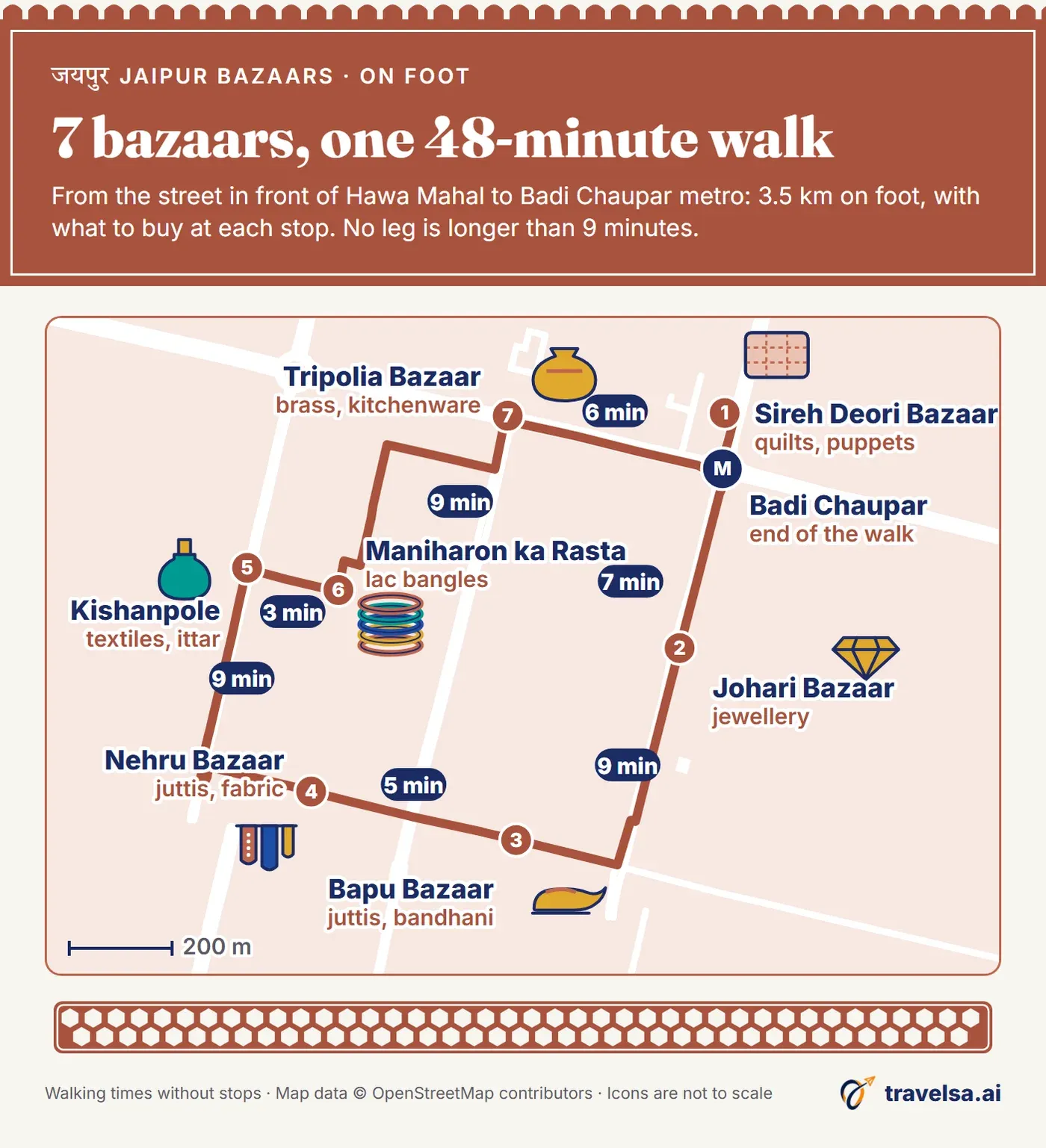
The 7-bazaar walk, with what to buy at each stop. Tap to enlarge.
| Stop | Walk from the last stop | What you buy here |
|---|---|---|
| 1. Sireh Deori Bazaar, in front of Hawa Mahal | Start | Quilts and kathputli puppets |
| 2. Johari Bazaar | 7 min (0.5 km) | Jewellery; lunch at Laxmi Mishthan Bhandar |
| 3. Bapu Bazaar | 9 min (0.7 km) | Juttis, bandhani and block prints |
| 4. Nehru Bazaar | 5 min (0.4 km) | More juttis and fabric, next door |
| 5. Kishanpole Bazaar | 9 min (0.7 km) | Textiles and ittar |
| 6. Maniharon ka Rasta | 3 min (0.2 km) | Lac bangles from the families who make them |
| 7. Tripolia Bazaar | 9 min (0.7 km) | Brass and kitchenware |
| End. Badi Chaupar metro station | 6 min (0.4 km) | End at the metro, or walk back to Hawa Mahal |
Leg times and distances are rounded, so they add up to a little more than the total.
Do this walk on a Monday, Wednesday, Thursday, Friday or Saturday. Sunday is the weekly off for many shops, and parts of Johari Bazaar close on Tuesdays.
From November to February, start at 11 am at Sireh Deori Bazaar, shop Johari Bazaar, and eat at LMB at about 1 pm. Then you shop south and west through the afternoon, and up Kishanpole Bazaar to the bangle lane. From April to June, split the walk over 2 evenings from 6 pm: stops 1 to 4 one evening, and 5 to 7 the next.
On the way, Govind Dev Ji Temple, which honours Lord Krishna, stands in the City Palace grounds. It is a 6-minute walk from City Palace, and City Palace is 7 minutes from Tripolia Bazaar. At places of worship, respect the local customs and dress modestly.
This is my pick for a first shopping day. Turn this walk into your own Jaipur plan.
Jaipur shopping by month and hour
From November to February, you can shop at any hour. From April to June, no shopping hour is cool, so shop from about 6 pm until the shops close at about 8 pm.
At 7 pm in May, 41% of days are still 35°C or hotter, against 85% at 11 am. The trade-off is time. You get about 2 hours, so pick 2 or 3 bazaars. Go to Bapu Bazaar first, since the city's page lists it closing at 7:30 pm. Carry water.
| Month | 11 am | 2 pm | 6 pm | 7 pm | Days at 35°C or more: 11 am | 6 pm | 7 pm | Sunset |
|---|---|---|---|---|---|---|---|---|
| January | 19°C | 21°C | 16°C | 15°C | 0% | 0% | 0% | 5:54 pm |
| February | 24°C | 26°C | 21°C | 20°C | 0% | 0% | 0% | 6:18 pm |
| March | 29°C | 31°C | 27°C | 25°C | 10% | 0% | 0% | 6:35 pm |
| April | 36°C | 37°C | 34°C | 31°C | 59% | 32% | 6% | 6:50 pm |
| May | 38°C | 39°C | 36°C | 34°C | 85% | 72% | 41% | 7:06 pm |
| June | 36°C | 38°C | 35°C | 34°C | 66% | 58% | 42% | 7:21 pm |
| July | 32°C | 32°C | 30°C | 29°C | 8% | 6% | 4% | 7:23 pm |
| August | 30°C | 31°C | 29°C | 28°C | 0% | 0% | 0% | 7:05 pm |
| September | 30°C | 32°C | 28°C | 28°C | 2% | 0% | 0% | 6:32 pm |
| October | 31°C | 32°C | 27°C | 26°C | 3% | 0% | 0% | 5:59 pm |
| November | 26°C | 28°C | 22°C | 21°C | 0% | 0% | 0% | 5:37 pm |
| December | 21°C | 23°C | 18°C | 17°C | 0% | 0% | 0% | 5:36 pm |
Temperatures are 10-year averages for 2016 to 2025 at Badi Chaupar, by the hour. Sunset is for the 15th of each month.
From July to September, carry an umbrella. In August, rain falls at 4 pm on about 21% of days, so plan an indoor stop for the afternoon.
Winter evenings turn cool. By 7 pm in December it is 17°C, so carry a light jacket. The sun sets at 5:36 pm then, so your last shopping hour is after dark.
The bazaars are most crowded before the big festivals. Devuthani Ekadashi, in November, opens the wedding season, and before it people shop for clothes, jewellery, decorations and puja items. Around Diwali, the city makes Bapu, Nehru, Indira and Sanjay Bazaar no-vehicle zones and closes many old-city roads to vehicles after 6 pm. Come by metro or on foot then. Ghewar, a round honeycomb-like sweet, is the sweet of Teej, and LMB makes it.
Pick your month and plan Jaipur around it.
Gold, gemstones and touts in Jaipur's bazaars
Check before you pay. Gold first: look for the hallmark. Hallmarked gold jewellery carries a hallmark ID code (HUID) stamped next to the hallmark. The Bureau of Indian Standards (BIS) runs an app for this.
Open the government's BIS CARE app, choose Verify HUID, and type the code: you see the piece's record. In doubt? Any hallmarking centre recognised by BIS can test a piece for you.
For costly gemstones, buy only from a shop that gives a proper bill and a certificate. Some jewel shops ask up to 3 times the fair price, so compare before you buy. To have a stone tested, use the lab the jewellery export council runs in Jaipur. It tests loose coloured stones, diamonds and studded jewellery, and gives you a certificate. You hand in a piece at its office on the 3rd floor of Rajasthan Chamber Bhawan, MI Road.
Walk away from this pitch. A friendly stranger invites you for tea and later offers you gemstones to sell back home at a profit. The stones sold this way are fakes. Say no to the tea and keep walking.
An auto driver or guide may want to take you to a shop you did not ask for. These shops pay the driver or guide a commission, and you pay for it in the price. I'd name the bazaar you want, and get off there. Touting at tourist places is against the law in Rajasthan.
Bargaining in Jaipur's bazaars
Carry cash in small notes. A local guide says UPI works almost everywhere, even at tiny stalls. But cash makes bargaining easier, and the phone network can drop in the narrow lanes. Bigger jewellery and craft showrooms take cards.
Bargain in the bazaars, and keep it friendly. Offer about half the first price, then work up from there with a smile. Compare 3 shops for the same item. Buy small gifts in a set, because the price for each piece drops when you buy more of them. At Rajasthali the price is fixed, so you skip it.
"Remember if the price feels too high, you are being duped and simply walk away." (A Jaipur travel blogger, 2020)
Jaipur food stops between bazaars
Laxmi Mishthan Bhandar in Johari Bazaar is the easiest lunch stop, because you walk right past it on the bazaar route. Eat there for lunch. MI Road, outside the south wall, has 3 more good places near Nehru Bazaar.
For a chai break, you'll find Chaisa, a vegetarian tea café, on Chaura Rasta, the book street, at the Tripolia Bazaar end. You can get chai, coffee, sandwiches and quick bites there until 10 pm. You can also go on a Sunday, from 8 am to 8 pm, when many bazaar shops are shut.
| Place | Near | Walk from that spot | Go for |
|---|---|---|---|
| Laxmi Mishthan Bhandar (LMB) | Johari Bazaar | On the street | Dal baati churma, pyaz kachori, ghewar |
| Masala Chowk | Bapu Bazaar | 15 min | Open-air court of Jaipur street food stalls |
| Lassiwala (MI Road) | Nehru Bazaar | 15 min | Lassi in a clay cup |
| Niros (MI Road) | Nehru Bazaar | 15 min | Rajasthani and North Indian meals |
| Indian Coffee House (MI Road) | Nehru Bazaar | 9 min | South Indian food and filter coffee |
| Chaisa (Chaura Rasta) | Chaura Rasta | On the street | Vegetarian chai, coffee, sandwiches and quick bites; open on Sundays too |
For a late evening, Masala Chowk food court near Albert Hall is open from 9 am until 10:30 pm, after most shops close. Entry is ₹10 on the state booking site's ticket card.
Shopping outside the old city: Sanganer, Bagru and blue pottery
For block prints at the source, go to Sanganer or Bagru. From Albert Hall Museum, the centre of Sanganer is 16 km south, about 40 minutes by road with no traffic. Amer is 10 km the other way, about 30 minutes, so give each its own half day.
Sanganer's Kagzi families make handmade paper from cotton rags. Raja Man Singh brought them to Sanganer in the 16th century. You buy the paper at the factories, because the town's shops do not stock it. A 2017 feature names Kagzi Handmade Paper, Kalpana Handmade Paper, AL Paper House and Century Papers.
Bagru is a block-printing town, and its prints carry their own GI tag. For the craft's history, visit the Anokhi Museum of Hand Printing at Amer, which shows printed textiles with the tools that make them. Anokhi's own shop in C-Scheme sells block-printed clothes and homeware.
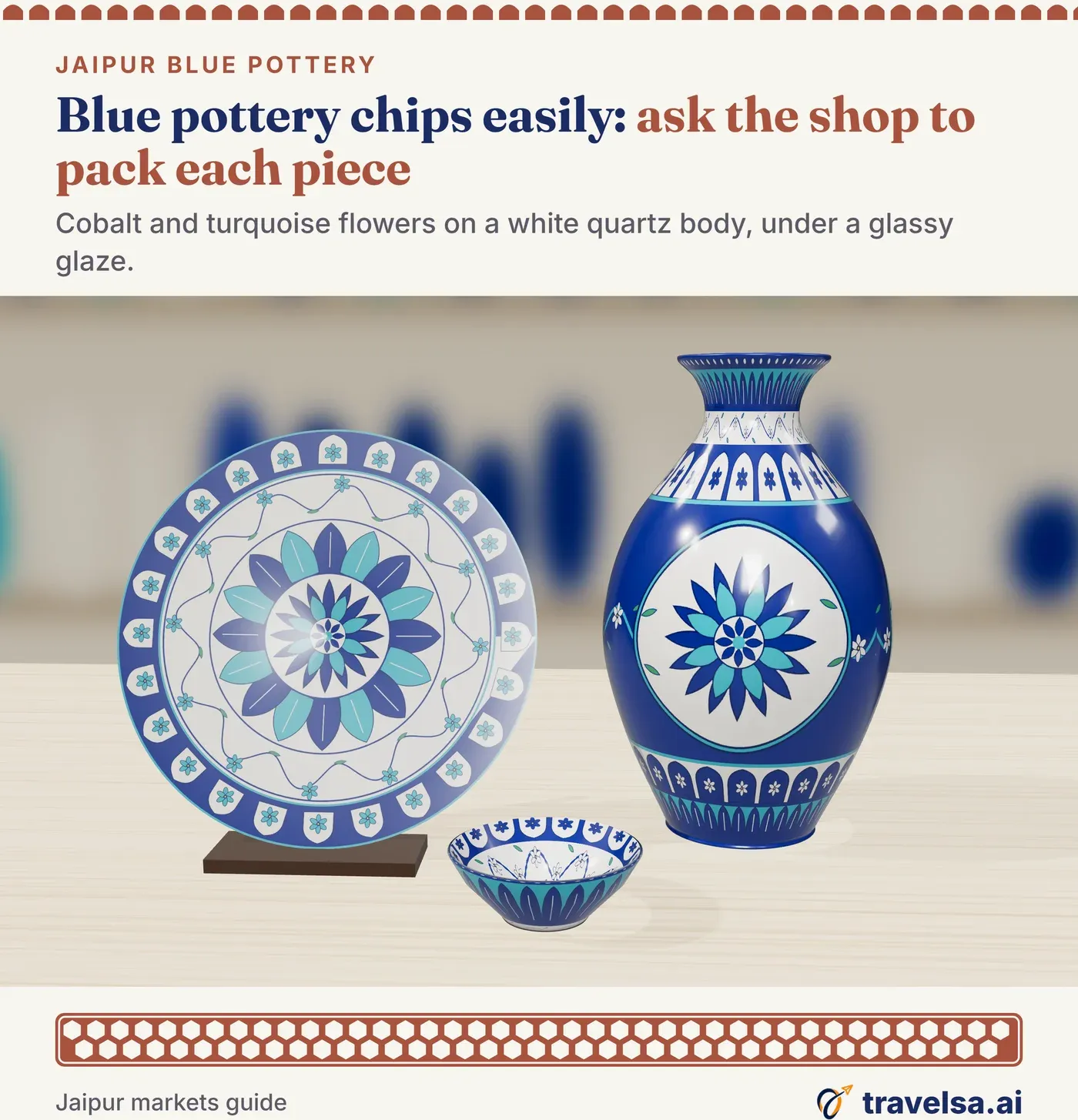
Jaipur blue pottery: patterned borders and a large flower in deep blue and light blue.
Drawn by Travelsa
You'll find blue pottery most easily at Rajasthali on MI Road or at the Jaipur Blue Pottery Art Centre. Pieces chip easily. Ask the shop to pack each piece for travel.
Add Sanganer or Amer to your Jaipur days.
Shopping with children, elders, or if walking is hard
The main bazaar streets are wide, and they are most crowded in the late morning and early evening. If you cannot manage steps or long walks, take an auto or e-rickshaw from bazaar to bazaar. Agree the fare first, and ask the driver to wait while you shop the street. With elders, shop on a winter afternoon: at 2 pm, December averages 23°C. With children, make Maniharon ka Rasta a stop: they can watch the bangles being shaped.
Plan your toilet stops. Public toilets are few in the old city. The surest are near Hawa Mahal, at Jalebi Chowk, and inside monuments and cafés where you're a customer. There's also a paid toilet just outside Sanganeri Gate, at the south end of Johari Bazaar.
Every metro station on the old-city line, Badi Chaupar, Chhoti Chaupar and Chandpole, has free toilets and a water cooler. So if you're shopping with family, plan a café break or a metro stop every couple of hours. Carry water too; bottled water is sold in every bazaar.
More guides for your trip
- Places to visit in Jaipur, with distance: every tourist place in the city, with drive times from Hawa Mahal and the station.
- Albert Hall Museum guide: timings, the mummy, and Masala Chowk next door, a short walk from Bapu Bazaar.
- How to reach Jaipur: trains, flights and buses from every big city.
Common questions
Which is the most famous market in Jaipur?
Which are the best places for shopping in Jaipur?
Which is the best market in Jaipur for clothes?
Is Jaipur market closed on Sunday?
What are Jaipur market timings?
What is Jaipur famous for in shopping?
Where can I buy lac bangles in Jaipur?
Which metro station is nearest to Johari Bazaar?
Sources
- Rajasthan Tourism: Jaipur — the shopping streets, the Sunday weekly off, the Rajasthali government shop
- Jaipur city corporation: main markets — what each bazaar is known for; opening days and hours
- Rajasthan Tourism: fairs and festivals — the kite festival, Gangaur and Teej dates and routes
- Rajasthan Tourism: ticket booking site — Masala Chowk's ₹10 entry and hours
- Bureau of Indian Standards (BIS, India's standards body): checking gold — the HUID hallmark code and the BIS CARE app
- Jaipur Metro: station cleaning contract (2024) — toilets and drinking water at the old-city metro stations
- The Bum Who Travels: shopping in Jaipur (2020) — the traveller's quote on bargaining
- Open-Meteo.com weather data — hourly temperature at Badi Chaupar, 2016 to 2025 (CC BY 4.0)
Dreaming of Jaipur?
Let Travelsa build your perfect Jaipur itinerary in minutes.